Poretsky's Law
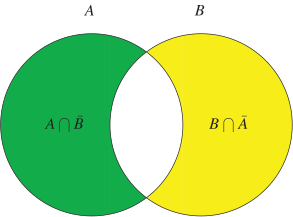
The theorem in set theory and logic that for all sets  and
and  ,
,
 |
(1)
|
where  denotes complement set of
  and
and  is the empty set. The set
  is depicted in the above Venn diagram and clearly coincides with
  iff
iff  is empty.
The corresponding theorem in a Boolean algebra  states that for all elements
  of
of  ,
,
 |
(2)
|
The version of Poretsky's Law for logic can be derived from (2) using the rules of propositional calculus, namely for all propositions  and
and  ,
,
![Q is equivalent to [(P and not Q) or (not P and Q)] iff P is false,](https://mathworld.wolfram.com/images/equations/PoretskysLaw/NumberedEquation3.svg) |
(3)
|
where "is equivalent to" means having the same truth table. In fact, in the following table, the values in the second and in the third column coincide if and only if the value in the first column is 0.
 |
 |
( and not and not  ) or (not ) or (not  and and  ) ) |
| 0 |
0 |
0 |
| 0 |
1 |
1 |
| 1 |
0 |
1 |
| 1 |
1 |
0 |
REFERENCES
Hall, F. M. An Introduction to Abstract Algebra, Vol. 1, 2nd ed. Cambridge, England: Cambridge University Press, p. 50, 1972.
Hall, F. M. An Introduction to Abstract Algebra, Vol. 2, 2nd ed. Cambridge, England: Cambridge University Press, p. 348, 1972.








