
Lateral release
 المؤلف:
Richard Ogden
المؤلف:
Richard Ogden
 المصدر:
An Introduction to English Phonetics
المصدر:
An Introduction to English Phonetics
 الجزء والصفحة:
112-7
الجزء والصفحة:
112-7
 13-7-2022
 1193
1193
Lateral release
Lateral release involves letting air out down the sides of the vocal tract rather than down the mid-line. This occurs in English only in sequences of [t+l] and [d+l], with the sides of the tongue being lowered while the tip or blade of the tongue makes a complete closure against the alveolar ridge, as in ‘immediately’, ‘rapidly’, ‘little’ and ‘handle’. Lateral release is transcribed with a superscript [l]:  .
.
Lateral release is just one possibility for joining the elements of plosive + lateral sequences, because it is also possible to release the plosives centrally, into a vowel articulation.
Lateral release is generally optional in English, and its distribution a little complex. It is common in unstressed syllables at the ends of words where the final vowel is (or would be) [ə], like ‘handle’, ‘little’, ‘bottle’, ‘puddle’ (which end in [-dəl -təl] or  ), but can sometimes also be heard in the middle of words, as in ‘Italy’,
 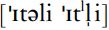 .
.
Some dialects (notably in northern England) also have laterally released [t d] sounds in some initial clusters, in words such as ‘clothes’, ‘clean’, ‘gloves’: i.e. in clusters which in other varieties have velar + lateral articulations, pronounced with  in those dialects.
 الاكثر قراءة في Phonetics
 اخر الاخبار
اخبار العتبة العباسية المقدسة









