0
EN
1
المرجع الالكتروني للمعلوماتية

Grammar

Tenses

Present

Present Simple

Present Continuous

Present Perfect

Present Perfect Continuous

Past

Past Simple

Past Continuous

Past Perfect

Past Perfect Continuous

Future

Future Simple

Future Continuous

Future Perfect

Future Perfect Continuous

Parts Of Speech

Nouns

Countable and uncountable nouns

Verbal nouns

Singular and Plural nouns

Proper nouns

Nouns gender

Nouns definition

Concrete nouns

Abstract nouns

Common nouns

Collective nouns

Definition Of Nouns

Animate and Inanimate nouns

Nouns

Verbs

Stative and dynamic verbs

Finite and nonfinite verbs

To be verbs

Transitive and intransitive verbs

Auxiliary verbs

Modal verbs

Regular and irregular verbs

Action verbs

Verbs

Adverbs

Relative adverbs

Interrogative adverbs

Adverbs of time

Adverbs of place

Adverbs of reason

Adverbs of quantity

Adverbs of manner

Adverbs of frequency

Adverbs of affirmation

Adverbs

Adjectives

Quantitative adjective

Proper adjective

Possessive adjective

Numeral adjective

Interrogative adjective

Distributive adjective

Descriptive adjective

Demonstrative adjective

Pronouns

Subject pronoun

Relative pronoun

Reflexive pronoun

Reciprocal pronoun

Possessive pronoun

Personal pronoun

Interrogative pronoun

Indefinite pronoun

Emphatic pronoun

Distributive pronoun

Demonstrative pronoun

Pronouns

Pre Position

Preposition by function

Time preposition

Reason preposition

Possession preposition

Place preposition

Phrases preposition

Origin preposition

Measure preposition

Direction preposition

Contrast preposition

Agent preposition

Preposition by construction

Simple preposition

Phrase preposition

Double preposition

Compound preposition

prepositions

Conjunctions

Subordinating conjunction

Correlative conjunction

Coordinating conjunction

Conjunctive adverbs

conjunctions

Interjections

Express calling interjection

Phrases

Sentences

Clauses

Part of Speech

Grammar Rules

Passive and Active

Preference

Requests and offers

wishes

Be used to

Some and any

Could have done

Describing people

Giving advices

Possession

Comparative and superlative

Giving Reason

Making Suggestions

Apologizing

Forming questions

Since and for

Directions

Obligation

Adverbials

invitation

Articles

Imaginary condition

Zero conditional

First conditional

Second conditional

Third conditional

Reported speech

Demonstratives

Determiners

Direct and Indirect speech

Linguistics

Phonetics

Phonology

Linguistics fields

Syntax

Morphology

Semantics

pragmatics

History

Writing

Grammar

Phonetics and Phonology

Semiotics

Reading Comprehension

Elementary

Intermediate

Advanced

Teaching Methods

Teaching Strategies

Assessment

قم بتسجيل الدخول اولاً لكي يتسنى لك الاعجاب والتعليق.

Peer Assessment among Students in a Problem-Based Learning Format Procedure Results

المؤلف:  Steve Frankland

المصدر:  Enhancing Teaching and Learning through Assessment

الجزء والصفحة:  P150-C14

2025-06-28

817

+

-

20

Peer Assessment among Students in a Problem-Based Learning Format Procedure Results

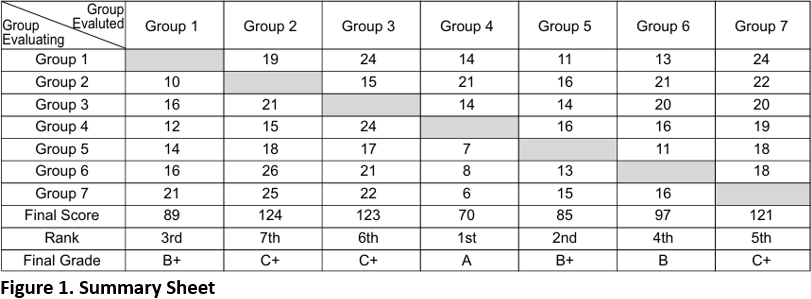
Using the results of the numerical scores, with seven groups in the class, each group would evaluate the six other groups, so the best-case scenario would be if a particular group was ranked 1st on each occasion for each of the five criteria, i.e. 1st x 5 factors x 6 groups = a total score of 30. Conversely, worst case scenario would be if a particular group was ranked 6th (last) on each occasion for each of the five criteria, i.e. 6th x 5 factors x 6 groups = a total score of 180. Accordingly, a score of each group will range between 30 (1st for every factor by each group) and 180 (last on each factor by each group).


Finally, the numerical scores were converted to the University's grading system. i.e. A+ (Outstanding), A (Excellent) B+ (Very Good), B (Good), C+ (Wholly Satisfactory), C (Satisfactory), D+ (Barely Adequate) D (Weak) and F (Fail). This was done by the teacher who used subjective judgement by looking for natural breaks between the relative scores of groups. This is shown on the Evaluation sheet in Figure 3 in Peer Assessment among Students in a Problem-Based Learning Format Procedure.


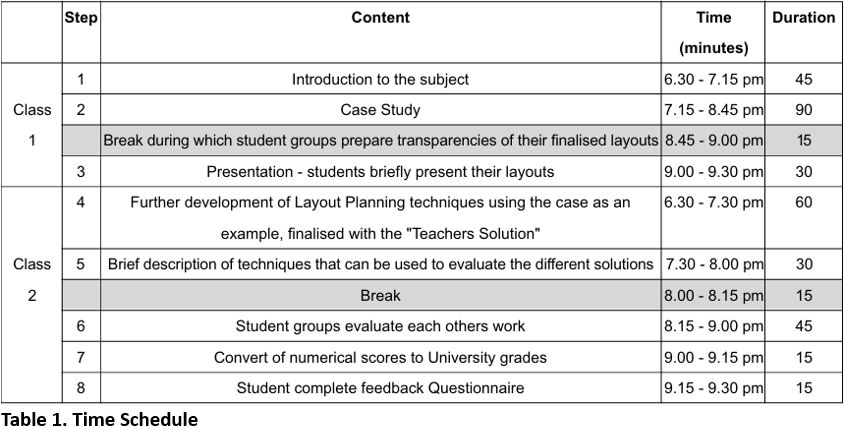
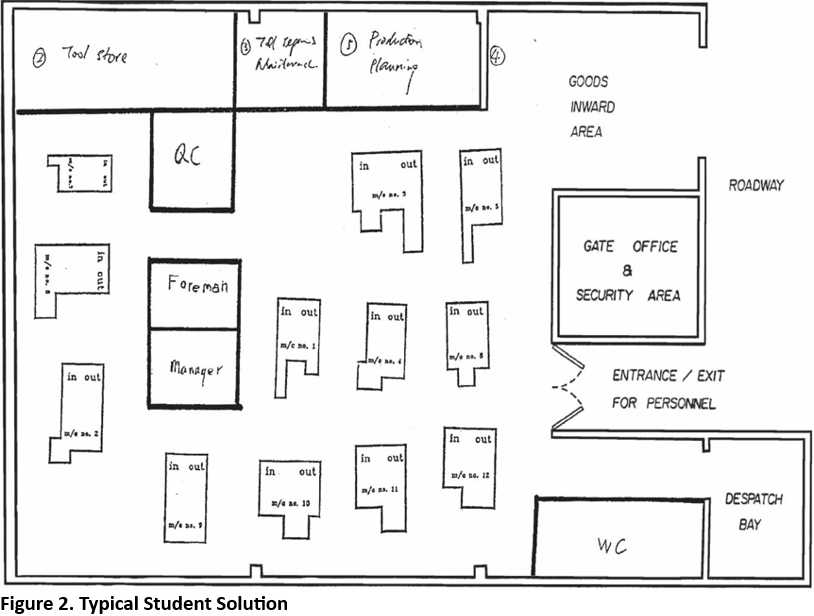
Within these two classes, students were introduced to various practical payout planning and evaluation techniques used in engineering, as well as other forms of management. A learning environment was created that allowed students to act as a group of engineers working together to solve a realistic problem. Without strong intervention from the teacher, this case provokes students to discuss and share ideas, identify priorities, and examine the materials in the limited time available.
اخر الاخبار

اشترك بقناتنا على التلجرام ليصلك كل ما هو جديد