Modality
The term MODALITY covers a fairly wide range of semantic contrasts. In order to get a feeling for some of the parameters involved, let us consider the behavior of some English modal auxiliary verbs. What type of ambiguity is illustrated in the following examples?
(43) a The older students may leave school early (unless the teachers watch them carefully).
b Theolder students may leave school early (if they inform the headmaster first).
(44) a Your agent must be a close personal friend of the ambassador
(otherwise he would never have gotten into the embassy).
b Your agent must be a close personal friend of the ambassador
(in order to carry out this mission successfully).
These two pairs of sentences show that may and must can be used in two different senses. In the (a) sentences, the modal carries a meaning which relates to the speaker’s state of knowledge or belief about the proposition being expressed. May in this sense (43a) indicates that the speaker believes the proposition is possibly true; and must (44a) indicates that the speaker is fairly certain that the proposition is true, though this certainty is based on inference or supposition rather than direct knowledge. In the (b) sentences, the modal carries a meaning which relates to some kind of obligation or permission on the part of the agent. May in this sense (43b) indicates that the agent is permitted to do something, while must (44b) indicates that the agent is required or obligated to do something.
Semantic contrasts relating to the speaker’s state of knowledge or belief (possibility, probability, certainty, etc.) are said to involve EPISTEMIC MODALITY. Semantic contrasts relating to obligation or permission on the part of the agent are said to involve DEONTIC MODALITY. But these categories can be seen as sub-sets of a more general distinction between SPEAKER-ORIENTED and AGENT-ORIENTED modalities. Speaker-oriented categories which have special grammatical marking in various languages include: possibility or potential, certainty, supposition, doubt (dubitative), and evidentiality (reflecting the speaker’s basis for belief, e.g. hearsay vs. direct observation). Agent-oriented categories include ability, permission, obligation, desire (desiderative), intention, etc.
As we have noted, there are often connections between modality and tense or aspect. For example, only the deontic interpretation (obligation) is possible for must with future time reference, so (45a) can only be interpreted to refer to obligation. Only the epistemic interpretation (certain inference) is possible in the perfect, as in (45b). The ambiguity demonstrated above is only possible with present tense states or habitual actions; so the simple present tense as in (45c, d) allows both interpretations, but the present continuous form (45e) is unambiguous. (Which reading is the correct one for 45e?)
(45) a You must leave tomorrow.
b You must have offended the Prime Minister very seriously.
c You must read the market reports every day.
d You must be very patient.
e You must be reading the market reports every day.
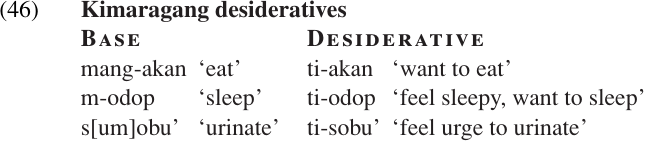
We cannot attempt a detailed survey of this topic here, but it will be helpful to give some examples of other modal categories found in various languages. One fairly common type of agent-oriented modality is the DESIDERATIVE, which expresses a desire rather than an actual event. The following examples are from Kimaragang Dusun, a language of East Malaysia.
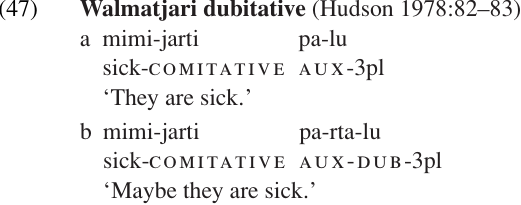
Turning to speaker-oriented modality, some languages have a special DUBITATIVE marker, which indicates that the speaker has some doubt about the truth of the proposition expressed.
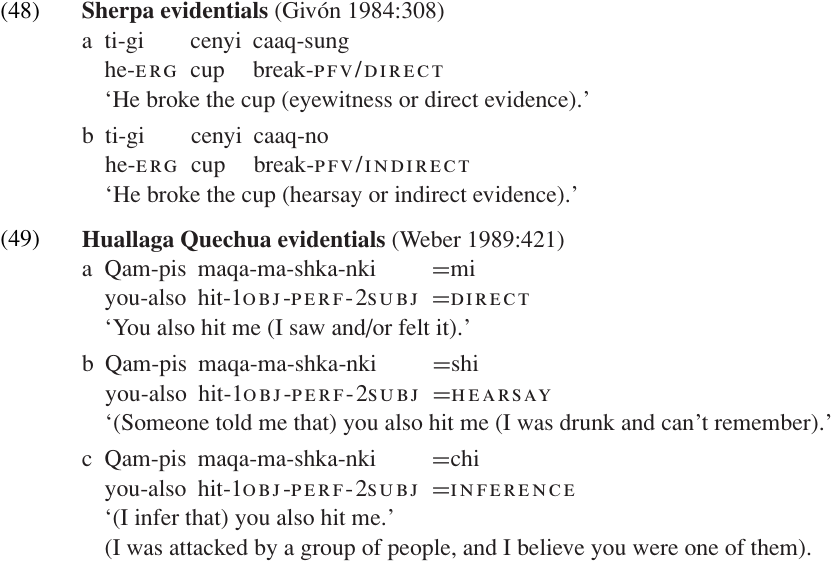
Many languages have some means of indicating the speaker’s basis for asserting the proposition, i.e. how the knowledge was acquired. Common distinctions in this area include direct knowledge (eye-witness report) vs. hearsay vs. inference; some examples are presented in (48–49).
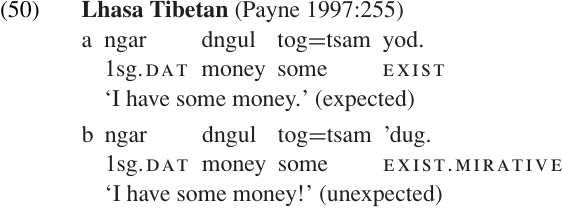
Some languages have a special marker to indicate that the speaker is surprised at what he is reporting. This form is often called the MIRATIVE:
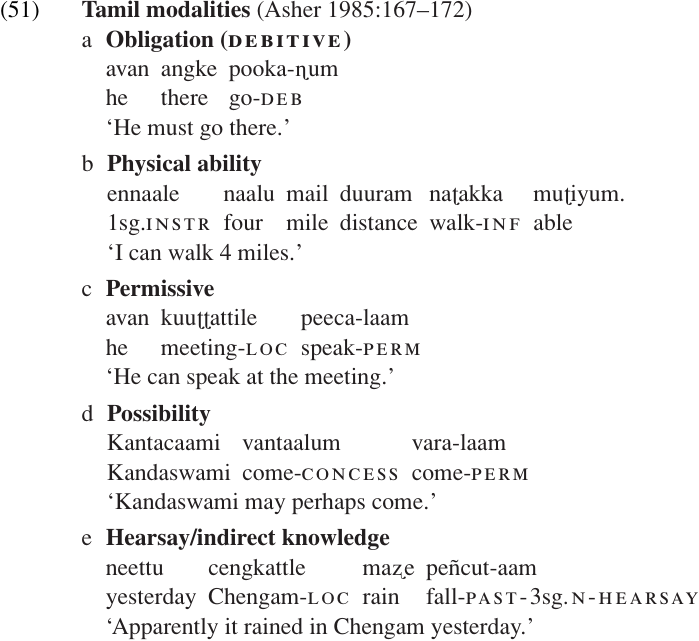
Tamil (a Dravidian language of southern India) has a fairly complex system of moods and modalities, involving both inflectional suffixes and modal verbs. Some of the modalities are illustrated in (51). Note that the suffix-laam, which marks a kind of hortative mood, is also used for the modalities of permission and possibility. It is glossed as “PERM” (for ‘permissive’) in these examples.