Grammar
Tenses
Present

Present Simple
Present Continuous
Present Perfect
Present Perfect Continuous
Past
Past Simple
Past Continuous
Past Perfect
Past Perfect Continuous
Future
Future Simple
Future Continuous
Future Perfect
Future Perfect Continuous
Parts Of Speech
Nouns
Countable and uncountable nouns
Verbal nouns
Singular and Plural nouns
Proper nouns
Nouns gender
Nouns definition
Concrete nouns
Abstract nouns
Common nouns
Collective nouns
Definition Of Nouns
Animate and Inanimate nouns
Nouns
Verbs
Stative and dynamic verbs
Finite and nonfinite verbs
To be verbs
Transitive and intransitive verbs
Auxiliary verbs
Modal verbs
Regular and irregular verbs
Action verbs
Verbs
Adverbs
Relative adverbs
Interrogative adverbs
Adverbs of time
Adverbs of place
Adverbs of reason
Adverbs of quantity
Adverbs of manner
Adverbs of frequency
Adverbs of affirmation
Adverbs
Adjectives
Quantitative adjective
Proper adjective
Possessive adjective
Numeral adjective
Interrogative adjective
Distributive adjective
Descriptive adjective
Demonstrative adjective
Pronouns
Subject pronoun
Relative pronoun
Reflexive pronoun
Reciprocal pronoun
Possessive pronoun
Personal pronoun
Interrogative pronoun
Indefinite pronoun
Emphatic pronoun
Distributive pronoun
Demonstrative pronoun
Pronouns
Pre Position
Preposition by function
Time preposition
Reason preposition
Possession preposition
Place preposition
Phrases preposition
Origin preposition
Measure preposition
Direction preposition
Contrast preposition
Agent preposition
Preposition by construction
Simple preposition
Phrase preposition
Double preposition
Compound preposition
prepositions
Conjunctions
Subordinating conjunction
Correlative conjunction
Coordinating conjunction
Conjunctive adverbs
conjunctions
Interjections
Express calling interjection
Phrases
Sentences
Clauses
Part of Speech
Grammar Rules
Passive and Active
Preference
Requests and offers
wishes
Be used to
Some and any
Could have done
Describing people
Giving advices
Possession
Comparative and superlative
Giving Reason
Making Suggestions
Apologizing
Forming questions
Since and for
Directions
Obligation
Adverbials
invitation
Articles
Imaginary condition
Zero conditional
First conditional
Second conditional
Third conditional
Reported speech
Demonstratives
Determiners
Direct and Indirect speech
Linguistics
Phonetics
Phonology
Linguistics fields
Syntax
Morphology
Semantics
pragmatics
History
Writing
Grammar
Phonetics and Phonology
Semiotics
Reading Comprehension
Elementary
Intermediate
Advanced
Teaching Methods
Teaching Strategies
Assessment

Suppletion
 المؤلف:
PAUL R. KROEGER
المؤلف:
PAUL R. KROEGER
 المصدر:
Analyzing Grammar An Introduction
المصدر:
Analyzing Grammar An Introduction
 الجزء والصفحة:
P290-C15
الجزء والصفحة:
P290-C15
 2026-02-05
 561
561




+
-
20
Suppletion
Consider the paradigm of inflection for degree in English adjectives, which is illustrated in (5). The irregular comparative and superlative forms for good and bad seem totally unrelated to the basic (positive) form. Better and best do not contain any trace of the root form good, unlike such irregular plural forms as ox/oxen, child/children, criterion/criteria, etc. in which the original root can still be seen in the plural form.
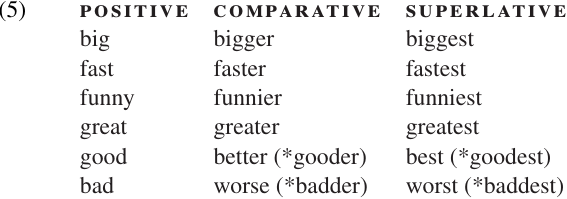
An alternation like good/better/best, in which the inflectional paradigm for a certain word involves more than one root form, has traditionally been referred to as SUPPLETION. Other examples in English include the irregular verb forms go–went and am–is–are–was–were. These suppletive forms of the root cannot be derived or predicted by any regular phonological rule, but must be listed in the lexical entry of the word.
Total suppletion (the existence of two unrelated roots or stems for the same word, as in go–went) occurs primarily as a marker of inflectional categories, and rarely (if ever) in derivational processes. Since derivational morphology is often semantically irregular and does not form paradigms, it would actually be very difficult to identify suppletive stems as belonging to the same morpheme. For example, on semantic grounds we might be tempted to say that kill is the causative form of die, or that drop is the causative form of fall. But there is no evidence that these pairs of forms are related morphologically; the best analysis seems to be that they are distinct (i.e. unrelated) lexical items which share certain components of meaning.
Modern linguists extend the term SUPPLETION to apply to affixes as well as roots.1 For example, the two allomorphs of the Huichol possessive marker in (4) stand in a suppletive relationship because neither form can be derived from the other by a phonological process (one is a prefix, the other a suffix). Since there is no way to predict which allomorph occurs with which noun, the choice must be indicated in some way in the lexical entry of each noun. This is an example of LEXICALLY CONDITIONED SUPPLETION.
The two forms of the Korean nominative case marker in (2) also stand in a suppletive relationship. However, in this case it is possible to predict which form will occur with which noun:-ka occurs after a vowel, while-i occurs after a consonant. This is an example of PHONOLOGICALLY CONDITIONED SUPPLETION, meaning that the choice of allomorph depends only on the phonological environment.
A third possibility is that affix suppletion may be MORPHOLOGICALLY CONDITIONED. This means that the choice of allomorph for a particular affix depends on what other specific affixes are present in the word. For example, Muysken (1981) reports that in Quechua verbs, the normal third person agreement suffix–n is replaced by a zero allomorph–Ø when the verb also bears the past tense suffix–rqa.
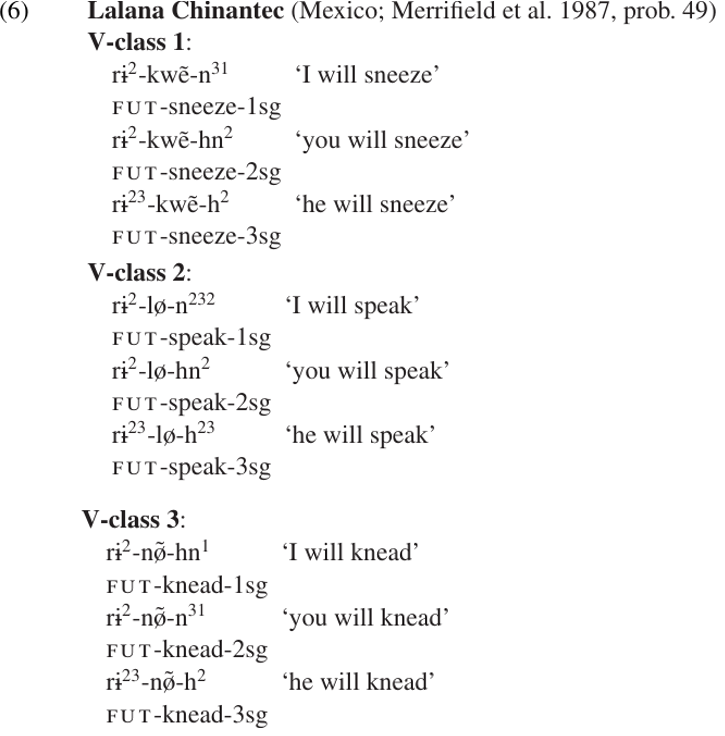
Morphologically conditioned suppletion appears to be less common than the lexical or phonological conditioning discussed above; at least it is harder to find cases where this is clearly the correct analysis. As another example, the future tense prefix in Lalana Chinantec has two allomorphs: /rɨ 2-/ when the verb is marked for first or second person vs. /rɨ23-/ when the verb is marked for third person. (The number 3 represents low tone, 1 is high tone.) This change in tone is not phonologically conditioned. The subject agreement suffixes appear in several different allomorphs, which are lexically conditioned. However, the tone pattern associated with the suffix does not affect the tone of the prefix; this seems to be determined strictly on the basis of person, as illustrated in (6).2
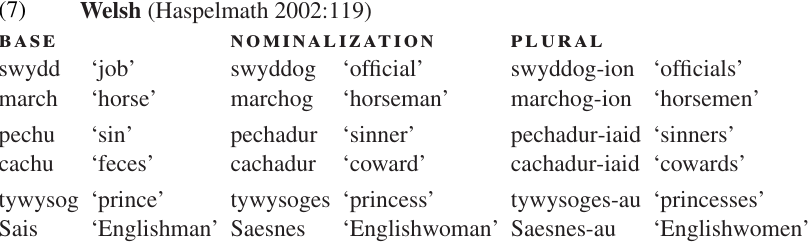
Haspelmath (2002) cites Welsh pluralization as another example of morphologically conditioned suppletion. Welsh has about a dozen different ways of marking plural number on nouns. In derived nouns, the form of the plural marker depends on which nominalizing suffix is used, as illustrated in (7).
We will discuss the kinds of rules we could use to represent each of these kinds of suppletion. But before proceeding further with our study of suppletion, it will be helpful to discuss the other major type of allomorphy, namely MORPHOPHONEMIC change.
1. The term is sometimes also applied to cases where some similarity of form remains between the allomorphs but the relationship is phonologically irregular, as in the plural forms man/men, goose/geese, mouse/mice, etc. So, in this extended usage of the term, any allomorphy which cannot be analyzed as morphophonemic can be considered to be a case of suppletion.
2. This analysis is based on Bill Merrifield’s unpublished teacher’s guide for Merrifield et al. (1987). Thanks to Cal Rensch for additional clarification.
 الاكثر قراءة في Morphology
 اخر الاخبار
اخبار العتبة العباسية المقدسة

الآخبار الصحية


مواضيع ذات صلة
 قسم الشؤون الفكرية يصدر كتاباً يوثق تاريخ السدانة في العتبة العباسية المقدسة
 "المهمة".. إصدار قصصي يوثّق القصص الفائزة في مسابقة فتوى الدفاع المقدسة للقصة القصيرة
 (نوافذ).. إصدار أدبي يوثق القصص الفائزة في مسابقة الإمام العسكري (عليه السلام)