Grammar
Tenses
Present

Present Simple
Present Continuous
Present Perfect
Present Perfect Continuous
Past
Past Simple
Past Continuous
Past Perfect
Past Perfect Continuous
Future
Future Simple
Future Continuous
Future Perfect
Future Perfect Continuous
Parts Of Speech
Nouns
Countable and uncountable nouns
Verbal nouns
Singular and Plural nouns
Proper nouns
Nouns gender
Nouns definition
Concrete nouns
Abstract nouns
Common nouns
Collective nouns
Definition Of Nouns
Animate and Inanimate nouns
Nouns
Verbs
Stative and dynamic verbs
Finite and nonfinite verbs
To be verbs
Transitive and intransitive verbs
Auxiliary verbs
Modal verbs
Regular and irregular verbs
Action verbs
Verbs
Adverbs
Relative adverbs
Interrogative adverbs
Adverbs of time
Adverbs of place
Adverbs of reason
Adverbs of quantity
Adverbs of manner
Adverbs of frequency
Adverbs of affirmation
Adverbs
Adjectives
Quantitative adjective
Proper adjective
Possessive adjective
Numeral adjective
Interrogative adjective
Distributive adjective
Descriptive adjective
Demonstrative adjective
Pronouns
Subject pronoun
Relative pronoun
Reflexive pronoun
Reciprocal pronoun
Possessive pronoun
Personal pronoun
Interrogative pronoun
Indefinite pronoun
Emphatic pronoun
Distributive pronoun
Demonstrative pronoun
Pronouns
Pre Position
Preposition by function
Time preposition
Reason preposition
Possession preposition
Place preposition
Phrases preposition
Origin preposition
Measure preposition
Direction preposition
Contrast preposition
Agent preposition
Preposition by construction
Simple preposition
Phrase preposition
Double preposition
Compound preposition
prepositions
Conjunctions
Subordinating conjunction
Correlative conjunction
Coordinating conjunction
Conjunctive adverbs
conjunctions
Interjections
Express calling interjection
Phrases
Sentences
Clauses
Part of Speech
Grammar Rules
Passive and Active
Preference
Requests and offers
wishes
Be used to
Some and any
Could have done
Describing people
Giving advices
Possession
Comparative and superlative
Giving Reason
Making Suggestions
Apologizing
Forming questions
Since and for
Directions
Obligation
Adverbials
invitation
Articles
Imaginary condition
Zero conditional
First conditional
Second conditional
Third conditional
Reported speech
Demonstratives
Determiners
Direct and Indirect speech
Linguistics
Phonetics
Phonology
Linguistics fields
Syntax
Morphology
Semantics
pragmatics
History
Writing
Grammar
Phonetics and Phonology
Semiotics
Reading Comprehension
Elementary
Intermediate
Advanced
Teaching Methods
Teaching Strategies
Assessment

Erosion
 المؤلف:
Bernd Heine and Tania Kuteva
المؤلف:
Bernd Heine and Tania Kuteva
 المصدر:
The Genesis of Grammar
المصدر:
The Genesis of Grammar
 الجزء والصفحة:
P42-C1
الجزء والصفحة:
P42-C1
 2026-02-23
 288
288




+
-
20
Erosion
Erosion means that as a result of undergoing grammaticalization, a linguistic expression loses phonetic substance. As we observed above, this parameter is usually the last to apply in grammaticalization processes, and it is not a requirement for grammaticalization to happen. For ex ample, the Germanverb haben ‘to have, possess’ has been grammaticalized to a perfect aspect (and also a past tense) marker. But in spite of its history of nearly one millennium as a tense–aspect auxiliary it has not undergone erosion, being phonetically indistinguishable from the lexical verb; and much the same applies to its Latin equivalent habēre ‘to hold, possess’, which has also given rise to a tense–aspect auxiliary in the Romance languages, but its form as a verb of possession and as an auxiliary for example in French is the same1(Vincent 1995: 437).
Erosion can be of two kinds: First, it may involve entire morphological units. Thus, when the Old English phrase þa hwile þe ‘that time that’, or any of its variants,2 was grammaticalized to the temporal and concessive subordinator while in Modern English, this meant that morphological segments were lost, and much the same happened in the case of its Old High German counterpart al di wila daz ‘all the time that’, which was grammaticalized to the causal subordinator weil ‘because’ in Present-Day German, which is also characterized by loss of morphological elements. We will refer to such cases as morphological erosion (see Heine and Reh 1984). More commonly, however, change is restricted to phonetic erosion, that is, to phonetic properties, in particular the ones listed in (17), or any combination thereof.
(17) Kinds of phonetic erosion
a. Loss of phonetic segments, including loss of full syllables.
b. Loss of suprasegmental properties, such as stress, tone, or into nation.
c. Loss of phonetic autonomy and adaptation to adjacent phonetic units.
d. Phonetic simplification.
The development in English from because to colloquial English coz is an instance of (17a): It entailed both loss of phonetic segments and reduction from a disyllabic to a monosyllabic unit. Since the eroded form coz does not occur in all varieties of English, there is reason to assume that erosion was a process that took place subsequent to desemanticization and decategorialization. The grammaticalization of the English adjective full to the derivational suffix-ful illustrates (17b), in that it entailed a loss of the ability to be stressed. (17c) can be illustrated with the following example. In the West African language Maninka, a locative construction [X be at Y], illustrated in (18a), has been grammaticalized to a progressive aspect (18b), as has happened in many other languages (Heine 1993; Bybee, Perkins, and Pagliuca 1994; Kuteva 2001). The result is that the copula ye̒ (PM) and the locative postposition na̒ ‘at’ have been reinterpreted as a discontinuous progressive marker. Another result of this process is that na̒ has lost its phonetic autonomy: While it is invariable as a postposition, as a progressive marker it no longer is: It assimilates to the preceding verb, taking the form na when the verb ends in a nasal but la elsewhere, and it has lost its high tone, adopting the tone of the preceding verb.
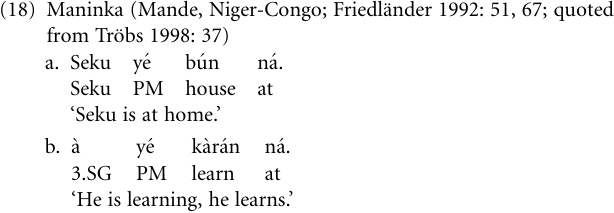
A paradigm case of (17d) concerns phonetically complex sound units that in the process of grammaticalization lose phonetic properties. For example, many West and central African languages have labial-velar consonants, such as kp and gb, which are phonetically more complex than the corresponding labial (p, b) or velar (k, g) consonants. Accordingly, in the Ewe language of Ghana and Togo, gb was ‘‘simplified’’ to a corresponding velar g in some words that underwent grammaticalization, for example when the noun gbe̒ ‘location, direction’ gave rise to an ingressive aspect marker-ge̒, or the verb gbɔ ‘to return’ to the repetitive aspect prefix-ga (Heine 1993: 107).
In quite a number of cases, both morphological and phonetic erosion tend to be involved. For example, the grammaticalization of the phrase by the side of to the preposition beside in Modern English, or of by cause of to because (of) appear to have involved both morphological and phonetic erosion. Similarly, the development of the Latin phrase (in) casa ‘in the house (of)’ via Old French (en) chies ‘at’ to the Modern French locative preposition chez ‘at’ involved loss of both morphological and phonological substance.
In accordance with the definition provided above, we are using erosion as a technical term of grammaticalization theory, which needs to be distinguished from ‘‘phonetic reduction,’’ for the following reasons: First, phonetic reduction does not necessarily involve grammaticalization; for example, the English copula verb ’s in She’s a teacher is a phonetically reduced version of is, but this is not due to grammaticalization. And second, erosion also differs from phonetic reduction in that it includes a loss of morphological elements, as we just saw.
1 This does not apply to the development of Latin habēre as a future tense auxiliary, which has been affected by all parameters of grammaticalization, including erosion, in almost all of the Western Romance languages (Portuguese being an exception; anonymous referee).
2 Such variants being ðe hwile ðe, þa hwile þe, þa hwile þa, þa hwila þe, a hwile ðæ, ðe hwile ðæt, etc.
 الاكثر قراءة في Linguistics fields
 اخر الاخبار
اخبار العتبة العباسية المقدسة

الآخبار الصحية


مواضيع ذات صلة
 قسم الشؤون الفكرية يصدر كتاباً يوثق تاريخ السدانة في العتبة العباسية المقدسة
 "المهمة".. إصدار قصصي يوثّق القصص الفائزة في مسابقة فتوى الدفاع المقدسة للقصة القصيرة
 (نوافذ).. إصدار أدبي يوثق القصص الفائزة في مسابقة الإمام العسكري (عليه السلام)