Grammar
Tenses
Present

Present Simple
Present Continuous
Present Perfect
Present Perfect Continuous
Past
Past Simple
Past Continuous
Past Perfect
Past Perfect Continuous
Future
Future Simple
Future Continuous
Future Perfect
Future Perfect Continuous
Parts Of Speech
Nouns
Countable and uncountable nouns
Verbal nouns
Singular and Plural nouns
Proper nouns
Nouns gender
Nouns definition
Concrete nouns
Abstract nouns
Common nouns
Collective nouns
Definition Of Nouns
Animate and Inanimate nouns
Nouns
Verbs
Stative and dynamic verbs
Finite and nonfinite verbs
To be verbs
Transitive and intransitive verbs
Auxiliary verbs
Modal verbs
Regular and irregular verbs
Action verbs
Verbs
Adverbs
Relative adverbs
Interrogative adverbs
Adverbs of time
Adverbs of place
Adverbs of reason
Adverbs of quantity
Adverbs of manner
Adverbs of frequency
Adverbs of affirmation
Adverbs
Adjectives
Quantitative adjective
Proper adjective
Possessive adjective
Numeral adjective
Interrogative adjective
Distributive adjective
Descriptive adjective
Demonstrative adjective
Pronouns
Subject pronoun
Relative pronoun
Reflexive pronoun
Reciprocal pronoun
Possessive pronoun
Personal pronoun
Interrogative pronoun
Indefinite pronoun
Emphatic pronoun
Distributive pronoun
Demonstrative pronoun
Pronouns
Pre Position
Preposition by function
Time preposition
Reason preposition
Possession preposition
Place preposition
Phrases preposition
Origin preposition
Measure preposition
Direction preposition
Contrast preposition
Agent preposition
Preposition by construction
Simple preposition
Phrase preposition
Double preposition
Compound preposition
prepositions
Conjunctions
Subordinating conjunction
Correlative conjunction
Coordinating conjunction
Conjunctive adverbs
conjunctions
Interjections
Express calling interjection
Phrases
Sentences
Clauses
Part of Speech
Grammar Rules
Passive and Active
Preference
Requests and offers
wishes
Be used to
Some and any
Could have done
Describing people
Giving advices
Possession
Comparative and superlative
Giving Reason
Making Suggestions
Apologizing
Forming questions
Since and for
Directions
Obligation
Adverbials
invitation
Articles
Imaginary condition
Zero conditional
First conditional
Second conditional
Third conditional
Reported speech
Demonstratives
Determiners
Direct and Indirect speech
Linguistics
Phonetics
Phonology
Linguistics fields
Syntax
Morphology
Semantics
pragmatics
History
Writing
Grammar
Phonetics and Phonology
Semiotics
Reading Comprehension
Elementary
Intermediate
Advanced
Teaching Methods
Teaching Strategies
Assessment

Evidence from signed languages
 المؤلف:
Bernd Heine and Tania Kuteva
المؤلف:
Bernd Heine and Tania Kuteva
 المصدر:
The Genesis of Grammar
المصدر:
The Genesis of Grammar
 الجزء والصفحة:
P108-C2
الجزء والصفحة:
P108-C2
 2026-02-28
 227
227




+
-
20
Evidence from signed languages
As we concluded, the first layers of grammatical evolution were restricted to lexical categories, which are the earliest forms of grammar that are accessible via grammaticalization in spoken (and written) languages. This raises the question of whether it may not be possible to push reconstruction back to linguistic forms that may have preceded lexical categories. There is no lack of works dealing with this question, nor of hypotheses that have been voiced; nevertheless, we will not deal with these hypotheses here because they are generally based on premises that are empirically not satisfactory in every respect.
But there is one possible exception and it concerns signed languages. As has been demonstrated in recent work, signed languages show roughly the same kinds of grammaticalizations that we observe in spoken languages (see e.g. Janzen 1995, 1998, 1999; Janzen and Shaffer 2002; Morford 2002; Sexton 1999; Pfau 2004; Pfau and Steinbach 2005, 2006; Shaffer 2000; Wilbur 1999). We saw above that a number of the pathways outlined for spoken languages have analogs in signed languages (see the seminal work of Pfau and Steinbach 2006 for a general treatment).
But there are also what appear to be modality-specific grammaticalizations in signed languages which are undocumented in spoken languages. For example, in German Sign Language (DGS), a grammaticalization from noun to auxiliary has been observed (Pfau and Steinbach 2006), and—to our knowledge—the development of the adjective WRONG of American Sign Language into an adverbial marker for unexpected events (Morford2002:331) also has no equivalent in spoken languages. However conceptually plausible these processes may be, we are not aware of any parallel of them in spoken or written languages (for an exceptionally interesting development of the noun ‘thing’ → ‘long object used as an instrument’→ purpose marker, see Epps2007).
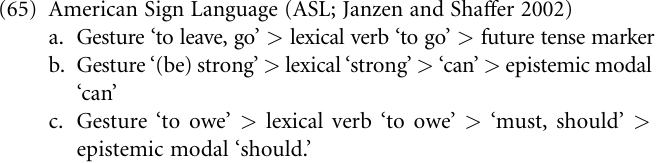
Perhaps more importantly, research on signed languages may also shed light on the question posed above, namely on whether it may not be possible to push reconstruction back to linguistic forms that preceded lexical forms. There is little doubt that at least some lexical items of signed languages that were grammaticalized to functional categories have their source in gestures, that is, in communicative expressions using the hands and face. Thus, Janzen and Shaffer (2002) propose the reconstructions in (65); note further that Wilcox and Wilcox (1995) argue that there are gestural origins for markers of evidentiality (see also Pfau and Steinbach 2006).
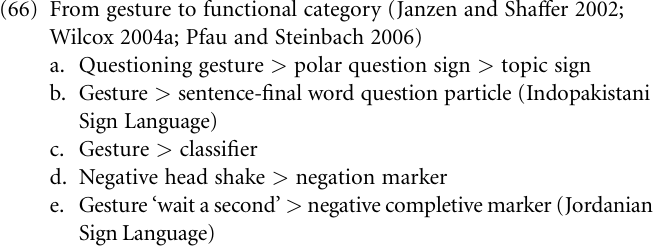
But work on signed languages provides yet another perspective that is immediately relevant for the reconstruction of language evolution. Our discussion in “Layers” suggested that functional categories can be traced back ultimately to lexical categories. As it surfaces from recent research (especially Janzen 1999; Janzen and Shaffer 2002; Pfau and Steinbach 2005, 2006), however, there is an alternative pathway for functional categories, namely one that bypasses the lexicon, leading straight from manual or non-manual gesture to functional marker, such as the ones summarized in (66). In (66a) for example, the gesture proposed as the origin of the polar (= yes–no) question marker in both American Sign Language and British Sign Language (Woll 1981) is an eyebrow raise extending over the entire proposition being questioned, which became the obligatory sign for polar questions (usually along with a forward head tilt), that is, a marker for a grammatical function. Subsequently, this marker was further grammaticalized to a topic marker, first within the pragmatic domain, subsequently within the syntactic, and finally the textual domain.
On the basis of such observations one might conclude that ultimately lexical material might not be the only source for functional categories. Conceivably, such a hypothesis could be strengthened by more detailed analysis of suprasegmental grammatical forms as they show up, for example in tone or intonation contours of polar question marking. Unfortunately, the evidence available does not allow for any generalizations on this issue. But this raises more generally the question of what role gesture and prosody may have played in the evolution of spoken languages. Since we are restricted here to segmental speech, we have little to say about this issue except that it requires more research.
 الاكثر قراءة في Grammar
 اخر الاخبار
اخبار العتبة العباسية المقدسة

الآخبار الصحية


مواضيع ذات صلة
 قسم الشؤون الفكرية يصدر كتاباً يوثق تاريخ السدانة في العتبة العباسية المقدسة
 "المهمة".. إصدار قصصي يوثّق القصص الفائزة في مسابقة فتوى الدفاع المقدسة للقصة القصيرة
 (نوافذ).. إصدار أدبي يوثق القصص الفائزة في مسابقة الإمام العسكري (عليه السلام)