Grammar
Tenses
Present

Present Simple
Present Continuous
Present Perfect
Present Perfect Continuous
Past
Past Simple
Past Continuous
Past Perfect
Past Perfect Continuous
Future
Future Simple
Future Continuous
Future Perfect
Future Perfect Continuous
Parts Of Speech
Nouns
Countable and uncountable nouns
Verbal nouns
Singular and Plural nouns
Proper nouns
Nouns gender
Nouns definition
Concrete nouns
Abstract nouns
Common nouns
Collective nouns
Definition Of Nouns
Animate and Inanimate nouns
Nouns
Verbs
Stative and dynamic verbs
Finite and nonfinite verbs
To be verbs
Transitive and intransitive verbs
Auxiliary verbs
Modal verbs
Regular and irregular verbs
Action verbs
Verbs
Adverbs
Relative adverbs
Interrogative adverbs
Adverbs of time
Adverbs of place
Adverbs of reason
Adverbs of quantity
Adverbs of manner
Adverbs of frequency
Adverbs of affirmation
Adverbs
Adjectives
Quantitative adjective
Proper adjective
Possessive adjective
Numeral adjective
Interrogative adjective
Distributive adjective
Descriptive adjective
Demonstrative adjective
Pronouns
Subject pronoun
Relative pronoun
Reflexive pronoun
Reciprocal pronoun
Possessive pronoun
Personal pronoun
Interrogative pronoun
Indefinite pronoun
Emphatic pronoun
Distributive pronoun
Demonstrative pronoun
Pronouns
Pre Position
Preposition by function
Time preposition
Reason preposition
Possession preposition
Place preposition
Phrases preposition
Origin preposition
Measure preposition
Direction preposition
Contrast preposition
Agent preposition
Preposition by construction
Simple preposition
Phrase preposition
Double preposition
Compound preposition
prepositions
Conjunctions
Subordinating conjunction
Correlative conjunction
Coordinating conjunction
Conjunctive adverbs
conjunctions
Interjections
Express calling interjection
Phrases
Sentences
Clauses
Part of Speech
Grammar Rules
Passive and Active
Preference
Requests and offers
wishes
Be used to
Some and any
Could have done
Describing people
Giving advices
Possession
Comparative and superlative
Giving Reason
Making Suggestions
Apologizing
Forming questions
Since and for
Directions
Obligation
Adverbials
invitation
Articles
Imaginary condition
Zero conditional
First conditional
Second conditional
Third conditional
Reported speech
Demonstratives
Determiners
Direct and Indirect speech
Linguistics
Phonetics
Phonology
Linguistics fields
Syntax
Morphology
Semantics
pragmatics
History
Writing
Grammar
Phonetics and Phonology
Semiotics
Reading Comprehension
Elementary
Intermediate
Advanced
Teaching Methods
Teaching Strategies
Assessment

Kenya Pidgin Swahili (KPS)
 المؤلف:
Bernd Heine and Tania Kuteva
المؤلف:
Bernd Heine and Tania Kuteva
 المصدر:
The Genesis of Grammar
المصدر:
The Genesis of Grammar
 الجزء والصفحة:
P169-C4
الجزء والصفحة:
P169-C4
 2026-03-09
 405
405




+
-
20
Kenya Pidgin Swahili (KPS)
In order to illustrate the nature of pidgins we will now look in more detail at one particular pidgin, namely Kenya Pidgin Swahili (henceforth: KPS), a variety of the East African language Swahili that was spoken in up-country Kenya in the 1960s and 1970s, when the first-named author had a chance to work on it (Heine 1973, 1991). Its most representative speakers were people having no or hardly any formal education, living on what was then known as the ‘‘White Highlands’’ of up-country Kenya, in and around urban centers such as Nairobi, Thika, Nakuru, Eldoret, Kitale, and Nanyuki. The first languages of the pidgin were Bantu languages such as Kikuyu, Kamba, Luyia, and Gusii, or Nilotic languages such as Luo, Kalenjin, Maa (Maasai), Turkana, as well as Cushitic languages such as Somali and Oromo, thus representing three of the four African language phyla (Niger-Congo, Nilo-Saharan, and Afroasiatic, respectively). As far as we know there were never any speakers using KPS as their L1 (first language), and its speakers tended to refer to it as ‘‘nobody’s language’’.
KPS is elusive to the traditional taxonomy of pidgins that we introduced in “On pidgins and other restricted linguistic systems Introduction” It has properties of a jargon for many speakers of northern Kenya, approaches what is commonly assumed to be a stable pidgin, but— as we will see in “The rise of new functional categories “—also shows properties of extended pidgins. It may best be called a post-pidgin continuum in that it contains a large range of varieties extending along a scale from full pidgin to varieties approaching Coastal Swahili (CS),2 that is, the Swahili dialects spoken natively along the East African coastal belt (Duran 1979). Its speakers do not normally consider it to be a distinct linguistic form; rather, they maintain that they simply speak ‘‘Swahili’’. In its genesis, KPS was to some extent a ‘‘workforce pidgin’’, being the medium of communication on the European-owned plantations in the ‘‘White Highlands’’ of Kenya, but it was also used in other multi-lingual settings, especially in the urban centres.
The pidgin variety discussed here is nearly, though not entirely, identical with what Muthiani (1974) describes as ‘‘Kisetla’’. The name Kisetla (ki is a prefix of noun class 7, denoting ‘language’, and setla ‘European settler’) is due to the use of Swahili as a lingua franca by British settlers in colonial Kenya; hence, its original meaning was ‘‘the Swahili variety spoken by British settlers in up-country Kenya’’. However, the way the term is used by Muthiani (1974: 32) refers primarily to the variety spoken as a pidgin spoken ‘‘by many Africans’’. Neither of the terms ‘‘Kisetla’’ nor ‘‘Kenya Pidgin Swahili’’ was accepted by the speakers of this variety when we worked on it in the late 1960s and the 1970s; rather, the existence of KPS tended to be denied both by its speakers and by speakers of Standard Swahili. KPS differs from Kihindi (‘Indian language’), the Swahili pidgin variety spoken by a large segment of the Indian population in up-country Kenya, especially shop-keepers, mechanics, etc.; to our knowledge, no description of this variety exists (Heine 1973: 59–69).
There is no clear information on whether, or to what extent, KPS still exists the way it was recorded more than thirty years ago. With the introduction of Standard Swahili3 as a compulsory medium of education since the 1980s and as the medium of radio and other mass media there has been a development leading to the decline of the pidgin in favor of the standard variety.
The history of this pidgin began with the arrival of British and later on of Indian immigrants since the end of the nineteenth century and the use of varieties of Coastal Swahili as a lingua franca in up-country Kenya among the European and Indian immigrants and Africans. Being virtually the only linguistic medium for communication among these communities in the emerging administrative and commercial centers and plantation areas of up-country Kenya, the lingua franca underwent massive restructuring. On the basis of our knowledge of the ‘‘native’’ L1 varieties of Swahili (henceforth: CS, i.e. Coastal Swahili varieties which form the basis of Standard Swahili) that served as a source for KPS and of written documents, it is reasonable to assume that at the latest by the 1930s, a form of KPS had emerged that was the result in particular of the following processes (see Heine 1983 for details):
(2) The ‘‘stripping’’ process in KPS
a. In phonology, the number of phonemic distinctions is reduced. For example, the dental fricatives th and dh, and the velar fricative gh (all three being restricted to Arabic loanwords) were entirely lost, the voiced fricatives z and v tended to be replaced by the corresponding voiceless fricatives s and f, respectively, and the distinction in vowel length was also lost.
b. Inflectional and derivational morphology was largely lost: The system of verbal derivational extensions and nominal inflections was drastically reduced.
c. Grammatical distinctions of gender, number, valency, and of tense, aspect, and modality largely disappeared: Both the noun class and the tense–aspect systems collapsed, with only few relics left.
d. All inflectional mechanisms of clause subordination disappeared.
e. Words tend to become multifunctional. For example, the noun mguu ‘foot, leg’ was extended to ‘car wheel’ or to any item supporting another item.
f. The inventory of lexical items shrank drastically, to 500 to 1000 with some speakers and to a few hundred with others.
In more general terms, the rise of KPS has been characterized in the following way:
One major result of this process is that almost the entire inflectional and derivational morphology characteristic of Bantu languages was given up, the agglutinating structure of Swahili was replaced by an analytic-isolating type of structure, and that hypotaxis gave way to parataxis as a means of structuring texts. With the breakdown of the noun class system and gender–number agreement, the language lost its major means of marking syntactic relations....Thus, KPS in its earlier forms can be reconstructed as a ‘‘jargon’’ consisting of several hundreds of lexical items, a handful of affixes, and a few word order rules. (Heine 1991: 32)
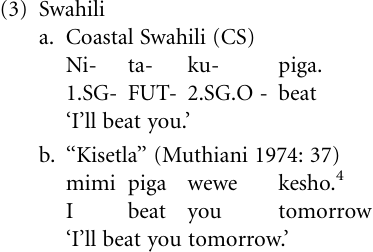
An example illustrating the result of this process is provided by Muthiani, where (3a) illustrates the source structure and (3b) the pidginized end product:
The structure of KPS, as we found it to be in the late 1960s, is that of an isolating language where grammatical functions were either unmarked or expressed by lexical means. Exceptions included most of all the following:
(a) Properties of the noun class system were not lost entirely but survived in some way or other among all speakers of KPS, even if the only semantic distinction characterizing this system is for the most part that between human and non-human participants.
(b) Some of the verbal derivational extensions survive as lexicalized relics. For example, the CS verb-nyonga ‘strangle’ survives in KPS in two extended forms: jinyonga (with the reflexive prefix ji-) ‘hang oneself, commit suicide’ and nyongwa (with the passive suffix-w-) ‘be hanged’.
(c) Tense–aspect markers are mostly absent, but the future marker ta and the present/progressive prefix na- tend to be retained, even if the function of the latter has been extended to function as a general marker for non-future situations.
(d) There are essentially no personal inflectional prefixes, even though human subject referents are occasionally cross-referenced on the verb and on demonstratives.
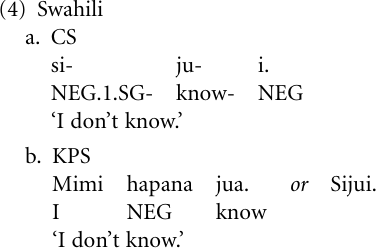
(e) There is no inflectional negation; rather, the invariable particle hapana ‘no, there is not’ is used (see below). Still, inflection survives in some lexicalized forms; thus, instead of the CS form (4a), there is the KPS phrase (4b), but more commonly the CS form is used as an invariable expression.
(f) Clause coordination by means of the conjunctions au ‘or’ and na ‘and’ is retained.
(g) The conjunctions kama ‘if’, lakini ‘but’, and (kwa) sababu ‘because’ are the only productive means of clause subordination.
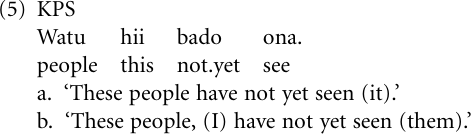
Like other pidgins, meaning relations in KPS are to a large extent determined by context pragmatics, which means that semantic or syntactic functions tend to be unmarked (see Heine 1991: 118 for an example illustrating this structure). However, it has retained the essential word order arrangements of CS: It places modifiers after the head, and the basic word order is verb-medial (SVO). As long as there are sufficient contextual clues, however, there is some range in word order variation. For example, without any further contextual information, sentence (5) has the meaning (5a), where watu hii ‘these people’ is the clausal subject. But in a situation where the relevant people were presented as topical in the preceding context it can as well mean (5b), where watu hii is a topicalized object.
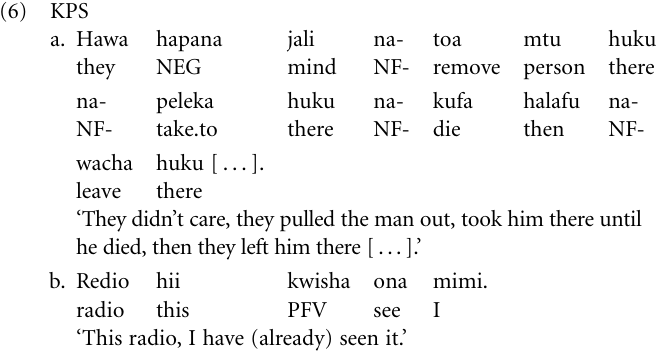
The extent to which meaning is context-dependent can be illustrated with the following example from an informant whose first language was Maasai: The hearer can only establish on the basis of the pragmatics of the speech situation that, for example, the subject referent of the verb-wacha ‘leave’ is hawa ‘they’ whereas in the case of the verb-kufa it is mtu ‘person, man’. As long as the hearer can be expected to be able to reconstruct the referential relations among participants, there are few constraints on the building of discourses. Accordingly, in (6b) the basic SVO order is ignored in favor of an OVS order since the hearer can be expected to infer from the meaning of the items employed who the agent and the patient are—that is, that the object redio ‘radio’ is topicalized and the subject mimi back grounded in the sentence-final position.
To summarize, with few exceptions, the main morphosyntactic characteristics of CS have disappeared in KPS, which can be defined as a restricted system, largely devoid of inflectional and derivational morphology. The few relics that have survived concern salient conceptual distinctions such as marking future vs. non-future, or human vs. non-human referents, and the skeleton of linear arrangement of the source language CS.
There is, however, one important observation to be made on the syntactic structure of KPS in its early stages. While essentially all morph ology for clause subordination was eliminated in the ‘‘stripping’’ process, there nevertheless was syntactic recursion: Data from older speakers who had preserved the older structure of KPS to some extent suggest that there was productive noun modification, both adjectival and possessive modification, for example kitu mbaya (thing bad) ‘a bad thing’, watu ya taun (people of town) ‘urban dwellers’. Accordingly, there is little doubt that at least noun phrase recursion was present at all stages in the development of this pidgin.
2 These varieties include but are not restricted to Kimvita, the Swahili dialect spoken in and around Mombasa.
3 Standard Swahili is based on the Kiunguja dialect of Zanzibar rather than on coastal varieties of Kenya.
4 This example is suggestive of Indian KPS speakers, who generally tend to omit tense aspect markers. According to our informants of KPS, the verbal future prefix ta- would be used in this example.
 الاكثر قراءة في Linguistics fields
 اخر الاخبار
اخبار العتبة العباسية المقدسة

الآخبار الصحية


مواضيع ذات صلة
 قسم الشؤون الفكرية يصدر كتاباً يوثق تاريخ السدانة في العتبة العباسية المقدسة
 "المهمة".. إصدار قصصي يوثّق القصص الفائزة في مسابقة فتوى الدفاع المقدسة للقصة القصيرة
 (نوافذ).. إصدار أدبي يوثق القصص الفائزة في مسابقة الإمام العسكري (عليه السلام)