Phonotactic constraints
Phonotactic constraints limit the possible phonological shapes of stems and words. Phonotactic constraints are often, but not always, connected with syllable structure.
At their most basic, phonotactic constraints determine the minimum length of content words in particular languages. For example, in Mohawk, each content word contains at least two syllables (Michelson 1988, cited by Hayes 1995: 47). Other languages require that content words consist of at least a heavy syllable, where heavy means that the syllable contains a long vowel, diphthong, or a vowel and a weight-bearing (moraic) consonant.1 Many languages do not have minimal word constraints, including Romanian, Hungarian, and Icelandic (Hayes 1995: 88–9).
Does English have a minimal word constraint? An analysis of nick-names suggests that it does (see McCarthy and Prince 1998: 287–8). Here is a list of some English first names and their corresponding short forms, or nicknames:
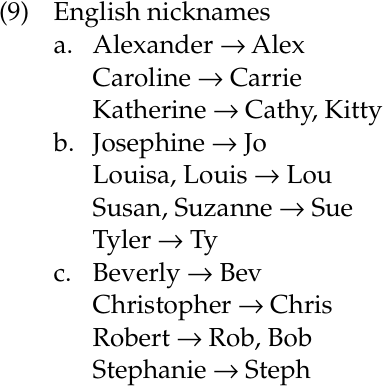
Even if we were to keep going, we would find that any nickname we can think of falls into one of these three sets. They are either polysyllabic (9a) (in this case, bisyllabic) names or monosyllabic names (9b–c) that have either a diphthong, a coda, or both. No native English nick names consist of a single, light syllable. From this data, it seems that English falls in with the set of languages that have a minimal word constraint. Even the shortest of names, nicknames, must consist minimally of a heavy syllable or two light syllables. And it is difficult, if not impossible, to find an English content word that contradicts this conclusion.
We also find that languages have restrictions on the possible shapes of roots. Nida (1965: 66) reports that in the Mayan languages, roots are predominantly of the shape CVC and in Bantu they are generally CVCV. In Hebrew, Arabic, and other Semitic languages, roots generally consist of three consonants: CCC.
1 If you are not already familiar with the terms “weight-bearing consonant” and “mora,” you do not need to learn them. We mention them in this context only to be complete. If you are interested in reading further on the topic, a good starting point is Hayes (1989).








