Grammar
Tenses
Present

Present Simple
Present Continuous
Present Perfect
Present Perfect Continuous
Past
Past Simple
Past Continuous
Past Perfect
Past Perfect Continuous
Future
Future Simple
Future Continuous
Future Perfect
Future Perfect Continuous
Parts Of Speech
Nouns
Countable and uncountable nouns
Verbal nouns
Singular and Plural nouns
Proper nouns
Nouns gender
Nouns definition
Concrete nouns
Abstract nouns
Common nouns
Collective nouns
Definition Of Nouns
Animate and Inanimate nouns
Nouns
Verbs
Stative and dynamic verbs
Finite and nonfinite verbs
To be verbs
Transitive and intransitive verbs
Auxiliary verbs
Modal verbs
Regular and irregular verbs
Action verbs
Verbs
Adverbs
Relative adverbs
Interrogative adverbs
Adverbs of time
Adverbs of place
Adverbs of reason
Adverbs of quantity
Adverbs of manner
Adverbs of frequency
Adverbs of affirmation
Adverbs
Adjectives
Quantitative adjective
Proper adjective
Possessive adjective
Numeral adjective
Interrogative adjective
Distributive adjective
Descriptive adjective
Demonstrative adjective
Pronouns
Subject pronoun
Relative pronoun
Reflexive pronoun
Reciprocal pronoun
Possessive pronoun
Personal pronoun
Interrogative pronoun
Indefinite pronoun
Emphatic pronoun
Distributive pronoun
Demonstrative pronoun
Pronouns
Pre Position
Preposition by function
Time preposition
Reason preposition
Possession preposition
Place preposition
Phrases preposition
Origin preposition
Measure preposition
Direction preposition
Contrast preposition
Agent preposition
Preposition by construction
Simple preposition
Phrase preposition
Double preposition
Compound preposition
prepositions
Conjunctions
Subordinating conjunction
Correlative conjunction
Coordinating conjunction
Conjunctive adverbs
conjunctions
Interjections
Express calling interjection
Phrases
Sentences
Clauses
Part of Speech
Grammar Rules
Passive and Active
Preference
Requests and offers
wishes
Be used to
Some and any
Could have done
Describing people
Giving advices
Possession
Comparative and superlative
Giving Reason
Making Suggestions
Apologizing
Forming questions
Since and for
Directions
Obligation
Adverbials
invitation
Articles
Imaginary condition
Zero conditional
First conditional
Second conditional
Third conditional
Reported speech
Demonstratives
Determiners
Direct and Indirect speech
Linguistics
Phonetics
Phonology
Linguistics fields
Syntax
Morphology
Semantics
pragmatics
History
Writing
Grammar
Phonetics and Phonology
Semiotics
Reading Comprehension
Elementary
Intermediate
Advanced
Teaching Methods
Teaching Strategies
Assessment

Linguistic Exaptation, Leveling, and Analogy
 المؤلف:
Mark Aronoff and Kirsten Fudeman
المؤلف:
Mark Aronoff and Kirsten Fudeman
 المصدر:
What is Morphology
المصدر:
What is Morphology
 الجزء والصفحة:
P86-C3
الجزء والصفحة:
P86-C3
 2026-04-06
 18
18




+
-
20
Linguistic Exaptation, Leveling, and Analogy
Rudes (1980) and Lass (1990) have both raised the question of what to do with “linguistic left-overs” (Rudes’s term) or “linguistic junk” (Lass’s term). In both cases, it has to do with morphemes that lose their semantic content or morphosyntactic function as a result of language change and are left as contentless, functionless strings of phonemes floating around in the system. Rudes’s and Lass’s investigations on this question cover a variety of cases. They show that languages are in general intolerant of useless elements, and speakers reanalyze them as having a new role. Lass calls this process linguistic exaptation, extending a term originally coined by Stephen Jay Gould and Elizabeth Vrba in the context of evolutionary biology to the study of language change. In evolutionary biology, exaptation occurs when a structure or feature that developed for a certain function through natural selection takes on a new and different function.1
Carstairs-McCarthy (1994) and Cameron-Faulkner and Carstairs-McCarthy (2000), in their work on inflectional classes and gender, and stem alternation, respectively, suggest that linguistic exaptation is pervasive. Carstairs-McCarthy considers the ingenuity that speakers show in assigning new roles to inflectional contrasts whose original purpose has been lost as being related to Clark’s (1987: 2) Principle of Contrast, “Every two forms contrast in meaning.” Linguistic exaptation is therefore a natural consequence of a core psycholinguistic mechanism that makes it easier for speakers to master complex inflectional systems or to learn the meanings of new vocabulary items, and we expect to find it playing an important role in the evolution of inflectional systems crosslinguistically.
One language family in which linguistic exaptation has occurred is Germanic (Lass 1990: 83–7). There, Indo-European vowel alternations within verbal paradigms came to encode the present/past distinction (e.g., English write, wrote). They had originally been used to encode aspectual distinctions. The case that we focus on here, however, is the one discussed by Rudes: the development of the verbal suffix -esc in Romance. Our story begins with Latin, where the suffix -sc attached to sequences of verb stem plus theme vowel to form the inchoative aspect (which has the general meaning ‘to begin to’). Compare the Latin verb form palleō ‘I am pale’ with its inchoative counterpart pallescō ‘I begin to pale’. Similarly, amō in Latin means ‘I love’, while amascō means ‘I am beginning to love’, and flōrēre is ‘to flower’, while flōrescere is ‘to begin to flower’ (examples from Rudes 1980). English doesn’t have a productive inchoative aspect, but we do have pairs like white and whiten ‘become pale; begin to be pale’.
A theme vowel, in the morphology of Latin, is a vowel that attaches to the verb stem and can be analyzed as determining its inflection class. One Latin verb class is identified by the theme vowel /a/. As Latin developed into the modern Romance languages, the inchoative suffix declined in productivity and eventually ceased to be productive at all. But while the semantic function of the affix eroded, the phonological material survived into various Romance languages, including Italian, Romanian, and dialects of Rhaeto-Romance. It was altered in one significant way: the theme vowel that originally fell between the verb stem and the inchoative suffix (which had varied among /a/, /i/, and /e/, depending on the verb) ceased to be identifiable as a theme vowel and came to be segmented along with the suffix in one invariable form. In both Romanian and Rhaeto-Romance, the suffix was reanalyzed as -esc. In Italian, it was reanalyzed as -isc. At this stage, -esc and -isc were both examples of what Lass calls “linguistic junk,” strings of phonemes without a function. Within Lass’s model, there were three possibilities regarding the future development of -esc and -isc:
i. They could disappear entirely.
ii. They could be kept as “marginal garbage,” i.e., meaningless idiosyncrasies of the verbs already bearing them.
iii. They could be kept, but instead of being relegated to the marginal role of (ii), they could be used for something new, taking on a new meaning or function.
What happened was (iii). The suffix represented by -esc and -isc became productive once again and is a distinctive feature of the verbal morphology of certain Romance languages. Why?
Although the classical conception of morpheme is a pairing between sound and meaning, we have defined it as the smallest grammatically significant unit in a word. What makes the development of -esc in the Romance languages distinctive is that its function was phonological, rather than syntactic or semantic. It is meaningless. We can exemplify this by looking at the paradigm of a verb that contains this morpheme. As seen below, the suffix occurs in the first, second, and third person singular and third person plural of the present indicative of the verbs that have it (so-called fourth conjugation verbs) in Romanian, illustrated here by a citi ‘to read’ (Rudes 1980: 333). (It also occurs in these persons in the present subjunctive and imperative.) But the core meaning of verbs does not change depending on the subject:
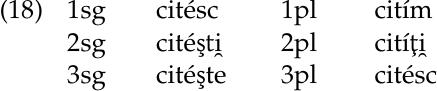
We can describe the new-found role of the -esc suffix in (18) as that of a stem-extender. The addition of -esc in the singular persons and in the third person plural had an effect on word stress. If not for the presence of the suffix, verbs like a citi, above, would be stressed on the root in the 1–3sg and 3pl forms, and on the suffix in the 1–2pl forms. Since the diachronic, or historic, development of vowels in Romanian and other languages varies depending on stress, this would have had the effect of creating two stems for many verbs. The renewed productivity of the suffix -esc long after its original meaning of inchoative aspect was lost is due to its regularizing effect on the stress of non-past verb forms. This is reflective of a larger tendency cross-linguistically. As languages evolve over time, they often show a preference for regularity within paradigms.
The story of the evolution of the Latin inchoative affix has another twist. Recall from above that one of the languages where it is productive and phonologically conditioned (appearing where stress would otherwise fall on the stem) is Italian. There, it is realized as [isk] or [iʃʃ], depending on the following vowel. From Italian, it was borrowed into Maltese.
Maltese is a Semitic language. Semitic is known for root-and-pattern morphology, as we saw in Root-and-pattern morphology Over the course of time, however, the productive verbal morphology of Maltese has become affixal, with only relics of the original root-and-pattern type remaining (Hoberman and Aronoff 2003). One consequence of this change is that Maltese easily borrows verbs intact from other languages – especially Romance. This is not so straightforward in other Semitic languages like Hebrew and Arabic. For example, as noted by Hoberman and Aronoff, Hebrew borrows nouns intact (e.g., telefon), but verbs are adjusted to the morphological patterns of Hebrew. Thus, one form of the verb ‘to telephone’ is tilfen.
When Maltese borrows Italian verbs containing the <-isc-> augment, it borrows the augment as well, which always takes the shape [iʃʃ], written <ixx>. This augment appears under the same conditions as in Italian: when stress would otherwise fall on the stem. But since the stress patterns of Maltese verbs differ from those of Italian verbs, these conditions are met in different tense, person, and number forms. This is shown in the box on the next page. Following Hoberman and Aronoff, we have indicated stress, though the orthographies of neither language do so.
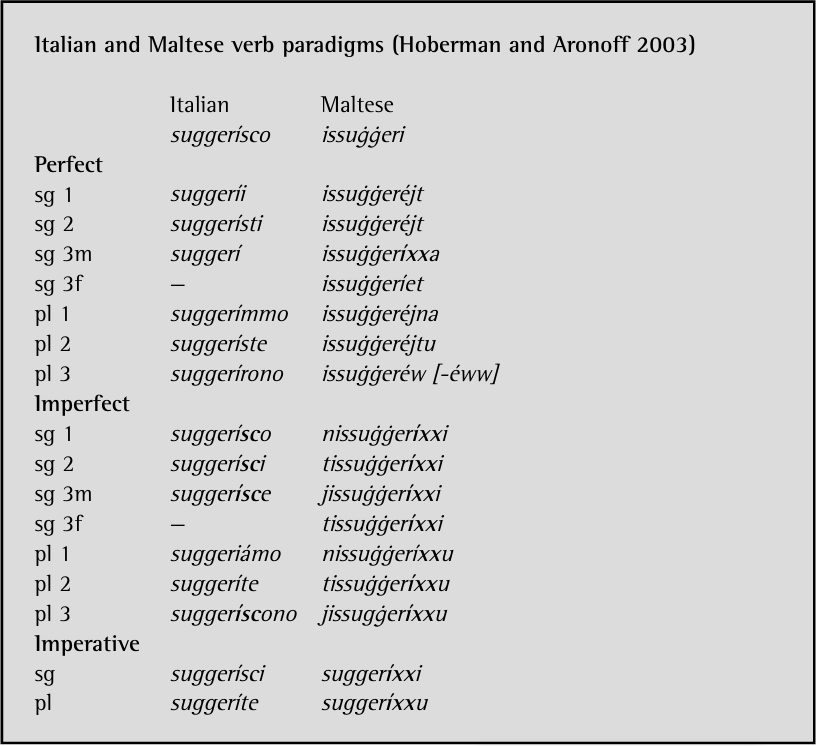
In some cases, the augment appears in parallel forms in both languages, but in other cases, it doesn’t. Maltese has borrowed a morpheme and the rule that governs its distribution, but not the verb forms themselves.
The tendency for languages to prefer regular paradigms over irregular ones sometimes leads to leveling, the elimination of sound alternations that do not signal important differences in meaning. A classic example of leveling comes from Latin. In Prehistoric Latin, the stems of words like colōs ‘color’ and honōs ‘worth’ ended in -s throughout the nominal paradigm:2
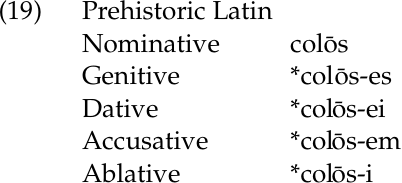
Through regular sound change, intervocalic /s/ became /r/, a process called rhotacism:
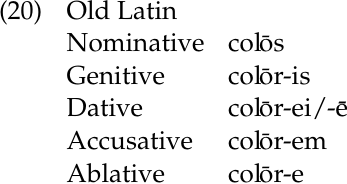
At this point, the paradigm was characterized by two stems, one ending in /s/ (the nominative form) and one ending in /r/ (the oblique forms). Eventually the final /s/ of the nominative form was replaced by /r/ in order to conform with the stem of the oblique forms. Note also that the /o/ preceding the /r/ of the nominative form shortened:3
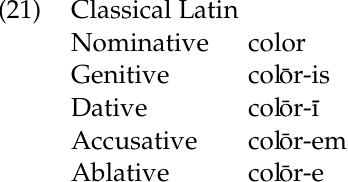
A second example of leveling comes from the history of Spanish. Latin, from which Spanish developed, had a class of verbs that was characterized by a nasal infix in the present stem. The nasal infix was present in some forms of the verb but absent from others (notably the past tense):

In the history of Spanish, the /n/ infix has been generalized to all forms of the verbs that once had it only in a limited number of forms of the paradigm. Modern Spanish has romper ‘to break’, rompo ‘I break’, rompí ‘I broke’, and vencer ‘to defeat’, venzo ‘I defeat’, vencí ‘I defeated’. (Venc- and venz- are pronounced alike in these forms.)
In discussions of leveling, we often speak of analogy (A is to B as C is to D). The nasal infix of verbs that had it was generalized throughout the paradigm by analogy with verbs that did not have such an alternation and that instead had a single form of the stem throughout the paradigm. Analogy is usually expressed as two equations, with the missing form represented by a variable X (A : B as C : X; solve for X). Using Modern Spanish forms for simplicity, the equation would be as follows, where conocer ‘to know’ is chosen randomly as a representative of verbs that did not have the nasal infix, and X represents the form that needs to be supplied by analogy to conocí:

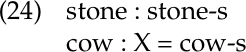
Informally, conocer is to conocí as vencer is to X, solved as vencí. More broadly, four-part analogy is used to describe the generalization or extension of a morphological pattern across (as opposed to within) paradigms (Hock 1991: 168). Through it, whole classes of words come to behave more similarly. Hock gives the example of English plurals. It is because of four-part analogy that the plural of cow is cows, replacing the earlier form kine. The new plural cows generalizes the plural formation familiar from other words, such as stone, stones, as in (24). Here, as in most instances of analogy, the pattern that serves as the basis of the analogy (in this case the regular plural suffix -s) is more productive.
Sometimes the older form that existed before analogical leveling remains as a relic, used for special meanings. The old plural of brother is brethren. These days, it is used only to refer to fellow-members of a church or social organization, not to brothers in the literal sense of the term. The title of a book about the United States Supreme Court, The Brethren, uses this form to emphasize the special nature of the relationship among the members of this most elite of groups.
Leveling and analogy are powerful forces in the development of languages over time. They are driven by a seemingly innate preference in speakers for phonological and morphological similarity between members of a paradigm or a class of words.
1 Some of the discussion is adapted from Fudeman (2004).
2 We thank Alan Nussbaum for help with the Latin data.
3 In the case of both color and honor, the older nominative forms colōs and honōs hung around for a long time. We use color here because it has the advantage of attesting the old nominative colōs while still showing the new nominative color at a relatively early date. Relic forms are relatively common when it comes to analogical change. Unlike regular sound changes, which can be accounted for in purely phonetic terms (e.g., Latin rhotacism), analogy is sensitive to morphologic, syntactic, and semantic factors.
 الاكثر قراءة في Morphology
 اخر الاخبار
اخبار العتبة العباسية المقدسة

الآخبار الصحية


مواضيع ذات صلة
 قسم الشؤون الفكرية يصدر كتاباً يوثق تاريخ السدانة في العتبة العباسية المقدسة
 "المهمة".. إصدار قصصي يوثّق القصص الفائزة في مسابقة فتوى الدفاع المقدسة للقصة القصيرة
 (نوافذ).. إصدار أدبي يوثق القصص الفائزة في مسابقة الإمام العسكري (عليه السلام)