Derivation and Structure
Having considered the issue of lexical storage of derived forms, let’s go back to the notion of derivation and structure. We can schematize derivation as follows:

If we can have lexeme X as an input and lexeme Y as an output, then it should also be possible to take lexeme Y as an input to a second function:

This is precisely what we do when we form words like unfriendly:
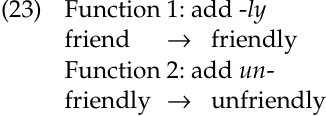
We can even go on to form unfriendliness from unfriendly via a function that adds -ness. In each case, the output of one derivation serves as the input to the next.
To determine the order of functions leading to a form, it helps to consider other words that contain the same parts. Consider the example of unfriendly. Un- attaches to nouns only in exceptional cases (for example, uncola, a word once used in an ad campaign for a particular soda). However, it regularly attaches to adjectives. We use this fact in determining that the function ‘Add -ly’, which forms adjectives, must come before the function ‘Add un-’.
Let’s go back to the compound we came across earlier: high voltage electricity grid systems supervisor. This compound clearly has an internal structure. [High voltage] is a compound, as are [electricity grid] and [systems supervisor]. [ [High voltage] [electricity grid] ] is also a compound, and in turn, [ [ [high voltage] [electricity grid] ] [systems supervisor] ]. We have taken English words, made compounds of them, and then used those compound words to yield further compound words. The output of the first compounding function serves as the input to the second and third compounding functions.
The same occurs with any kind of affix, and this gives derivational morphology a great deal of power. We can think of derivation as always being binary in a sense. We take a form and apply a function to it. We then take the output of that function and perform another function on it. We can keep on going, getting bigger and bigger things, simply by adding one thing at a time. (When we get to inflection, we will see that this is not always the case.)
The fact that speakers of many languages can add phonological material to either end of a word sometimes leads to complex structures. Take the two English words in (24):
(24) a. reinterpretation
b. poststructuralist
These words have the following structures:
(25) a. [ [re- [interpret]V ]V -ation]N
b. [post- [ [ [structur]N -al]A -ist]A ]A
(25a) tells us that reinterpretation is the act of reinterpreting, from reinterpret, not re- the act of interpreting. We start out with a verb, interpret, form a new verb via the prefix re-, and finally form a noun by adding the suffix -ation. In the case of poststructuralist, we start out with the noun structure, make an adjective via the adjectival suffix -al, create a new adjective by adding the suffix -ist, and a further one by adding the prefix post-. Poststructuralist (structuralist, too) can in turn be made into a noun by zero-derivation.
The bracketing structures in (25) are convenient, in part because they are so compact. But the structure of morphologically complex words is made most clear when we use tree diagrams, like the following:
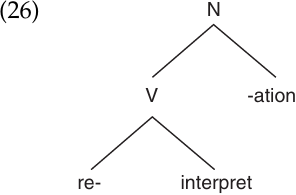
This diagram clearly shows that re- and the verb interpret form a unit, a verb, which attaches to the noun-forming suffix -ation. In order to draw a tree diagram, it is first necessary to break a word down into its components and to fully understand how they fit together.
The following argument demonstrates that even identical strings may have distinct structures. Consider the structure of the two words pseudonaturalistic and supernaturalistic:
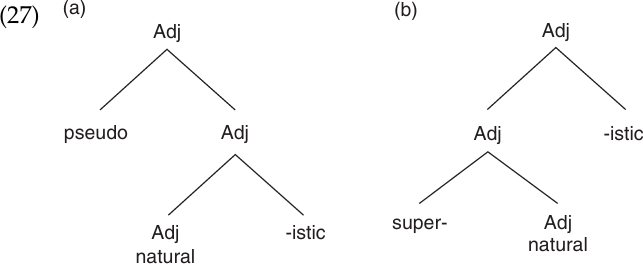
In both cases we start out with the adjective natural, which we purposely have not broken down into nature and -al, although we could have. In (27a) we first make a new adjective, naturalistic, which we then modify with the prefix pseudo-, yielding a word with the meaning ‘falsely naturalistic’. In (27b), however, we take the adjective natural and add the prefix super- to it, giving supernatural ‘pertaining to an existence outside the natural world’. It is to this form that we add the suffix -istic. English morphology is such that we could form a different supernaturalistic, this time with the same structure as pseudonaturalistic in (27a). This supernaturalistic would mean ‘really naturalistic’.1
Combining prefixation and suffixation leads to other potentially ambiguous forms in English. Three famous examples are given in (28):
(28) a. undressed
b. unpacked
c. unzipped
The ambiguity of the forms in (28) is due to the fact that the prefix un- has at least two distinct roles in English, depending on what it attaches to. When prefixed to a verb, un- is a so-called reversative with the basic meaning ‘undo the action of the verb’. If you unpack a suitcase, you return the suitcase to the state it was in before the packing action took place. If you untie a package, you return it to the state it was in prior to being tied. When attached to adjectives, including participial adjectives like wounded or stressed, un- means ‘not’. If a soldier leaves the battlefield unwounded, it is not the case that he was first wounded and then unwounded, because it is impossible to unwound a person (we say instead that we cure them). The soldier in question is ‘not wounded’. This second un- is the one we see in forms like unafraid, uncertain, and un-American.
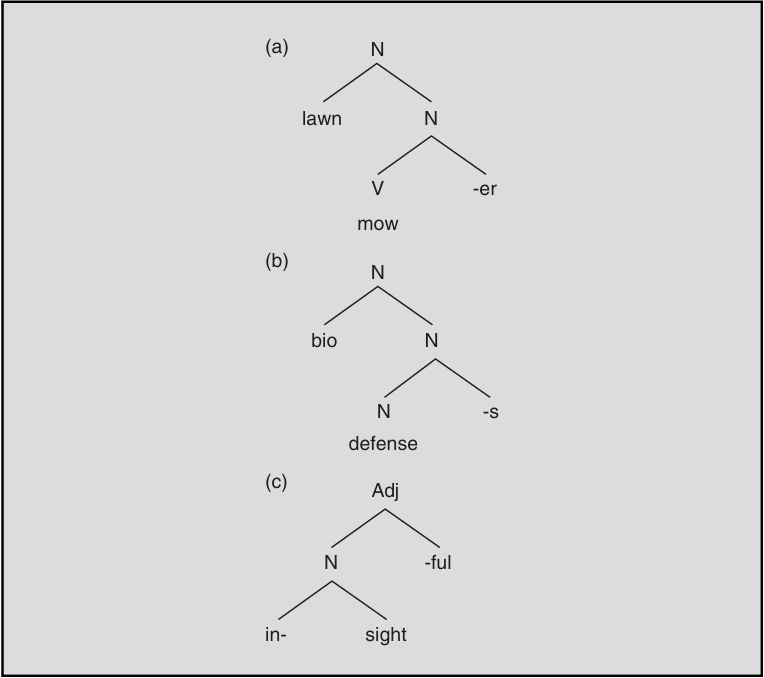
Our analysis of an example like unzipped (28c) depends on our interpretation of its prefix un-. One possibility is that its structure is as follows:
(29) [ [un-zip(p)] ed]
Here the prefixation of the reversative un- yields the meaning ‘cause to be zipped no longer’. The suffix -ed is then added to create the past tense or the past participle. The second possibility is that unzipped has the structure in (30):
(30) [un- [zipped] ]
This form has the meaning ‘not zipped’, or, in the case of a computer file, ‘having never been stored on a zip disk’. The crucial semantic distinction between (29) and (30) is that only (29) requires that a zipping action have taken place at some past point. Structurally, (29) and (30) differ in the ordering of the affixation processes. Morphological structure depends not only on the elements you use, but on the order in which the elements have been applied.
Let’s look at some other words. Is unwashed ambiguous? It is not; we cannot unwash something. Unwashed can only mean ‘not washed’. Similarly, undisturbed can only mean ‘not disturbed’. The only word we know of that works the other way is unraveled. Although English speakers do not use it very often, there is a verb ravel. But it means the same thing as unravel: ‘separate or undo the threads or fibers of something’. As a result, if something is unraveled, it cannot mean ‘not raveled’. It can only mean that it has come undone.
Bloomfield (1933) provides us with more complicated examples of this sort from Tagalog. Tagalog is like English in that you can add things to the front and to the end of a word or stem. But unlike in English, you can also put things in the middle. As a result, the order of operations and the linear order are not reflective of one another at all.
The following set of examples involves reduplication of the first syllable (31b) and infixation of -um- (31c) (Bloomfield 1933: 221). The failure of the infix to participate in reduplication tells us that the infix is not inserted until after the first syllable has been reduplicated. Otherwise, we would expect *tutuma:wa, which we don’t find:

As Bloomfield shows us (p. 222), Tagalog also has forms like those in (32) which involve the same operations, reduplication and infixation, but in the opposite order:

We see in (32c) that the reduplicated syllable pu- includes the vowel of the infix -um-. This tells us that in this construction, infixation precedes reduplication. If reduplication had preceded infixation, we would have expected the non-occurring form *pumi:pi:lit.
The next set of examples raises still another issue (p. 222):

We begin with pu:tul ‘cut’ (33a). If we add the prefix paŋ- to it, the final nasal /ŋ/ coalesces with the following stop, yielding [m] (33b). We then reduplicate the first syllable of the internal stem, giving (33c). The reduplication doesn’t take place at the beginning of the word; it takes place inside. Ordering reduplication before prefixation yields the wrong form:

With this example, Bloomfield shows that the linear order and the structural order of a set of elements can be different.
Once Tagalog speakers form the word pamu:tul (33b), they retain its internal structure, and this enables them to reduplicate the initial syllable of a stem, even when it is buried within the layer of an intermediate derivation. Some linguists claim that this isn’t possible, but their view is contradicted by evidence across languages that speakers can reach inside morphologically complex forms and pull out an internal piece. In the morphological literature this goes by the unfortunate name of head operation, because such an operation generally involves the head or stem of a word. Consider the following English examples:

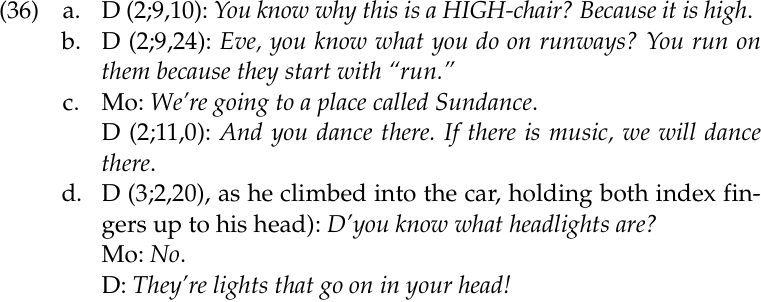
The fact that the plural of flower child is flower children instead of *flower childs means that speakers apply the pluralization operation to the head of the compound, child, which has an unproductive, irregular plural ending, instead of to the compound as a whole. Similarly, to pluralize frogman, you pluralize its head, leading to frogmen. Head operations are possible because word-level morphology is a two-way street where creation of word forms is as much a part of the human language faculty as is their analysis. Again, we can cite evidence for this from child language acquisition. Clark (1993: 404) uses the examples below to illustrate that, at an early age, children are able to analyze the complex word forms that they hear:
1 For expository purposes, we left -istic as it is, although it is of course made up of two suffixes, -ist and -ic.








