GIVEN AND NEW INFORMATION
The distribution of ‘Given’ and ‘New’ information is to a great extent the motivation for the information unit. Each information unit contains an obligatory ‘New’ element, which is associated with the tonic of the tone unit, the focus of information. There can also be optional ‘Given’ elements of information, which are associated with the rest of the tone unit. Rather than a clear-cut distinction between ‘Given’ and ‘New’, however, there is a gradation of givenness and newness. This is compatible with the notion of communicative dynamism, by which the message typically progresses from low to high information value.
The Given element is concerned with information that the speaker presents as recoverable by the hearer, either from the linguistic co-text, that is, what has been said before, or because it can be taken as ‘known’ from the context of situation or the context of culture. The New element is concerned with whatever information the speaker presents as not recoverable by the hearer. The following exchange illustrates the possible relationship of Given and New to information focus:
A. What’s NEW then?
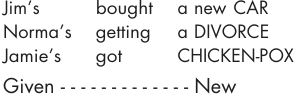
B. Well, Jim’s bought a new CAR, //, Norma’s getting a DIVORCE // and Jamie’s got CHICKEN-POX //, but apart from that . . .
In each tone unit, the tonic syllable, identified here by capitals, represents the culmination of the New information. The syntactic unit in which the tonic occurs (a new CAR, a DIVORCE, CHICKEN-POX) is in each case ‘in focus’. The referents of the proper names Jim, Norma and Jamie are treated as identifiable and Given, or at least accessible, in the discourse situation (that is the function of proper names) and there is a gradation from Given to New, with the verbs bought, getting and got marking the transition: