REFERRING TO PEOPLE AND THINGS AS DEFINITE, INDEFINITE, GENERIC
DEFINITE AND INDEFINITE REFERENCE
In English, the grammar obliges us to refer to people and things as definite, indefinite, or generic. This is done syntactically by the use of determinatives, and among these, in particular, by the definite, indefinite and zero articles. Definite reference is made by the or a deictic determinative (this, that, these, those) or a possessive (my, your, etc.). Indefinite reference is made by a(n), unstressed some, any or the absence of a marker, which, since its absence is grammatically significant, is called the ‘zero article’. ‘Zero’ doesn’t mean that an article has been omitted, as may occur in a newspaper headline, such as Plane crashes on village, but is a category in its own right.
The three articles are distributed as follows with mass and count nouns:
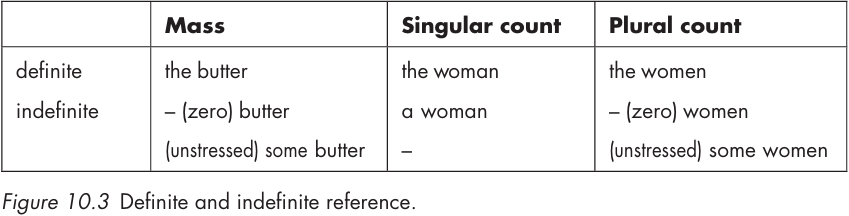
An entity is considered as ‘indefinite’ if there is nothing in the discourse or the situation or our general knowledge of the world that identifies it for us. This is the case with an amateur musician, a 70-strong orchestra, a violinist, all introduced for the first time by the indefinite article a(n) in the news item from The Week below:
An amateur musician has formed a 70-strong orchestra by approaching strangers on the London Underground. Shaun Buswell, 36, came up with the idea after meeting a violinist on the Tube in 2011. Having drawn up rules – musicians had to be carrying their instruments when he met them – he approached more than 300 people in 12 months. His orchestra, which includes students from the Royal Academy of Music, played their first gig at the Shepherd’s Bush Empire on Saturday, raising money for a children’s charity.
Once the entity has already been mentioned it can be considered as ‘definite’: Shaun Buswell, his orchestra. Definiteness is inferred if there is sufficient information to identify it, either in the text (the idea) or in the non-linguistic situation (the London Underground, their first gig) or in general knowledge (the Tube). Note that the gig had not been previously mentioned. We identify it in relation to orchestra and musician through general knowledge and inference: gigs are performances, especially by pop musicians. This is known as indirect anaphoric reference.








