MIXED PRE-MODIFIERS AND THEIR ORDERING
Between the head of a NG and the other elements, there is one basic logical relationship, that of successive dependency: leftwards from the head to the pre-head elements and rightwards in the case of the post-head elements, as indicated by the arrows in the following example:
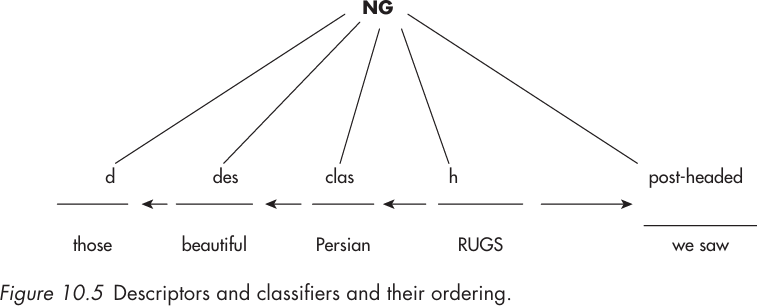
Within this logical framework, speakers seem to use semantic criteria, based on degrees of permanence and objectivity, to decide the order of pre-modifiers. Those properties perceived as permanent, intrinsic and undisputed are placed nearest the head of the nominal group. Those that are more variable, subjective or attitudinal are placed further from the head.
Immediately to the left of the head is the classifier, since this is the closest relationship, as in Persian rugs, radio program, park entrance, leather suitcases.
Where there is more than one classifier, affiliation precedes substance as in German leather suitcases, Indian lamb curry. If there is no affiliation, substance precedes other classifiers (steel medical instrument, cotton gardening gloves).
The next place, moving to the left, is occupied by color adjectives, and before them come any participial modifiers (battered brown German leather suitcases, stained blue plumbers’ overalls). Preceding these are the most central adjectives, such as tall, young, long, hot. At the start of the list are the attitudinal adjectives – such as beautiful, ugly, marvelous, horrible, nice, nasty – after any determinatives. This is the unmarked order, which causes us to say:
a large oil tanker and not *an oil large tanker
increased income tax rebates and not *income tax increased rebates
a beautiful blue silk scarf and not *a silk beautiful blue scarf
a nice hot Indian curry and not *a hot Indian nice curry
Participial modifiers can occupy various positions. Those that are verbal nouns, such as gardening in gardening gloves, always stay close to the head noun, whereas those that have become gradable adjectives, such as interested, bored, exciting, may occur nearer the determinative, if there is one. If the participial seems to have an evaluative tinge, it is even more likely to precede other adjectives:
interested foreign spectators
an exciting new adventure story
a battered old leather suitcase
The following extract from All American Girl shows how a teenager sees herself at a particular moment:
I stood on the kerb across from the Founding Church of Scientology, squinting into the light drizzle and headlights in the direction Theresa was supposed to come. As I stood there, I couldn’t help feeling kind of sorry for myself. I mean, there I was, a fifteen-year-old, left-handed, red-headed, misunderstood middle-child reject, broke, standing in the rain after skipping her drawing-class because she couldn’t take criticism.








