Realization(s): Systemic-Functional Linguistics and the Language Classroom
SYSTEMIC FUNCTIONAL LINGUISTICS
Over the last 15 years, SFL has had a strong impact in Australia on curriculum development in English, literacy, and child and adult ESOL programs. In many undergraduate and postgraduate programs, SFL is now taught as a major linguistic theory to students enrolled in education and linguistics courses. Yet, very little research has looked at how ESOL teachers draw on SFL or what role it plays in their pedagogical practices and decisions.
Systemic functional linguistics (SFL) is a text-based theory of language. The key questions and applications of the theory revolve not around the syntax of sentences, but around the functions of texts in context. Language is seen as a social resource; meanings are negotiated in social contexts by social beings (see Burns & Coffin, 2001; Butt et al., 2000; de Silva Joyce & Burns, 1999; Eggins, 1994; Gerot & Wignell, 1994; Halliday, 1985; Halliday & Hasan, 1989; Hammond, Burns, Joyce, Brosnan & Gerot, 1992; Martin, 1992).
Language is structured in response to the social functions it serves. This relationship between social context and text is an integral element of the theory; language is conceived in terms of levels or strata rather than components, and the relationship between the levels is one of realization, where ‘higher’ level meanings are realized in ‘lower’ levels. This can be represented diagrammatically as follows (cf. Martin, 1992, 1997).
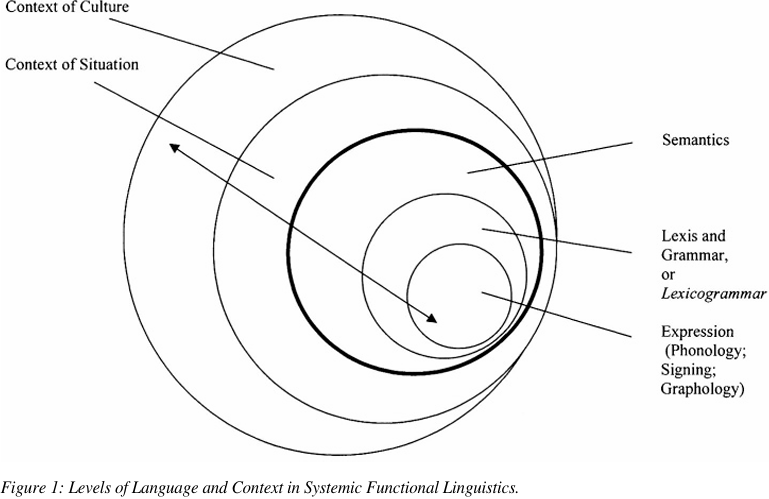
Despite this principle of ‘lower’ levels realizing ‘higher’ levels, it is important to note also that the relationships between the strata are dialectic, so that changes in phonology affect lexicogrammar, which in turn affects semantics, and so on.
Another key feature of systemic functional linguistics is that the text, not the sentence, is the fundamental unit of analysis. To illustrate this model of language, we present a short text: the headline and lead from the ‘General News’ page of the online version of The Bangkok Post from February 26, 2002.
Shelters might be built to stop elephants begging for food
The Forest Industry Organization plans to build elephant shelters to help ease the suffering of elephants forced to roam the city streets to beg for a living, managing director Chanatt Lauhawatana said yesterday.
With reference to the context of culture in Figure 1, we can say that social processes are realized and recognized textually in typical ways within particular cultures. ‘When texts share the same general purpose in the culture, they will often share the same obligatory and optional structural elements and so they belong to the same genre” (Butt et al., 2000: 9). The shared purpose of the genre to which the text under discussion belongs is to provide the essential information, or nucleus of a news story to the reader, and to provide a link to the text from which it derives. The structural elements include an obligatory Abstract (the headline), and an obligatory Event (the lead) entailing one or more actors, an action, a setting (cf. Bell, 1998).
The specific text that emerges from any context of situation relates to three register variables, field, tenor, and mode. Together these three variables determine the language choices made by the speaker or writer at the levels of semantics and lexicogrammar as shown in Figure 1.
⁰ The field may be glossed as the topic – in this instance the plight of elephants and a proposed measure to mitigate the problem. This variable of the situational context is expressed through the experiential grammar, the means by which we tell ‘what happens to whom under what circumstances’. In the short text above, ‘what happens’ is construed largely by the verbal group plans to build and the verb said. The ‘who’ and ‘whom’ include the nominal groups The Forest Industry Organization, elephant shelters, and Managing director Chanatt Lauhawatana. The ‘circumstances’ include the purpose of the elephants’ begging (for a living), and the time the statement was made (yesterday).
⁰ The tenor may be glossed as the relationship between the writer/speaker and reader/hearer – in this instance the social roles are of journalist and reader, the status is unequal (in that the journalist has knowledge of the event being imparted), and the social distance is large. This variable of the situational context is expressed through the interpersonal grammar, the means by which we position ourselves in relation to others through the texts we create. In the instance of the short text above, the role of the writer is to give information to the reader, not to ask for information as is the role of, for example, an interviewer; thus the three finite clauses in this text are declarative. As a relative authority on this event, the writer is not required to negotiate the status of the facts reported with the reader, so they are presented directly; there is no use of hedging or modalization (with the exception of might in the headline).
⁰ The mode may be glossed as the role of language: whether written or spoken, language as action or language as reflection In this instance the medium is written, and the language is reflective in that it plays no active part in creating the activity it reports. This variable of the situational context is expressed through the textual grammar, the means by which we construct coherent, cohesive, meaningful texts in context. The high number of content words (e.g. build, suffering; 30 including those in the headline) as opposed to function words (e.g. for, to; 13 including those in the headline) helps to identify this as a written text, in addition to the complex nominal groups and high level of embedding (e.g. the suffering of elephants forced to roam the city streets to beg for a living).
Thus, the perspective on grammar taken in SFL is semantic and functional. Grammatical elements are identified and classified in terms of the kind of meaning they are expressing and the grammatical role they are playing, rather than their grammatical class (noun, verb and so on).








