Researching the Effectiveness of Professional Development in Pragmatics
THE PROFESSIONAL DEVELOPMENT PROJECT IN PRAGMATICS
The motivation to investigate complex requests grew out of an earlier study conducted in the AMEP (Wigglesworth 2000b, 2001), in which data were collected from learners doing requested tasks orally with a teacher or trained assessor. It was noted that the learners were able to use only very minimal mitigation strategies and devices, and sounded abrupt, and even rude. This project was designed to investigate how native speakers might perform these tasks so that we could make recommendations about the kinds of devices non-native speakers might need to know in order to complete these tasks more successfully. The project was specifically designed to involve teachers as researchers because we felt this would be a good way of raising their awareness of mitigation pragmatics, and of harnessing their pedagogical expertise to develop appropriate materials to address these areas in the classroom.
Thus we had three broad aims: firstly, to enable a small group of teachers to help develop a description of the verbal mitigation behavior used by native speakers in the performance of oral request tasks which could be compared to non-native speaker performances from the earlier project. Secondly, to develop with the teachers’ materials drawing attention to mitigation pragmatics, which could be transmitted to other teachers through workshops and other professional development exercises. Thirdly, to investigate the impact of the project on both the language awareness and the teaching practice of the teachers involved, i.e. to research our own practice as applied linguists offering professional development to teachers.
The project was designed in two phases. In the first phase, a small group of five teachers were engaged in the empirical investigation of both native and non-native request task performance data. They then developed and trialed teaching materials based on the findings. In the second phase, we used these materials to conduct workshops designed to raise awareness among larger groups of teachers, and to offer them teaching strategies they could use in the classroom. The project was designed to enhance the areas of teacher knowledge proposed by Shulman (1986) as shown in Figure 1.
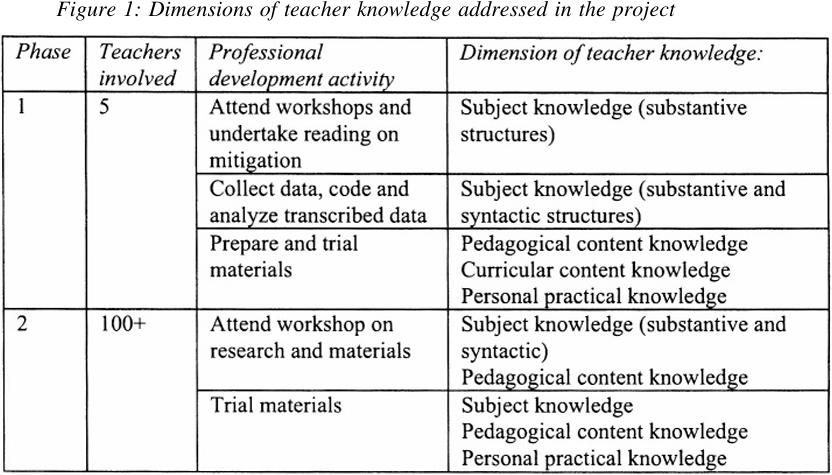
In order to identify and evaluate teacher reactions to the project, we encouraged teachers to reflect on their learning. We did this through a focus group discussion and an individual interview with each teacher. These allowed us to probe in depth how they felt about their involvement in the project how it had influenced their teaching, and how they thought it had shaped their views of language. In the second phase, the reactions of the larger group of teachers were evaluated through a series of brief questionnaires designed to evaluate their knowledge of mitigation pragmatics, and to investigate the impact of the workshops on their subsequent teaching practice.








