0
settings
الوضع الليلي
moon
انماط الصفحة الرئيسية arrow
EN
1
المرجع الالكتروني للمعلوماتية

Grammar

Tenses

Present

Present Simple

Present Continuous

Present Perfect

Present Perfect Continuous

Past

Past Simple

Past Continuous

Past Perfect

Past Perfect Continuous

Future

Future Simple

Future Continuous

Future Perfect

Future Perfect Continuous

Parts Of Speech

Nouns

Countable and uncountable nouns

Verbal nouns

Singular and Plural nouns

Proper nouns

Nouns gender

Nouns definition

Concrete nouns

Abstract nouns

Common nouns

Collective nouns

Definition Of Nouns

Animate and Inanimate nouns

Nouns

Verbs

Stative and dynamic verbs

Finite and nonfinite verbs

To be verbs

Transitive and intransitive verbs

Auxiliary verbs

Modal verbs

Regular and irregular verbs

Action verbs

Verbs

Adverbs

Relative adverbs

Interrogative adverbs

Adverbs of time

Adverbs of place

Adverbs of reason

Adverbs of quantity

Adverbs of manner

Adverbs of frequency

Adverbs of affirmation

Adverbs

Adjectives

Quantitative adjective

Proper adjective

Possessive adjective

Numeral adjective

Interrogative adjective

Distributive adjective

Descriptive adjective

Demonstrative adjective

Pronouns

Subject pronoun

Relative pronoun

Reflexive pronoun

Reciprocal pronoun

Possessive pronoun

Personal pronoun

Interrogative pronoun

Indefinite pronoun

Emphatic pronoun

Distributive pronoun

Demonstrative pronoun

Pronouns

Pre Position

Preposition by function

Time preposition

Reason preposition

Possession preposition

Place preposition

Phrases preposition

Origin preposition

Measure preposition

Direction preposition

Contrast preposition

Agent preposition

Preposition by construction

Simple preposition

Phrase preposition

Double preposition

Compound preposition

prepositions

Conjunctions

Subordinating conjunction

Correlative conjunction

Coordinating conjunction

Conjunctive adverbs

conjunctions

Interjections

Express calling interjection

Phrases

Sentences

Clauses

Part of Speech

Grammar Rules

Passive and Active

Preference

Requests and offers

wishes

Be used to

Some and any

Could have done

Describing people

Giving advices

Possession

Comparative and superlative

Giving Reason

Making Suggestions

Apologizing

Forming questions

Since and for

Directions

Obligation

Adverbials

invitation

Articles

Imaginary condition

Zero conditional

First conditional

Second conditional

Third conditional

Reported speech

Demonstratives

Determiners

Direct and Indirect speech

Linguistics

Phonetics

Phonology

Linguistics fields

Syntax

Morphology

Semantics

pragmatics

History

Writing

Grammar

Phonetics and Phonology

Semiotics

Applied Linguistics

Reading Comprehension

Elementary

Intermediate

Advanced

Teaching Methods

Teaching Strategies

Assessment

قم بتسجيل الدخول اولاً لكي يتسنى لك الاعجاب والتعليق.

Teacher Trainees’ Explicit Knowledge of Grammar and Primary Curriculum Requirements in England DATA COLLECTION

المؤلف:  Jane Hislam & Wasyl Cajkler

المصدر:  Applied Linguistics and Language Teacher Education

الجزء والصفحة:  P299-C17

2026-09-07

40

+

-

20

Teacher Trainees’ Explicit Knowledge of Grammar and Primary Curriculum Requirements in England

DATA COLLECTION

At the beginning of the PGCE year (September, 2001, through to June), we analyzed general language awareness audits of 28 trainees (4 male, 24 female), categorizing each according to achievement and declared level of confidence. These audits sought to identify broad understanding of language and levels of confidence. As a result, we found that trainees could be grouped in four categories:

High confidence, high language awareness score (6)

Low confidence, high score (4)

High confidence, low score (9)

Low confidence, low score (9).

(Confidence measured by trainee self-assessment on a scale 0-5)


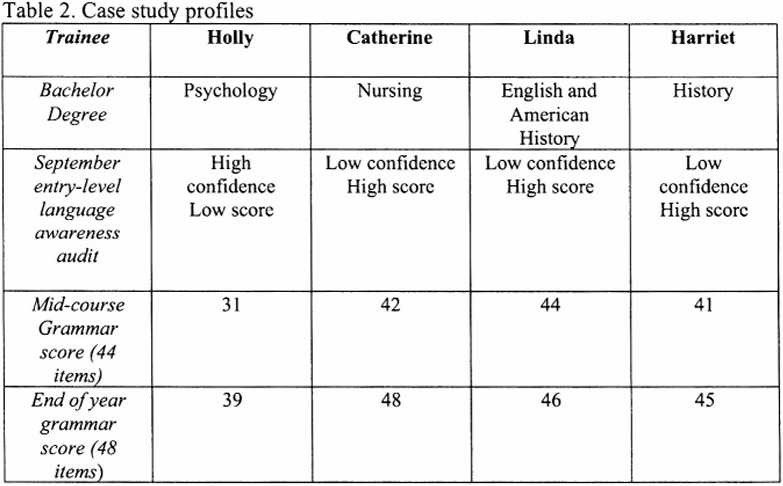
The 28 trainees then completed grammar audits in November, which tested ability to recognize nouns, verbs, prepositions, conjunctions, adverbs, adjectives, simple, compound and complex sentences. This activity was repeated at the end of the year in June to measure exit level understanding. Following the November audit, we asked for volunteers to engage in case studies of their grammar learning and teaching. Six people volunteered but only four were able to complete the activities. We were therefore unable to include an example of ‘high confidence, high score’. Profiles of trainees, re-named Holly, Catherine, Linda and Harriet to preserve anonymity, can be seen in table 2.


The entry and the first grammar audits showed that the trainees were at different stages with regard to grammatical knowledge and levels of confidence. The mid-course grammar scores suggested that Harriet had made significant efforts following the initial language awareness audit. She reported that she had made use of the self-access language study guide issued at the start of the course. Holly made progress during the


year but remained the lowest achiever in grammar audits. She could identify simple, compound and complex sentences and underline verbs in the same sentences without hesitation. She still had issues to address, notably the issue of functional shift with words like round, dash in the sentence:

I peep round the door then make a quick dash ...(from The Ankle Grabber by Rose Impey).


In this respect, she was similar to many of the 28 participants who completed entry and exit audits. Catherine and Linda began the year with high scores but low confidence.


اشترك بقناتنا على التلجرام ليصلك كل ما هو جديد

