Cognitive approaches to grammar
Cognitive Grammar
Word classes and grammatical functions in Cognitive Grammar
The view of language as an integral part of human cognition rather than as an independent module has also important repercussions for the analysis of traditional notions such as grammatical (or syntactic) functions (also known as grammatical/syntactic relations or roles) and word classes (also known as parts-of-speech or lexical categories). In particular, Cognitive Grammar, adopts (at least, in some cases) a universalist stance towards both grammatical functions and word classes (but not in the same sense as in Radical Construction Grammar, as will be pointed out below).
In Cognitive Grammar, “subject” for example is regarded as a universal notion ultimately based on the (perceptual) distinction between figure and ground, viz. trajector and landmark, configurations in a scene. As is well-known from Gestalt psychology (see Ungerer and Schmid 1996: Ch. 4 for an overview), certain objects function as primary foci of attention (e.g. smaller and/or moving objects as opposed to larger, static objects). A sentence like The table is under the book (employed to convey the scene depicted by The book is on the table) is felt to be deviant because it reflects a non-canonical perception of the intended spatial configuration. A smaller object like a book is usually chosen as the primary focus of attention (or trajector, in Cognitive Grammar terminology) whereas a larger object like a table functions as a secondary focus of attention (or landmark, in Cognitive Grammar terminology).
Cognitive Grammar proposes that subject is a universal category in that it can be defined schematically by characterizing it as a clause-level trajector. Similarly, object can be defined schematically as a clause-level secondary figure or landmark.
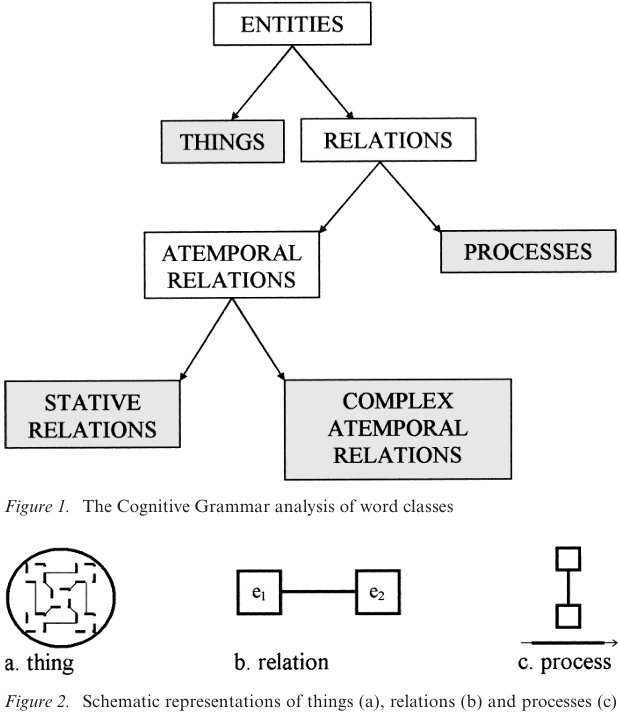
In addition to its schematic conception of grammatical relations, Cognitive Grammar also provides a schematic characterization of word classes. Cognitive Grammar contends that parts-of-speech can not only be defined prototypically (e.g. a noun prototypically refers to a physical object) but can also be described in a manner which is valid for all its other instantiations (i.e. a noun describes a “thing”). In other words, an “invariant” can be found for all major lexical categories. The Cognitive Grammar analysis of (the semantic pole of) word classes is summarized diagrammatically in Figure 1 (shaded boxes indicate concepts that are possible semantic poles for words; for example, the higher category of entities, unlike that of things, does not correspond to any particular word class). We start with the very general category of entities, which can be divided into things and relations. A “thing”, a technical term in Cognitive Grammar, is a set of interconnected entities and is the semantic pole of the noun class. For example, the noun team (see Langacker 1987: 197) profiles a set of entities (represented in Figure 2a as the dashed boxes connected to each other) rather than singling out any constitutive member. The bold circle visually represents such a set in Figure 2a. “Relations”, by contrast, profile connections between entities (as well as the entities themselves), as is shown for two arbitrary entities e1 and e2 in Figure 2b. Relations can be either processes (or temporal relations) or atemporal relations. In order to distinguish between the two, Cognitive Grammar contends that we can process complex scenes in two different ways. The different facets of a scene (e.g. the constitutive parts of a kissing event) are conceptualized either successively (as in a motion picture) or as a single Gestalt (as in a photo with multiple exposures, where the various parts are all made available simultaneously). The former mode of cognitive processing is called sequential scanning while the latter is referred to as summary scanning. Processes are said to involve sequential scanning: the different facets of a process are accessed sequentially, one after the other. Processes, depicted schematically in Figure 2c, constitute the semantic pole of verbs (e.g. kiss). The bold (temporal) line in Figure 2c represents the fact that the relation in question has a positive temporal profile, i.e. is scanned sequentially. By contrast, atemporal relations have a “null” temporal profile. This means that they are scanned summarily. Atemporal relations come in two types: stative relations and complex atemporal relations. Stative relations involve a single, stable configuration through time and correspond to the semantic pole of adjectives (i.e. stative relations whose trajector is a noun and whose landmark is a region on a scale), adverbs (i.e. stative relations whose trajector is a process and whose landmark is a region along a scale), and static prepositions (such as in, as opposed to into). Complex atemporal relations (e.g. into) are made up of more than one configuration over time and such configurations or facets are scanned in summary fashion.