Astronaut Tether
An astronaut of total mass 110 kg was doing an EVA (spacewalk, see Figure 1.1) when his jetpack failed. He realized that his only connection to
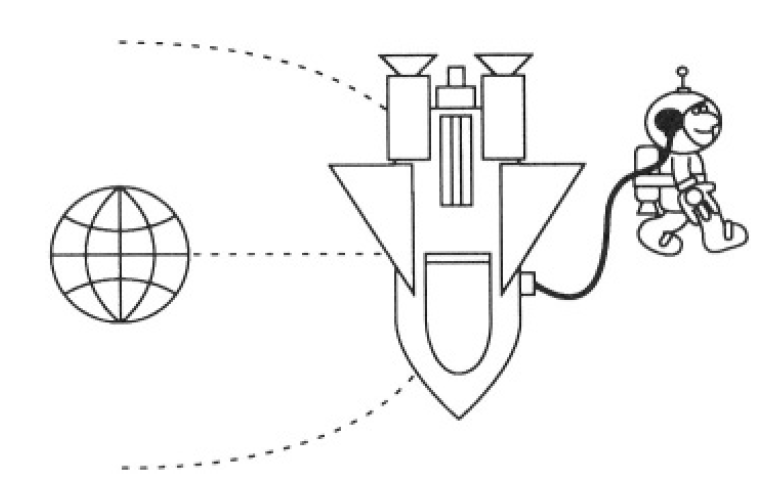
Figure 1.1
the spaceship was by the communication wire of length L = 100 m. It can support a tension of only 5 N before parting. Estimate if that is enough to keep him from drifting away from the spaceship. Assume that the height of the orbit is negligible compared to the Earth's radius (R = 6400 km). Assume also that the astronaut and the spaceship remain on a ray projecting from the Earth’s center with the astronaut further away from the Earth.
SOLUTION
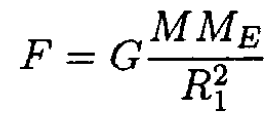
The spaceship moves under the influence of the Earth’s gravity, given by
 (1)
(1)
where M is the mass of the spaceship, ME is the Earth’s mass, R1 is the distance between the center of the Earth and the ship, and G is the gravitational constant (see Figure 1.2). We may write for the spaceship
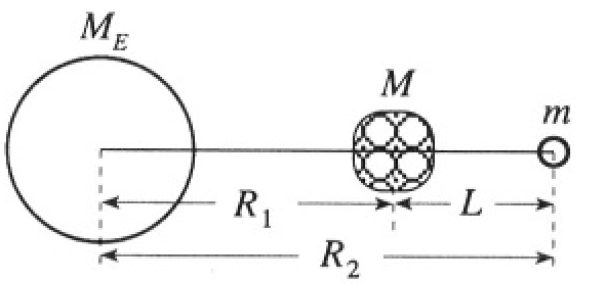
Figure 1.2
 (2)
(2)
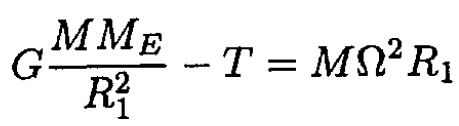
where Ω is the angular velocity of the ship and T is the tension of the communication cable. Similarly, for the astronaut,
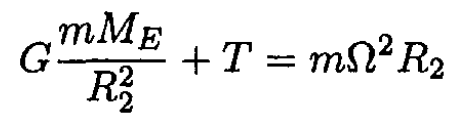 (3)
(3)
where m is the mass of the astronaut, R2 is the radius of the orbit of the astronaut, and Ω is the angular velocity of his rotation about the Earth. Obviously, we can write (2) and (3) with the same angular velocity only for the specific case where the spaceship and the astronaut fall on a ray from the Earth’s center. Equating Ω from (2) and (3), we obtain
 (4)
(4)
From equation (4), we can easily find the tension T :

Using we R1 ≈ R2 ≈ R, R32 – R31 = (R2 – R1)(R22 + R1R2 + R21) ≈ 3R2L, can rewrite T in the form:

where is the acceleration on the surface of the Earth. Also, since M >> m, we can write an even simpler formula as an estimate:

Hence, the wire would withstand the tension of holding the hapless astronaut in tow.








