Grammar
Tenses
Present

Present Simple
Present Continuous
Present Perfect
Present Perfect Continuous
Past
Past Simple
Past Continuous
Past Perfect
Past Perfect Continuous
Future
Future Simple
Future Continuous
Future Perfect
Future Perfect Continuous
Parts Of Speech
Nouns
Countable and uncountable nouns
Verbal nouns
Singular and Plural nouns
Proper nouns
Nouns gender
Nouns definition
Concrete nouns
Abstract nouns
Common nouns
Collective nouns
Definition Of Nouns
Animate and Inanimate nouns
Nouns
Verbs
Stative and dynamic verbs
Finite and nonfinite verbs
To be verbs
Transitive and intransitive verbs
Auxiliary verbs
Modal verbs
Regular and irregular verbs
Action verbs
Verbs
Adverbs
Relative adverbs
Interrogative adverbs
Adverbs of time
Adverbs of place
Adverbs of reason
Adverbs of quantity
Adverbs of manner
Adverbs of frequency
Adverbs of affirmation
Adverbs
Adjectives
Quantitative adjective
Proper adjective
Possessive adjective
Numeral adjective
Interrogative adjective
Distributive adjective
Descriptive adjective
Demonstrative adjective
Pronouns
Subject pronoun
Relative pronoun
Reflexive pronoun
Reciprocal pronoun
Possessive pronoun
Personal pronoun
Interrogative pronoun
Indefinite pronoun
Emphatic pronoun
Distributive pronoun
Demonstrative pronoun
Pronouns
Pre Position
Preposition by function
Time preposition
Reason preposition
Possession preposition
Place preposition
Phrases preposition
Origin preposition
Measure preposition
Direction preposition
Contrast preposition
Agent preposition
Preposition by construction
Simple preposition
Phrase preposition
Double preposition
Compound preposition
prepositions
Conjunctions
Subordinating conjunction
Correlative conjunction
Coordinating conjunction
Conjunctive adverbs
conjunctions
Interjections
Express calling interjection
Phrases
Sentences
Grammar Rules
Passive and Active
Preference
Requests and offers
wishes
Be used to
Some and any
Could have done
Describing people
Giving advices
Possession
Comparative and superlative
Giving Reason
Making Suggestions
Apologizing
Forming questions
Since and for
Directions
Obligation
Adverbials
invitation
Articles
Imaginary condition
Zero conditional
First conditional
Second conditional
Third conditional
Reported speech
Demonstratives
Determiners
Linguistics
Phonetics
Phonology
Linguistics fields
Syntax
Morphology
Semantics
pragmatics
History
Writing
Grammar
Phonetics and Phonology
Semiotics
Reading Comprehension
Elementary
Intermediate
Advanced
Teaching Methods
Teaching Strategies
Assessment

Discourse processing
 المؤلف:
Jonathan Culpeper and Michael Haugh
المؤلف:
Jonathan Culpeper and Michael Haugh
 المصدر:
Pragmatics and the English Language
المصدر:
Pragmatics and the English Language
 الجزء والصفحة:
139-5
الجزء والصفحة:
139-5
 13-5-2022
 876
876




+
-
20
Discourse processing
The question of how users understand pragmatic meaning can also be approached from the perspective of the emergent notion of Verständigung (“coming to an understanding”). Consider, for instance, how in the following recording of a conversation between two friends, they reach a converging understanding over a number of turns that Charlie won’t be able to give a ride to Ilene, despite having previously promised to do so:
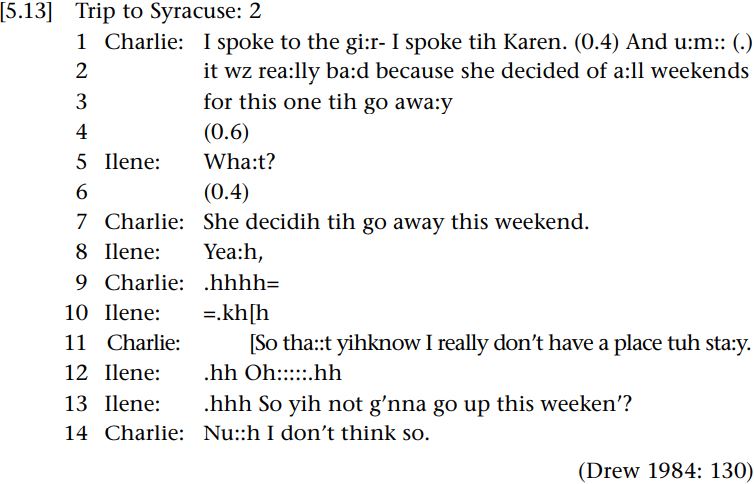
Charlie outlines potential trouble for their forthcoming trip to Syracuse when he reports that Karen is going away (lines 1–7), and so he doesn’t have anywhere to stay (line 11). This is taken by Ilene as indicating that Charlie won’t be able to go up to Syracuse, an understanding that is evident from her formulation of the upshot of his reporting (line 13), and subsequently confirmed by Charlie (line 14). Note, however, that Charlie has managed to indicate to Karen that he won’t be able to give her a ride without having said as such, and, more importantly, that this joint understanding only emerges over a number of turns of talk.
In the above example we can see that the interpretation of utterances and turns by the two participants proceeds in an incremental fashion, and is dependent on what precedes and follows in sequence. Work on understanding pragmatic meaning from a discourse perspective thus focuses on the incremental and sequential intertwining of two or more participation footings. Incrementality refers to the processing of elements or components of pragmatic meaning within the same utterance or turn, while sequentiality refers to the processing of meaning across different speaker turns. Utterer and recipient representations of speaker meaning (as well as recipient meaning) become intertwined through participants incrementally interpreting utterances and displaying those understandings in sequences. The question of whose meaning is at issue, which we have discussed, thus proves critical to any discourse-based account of how users understand pragmatic meaning.
The importance of incrementality in understanding meaning can be seen from the way in which users can use emerging syntax to project future talk, for instance. Consider the following excerpt from a recording of a conversation between Dianne and Claica, who are talking about a pie Jeff made.
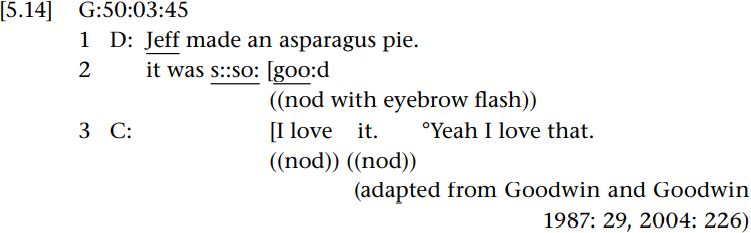
Dianne and Claica manage to accomplish simultaneously a positive assessment of Jeff’s pie, namely, that they both think it was delicious. In order for Claica to chime in at the right time she must have been able to anticipate what Dianne was meaning here. One resource Claica likely drew from here, alongside the non-verbal cues, is the emerging syntax, where the intensifier “s::so:” occurs in a construction through which Dianne is obviously about to attribute something to the pie (by means of the referring expression “it”). The occurrence of an intensifier in an attribution syntactic construction primes an understanding of Dianne’s utterance not only as an assessment (what Dianne does with her utterance), but also that this assessment is going to be a positive one (what Dianne means by her utterance).
The incremental and sequential nature of discourse processing is also clearly illustrated through the phenomenon of co-construction, where more than one participant contributes to the uttering of a single syntactic unit (either what is said or what is implicated). Take, for instance, the following excerpt from a conversation in the British National Corpus between an older married couple talking about fuchsias:
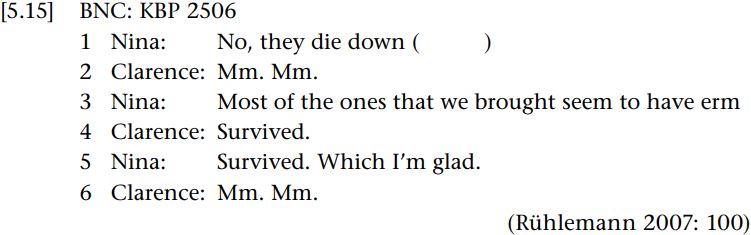
Here, in response to Nina indicating through the hesitation token erm that she is struggling to find the right word (line 3), Clarence completes the clause begun by Nina in the next turn (line 4). Nina then further expands upon the previously co-constructed utterance with the addition of which I’m glad (line 5). In this way, these two speakers can be seen to be co-constructing a single, complex syntactic unit through both completion and expansion of the prior speaker’s utterance.
It can be argued from a discourse-processing perspective, then, that
[m]eaning lies not with the speaker nor the addressee nor the utterance alone as many philosophical arguments have considered, but rather with the interactional past, current, and projected next moment (Schegloff et al. 1996: 40).
Such a perspective should not be taken to entail, however, that speakers are not generally held accountable for what they are taken to mean (a point to which we will return). Even in situations where utterances are co-constructed, the speaker who initiated the utterance (first speaker) nevertheless generally displays “ownership” of such meanings after the second speaker has “completed” the utterance, either through expressing agreement or disagreement with that utterance, or by repairing the co-constructed utterance (Haugh 2010; Lerner 2004). What a speaker is taken to have meant by participants, as opposed to how participants come to such understandings, are two distinct questions.
 الاكثر قراءة في pragmatics
 اخر الاخبار
اخبار العتبة العباسية المقدسة

الآخبار الصحية


 قسم الشؤون الفكرية يصدر كتاباً يوثق تاريخ السدانة في العتبة العباسية المقدسة
 "المهمة".. إصدار قصصي يوثّق القصص الفائزة في مسابقة فتوى الدفاع المقدسة للقصة القصيرة
 (نوافذ).. إصدار أدبي يوثق القصص الفائزة في مسابقة الإمام العسكري (عليه السلام)