Forms of metapragmatic awareness
Metapragmatics, in our view, encompasses the study of language usages that indicate reflexive awareness on the part of participants about those interactive or communicative activities they are currently engaged in. A number of indicators of metapragmatic awareness have been identified in studies thus far. These range from those that are expressed explicitly when language use becomes the subject matter of speech, through to those that arise implicitly insofar as the production of talk “takes account of its own nature and functioning” (Lucy 2000: 213). The latter involves anchoring linguistic (and non-linguistic) forms to contexts, an area that we have already discussed. We have therefore only focused on relatively explicit indicators of metapragmatic awareness in Table 8.1. The four key types listed are (1) pragmatic markers, (2) reported language use, (3) metapragmatic commentary, and (4) social discourses. Underpinning all of these different forms of metapragmatic awareness is the folk metalanguage drawn upon by users, in this case, users of English.
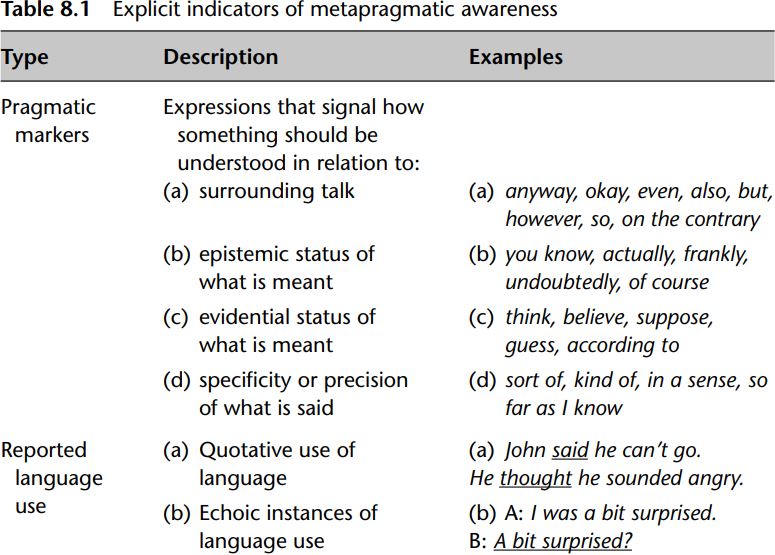
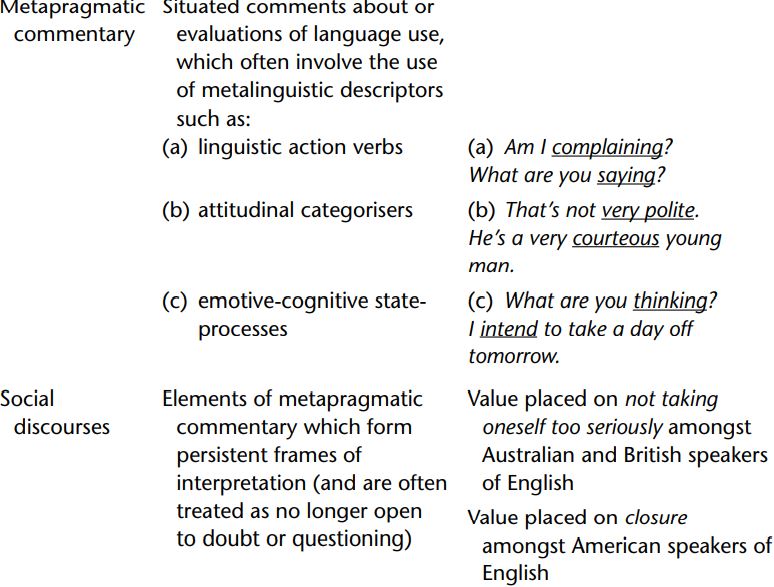
It is important to note that we have collapsed finer distinctions in some cases for the sake of simplicity in our presentation of these indicators. Categories such as pragmatic markers, for instance, can be further sub-divided by making distinctions between discourse markers, sentence adverbs, hedges, self-referential expressions, explicit intertextual links and so on (see Verschueren 2000). Such classifications, and the theoretical debates around them, are indeed important, at least to a point, but they often neglect the fact that the same indicator can often be used for a range of quite distinct functions. Therefore we have chosen to focus instead on exemplifying how these different indicators can be used by participants to display different forms of reflexive awareness in language use. It is to these different kinds of reflexivity that we now turn.
We propose that there are three key types of reflexive awareness underpinning this ability to recognize or talk about pragmatic phenomena: metacognitive awareness, metarepresentational awareness and metacommunicative awareness (see also Lucy 2000). Metacognitive awareness refers to reflexive presentations of the cognitive status of information, such as whether it is known, new, expected (and so on) information for participants. Metarepresentational awareness involves reflexive representations of the intentional states of self and other (as in their beliefs, thoughts, desires, attitudes, intentions etc.), or what we have earlier termed pragmatic meaning representations. Finally, metacommunicative awareness refers to reflexive interpretations and evaluations of talk, which arise as a consequence of our awareness of self and other as social beings. There is, in addition, a specific form of metacommunicative awareness worth drawing attention to in passing, namely, metadiscursive awareness. The latter refers to a persistent frame of interpretation and evaluation that has become objectified, or reified, in ongoing metapragmatic commentary about a particular pragmatic phenomenon. Metadiscursive awareness underpins particular ideologies relating to language use, that is to say, ways of thinking about language and language use that intersect with ways in which language is actually used. Given the evident influence of such ideologies vis-à-vis language use, metadiscursive awareness is arguably deserving of analysis in its own right, separate and distinct from the metacommunicative awareness through which it is ultimately derived, although space does not permit us to do so here.
We shall now discuss each of these different forms of metapragmatic awareness in greater detail.








