Analyzing Grammar
Grammatical form
Form, meaning, and use
Why do people talk? What is language for? One common answer to this question is that language is a complex form of communication, and that people talk in order to share or request information. That is certainly a very important use of language, but clearly it is not the only use.
For example, what is the meaning of the word hello? What information does it convey? It is a very difficult word to define, but every speaker of English knows how to use it: for greeting an acquaintance, answering the telephone, etc. We might say that hello conveys the information that the speaker wishes to acknowledge the presence of, or initiate a conversation with, the hearer. But it would be very strange to answer the phone or greet your best friend by saying “I wish to acknowledge your presence” or “I wish to initiate a conversation with you.” What is important about the word hello is not its information content (if any) but its use in social interaction.
In the Teochew language (a “dialect” of Chinese), there is no word for ‘hello’. The normal way for one friend to greet another is to ask: “Have you already eaten or not?” The expected reply is: “I have eaten,” even if this is not in fact true.
Now no one would want to say that hello means “Have you eaten yet?” But, in certain contexts, the English word and the Teochew question may be used for the same purpose or function, i.e. as a greeting. This example illustrates why it is helpful to distinguish between the meaning (or SEMANTIC content) of an utterance and its function (or PRAGMATIC content).
Of course, in many contexts there is a close relationship between meaning and function. For example, if a doctor wants to administer a certain medicine which cannot be taken on an empty stomach, he will probably ask the patient: “Have you eaten?” In this situation both the meaning and the function of the question will be essentially the same whether the doctor is speaking English or Teochew. The FORM, however, would be quite different. Compare the Teochew form in (1a) with its English translation in (1b):
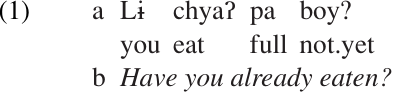
Obviously, the words themselves are different, but there are grammatical differences as well. Both sentences have the form of a question. In Teochew this is indicated by the presence of a negative element (‘not yet’) at the end of the sentence, while in English it is indicated by the special position of the auxiliary verb have at the beginning of the sentence.
We are primarily concerned with describing linguistic form, and in particular with describing grammatical structure. (What we mean by “grammatical structure” will be discussed below.) But in our study of these structural features, we will often want to talk about the meaning of a particular form and/or how it is used. The Teochew example illustrates how a particular form may be used for different functions, depending on the context. This means that the form of an utterance by itself (ignoring context) does not determine its function. But it is equally true that function by itself does not fully determine the form. In other words, we cannot fully explain the form of an utterance while ignoring meaning and function; at the same time, we cannot account for the form of an utterance by looking only at its meaning and function.








