Meaning postulates
Since propositions correspond to sentences, the logical formalism we have been developing has practically nothing to tell us about the meanings of individual words. We can, it is true, say something about the meanings of the quantifiers and of the operators ¬, &, V and ): the meanings of the latter are given by their truth tables (Tables 6.1, 6.2, 6.4 and 6.5), and the meanings of the universal and existential quantifiers can be explained as a picking out of all, and at least one of, the entities in the domain of dis course in question, as explained in 6.4 above. Granting that English all, some, not, and, or and if. . . then mean something similar to their logical counterparts, we at least have a logical analysis of these six expressions. This is all, however: taking the formula (x) Sx) Wx, translated ‘all snow is white’, we have no way of saying anything about the meanings of either snow or white.
Obviously, a theory of meaning that can only define the quantifiers and propositional operators is woefully inadequate as a semantic theory of natural language.
The propositional and quantificational operators can, however, be used to explore word meaning. These operators can be used to propose meaning postulates, logical statements which specify the relations that obtain between the different lexemes of a language. Originally advanced by Carnap (1947), meaning postulates offer an alternative mode of meaning representation to the approaches we have largely discussed until now. Most of these approaches are decompositional: to specify the meaning of a word, in other words, we decompose or break it down into its component parts, envisaged as, for example, bundles of semantic features (see 5.2) or clauses in a paraphrase corresponding to conceptual universals (2.5; for more on decomposition, see 8.1.1). The meaning postulates approach, however, adopts exactly the opposite technique. It does not attempt to break down word meanings into sets of components, but to describe the relations which a word has with other members of the same vocabulary. We can get an idea of what this involves by examining some examples of meaning postulates adapted from Murphy (2003: 63). On this picture, the grammar of English can be seen as containing the meaning postulates (94)–(96):
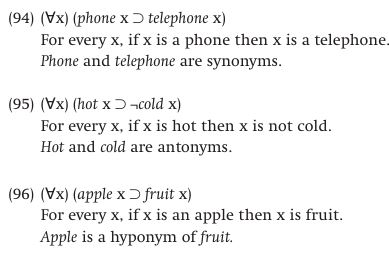
Postulates (94) –(96) are all to be taken as rules which speakers of English obey in their use of the words concerned. The import of each meaning postulate is paraphrased in terms of the familiar lexical relations on the last line of each example. The idea behind the meaning postulate approach is that we should be able to specify constraints on the use of any given item of the vocabulary which dictate what relations it may have with other items. Words which are synonyms, for example, may not be used in the following type of context:
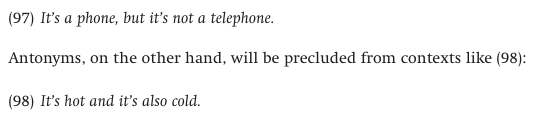
Specification of the entire set of meaning postulates governing the use of a word is thus intended to define the possible range of the word’s cooccurrence with other lexemes of the same language. Lyons (1963: 59) echoes the type of thinking behind the meaning postulates approach when he says that ‘the meaning of a given linguistic unit is defined to be the set of (paradigmatic) relations that the unit in question contracts with other units of the language (in the context or contexts in which it occurs), without any attempt being made to set up “contents” for these units’.
Meaning postulates are not just limited to the formalization of the specific lexical relations discussed in Chapter 5. They can also be used to express more particular interrelations between particular words. For instance, (99) says that if someone knows something, then that thing must be true:
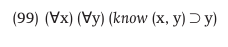
Postulate (99) allows us to predict, correctly, that sentence (100) will be semantically odd:

Similarly, the verb marry entails (except in exceptional cases which pose a problem for any theory of meaning) that both its object and its subject be alive: one cannot, for example, marry Cleopatra; no more, of course, can Cleopatra marry anyone herself. We can represent this constraint on the meaning of marry as, once again, a material conditional involving the universal quantifier:
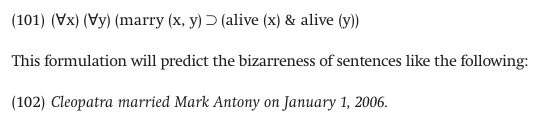
The relation between marry and alive does not form one of the standard lexical relations to which marry would usually be considered to belong, but it is very much part of the verb’s meaning, and we can represent this fact by proposing a meaning postulate.
The meaning postulates approach treats words as semantically unanalysable. Facts about meaning are not facts about the internal semantic com position of words, but about the relations which words have among themselves. We cannot, on this picture, exhaustively break a word down into its individual meaningful elements, but we can detail the various relations which it contracts with other words of the language. Meaning postulates thus have the advantage of avoiding the many problems confronted by attempts to decompose a word into its constituent parts (see 2.6). But by the same token, they can offer no explanation for the meaning relations into which a word enters. A definition of marry would make clear, among other things, that marrying is a particular type of activity found in human societies. From this it would follow that only living people can be married. For the meaning postulates approach, however, this is just an arbitrary fact.
A more serious problem for the meaning postulates approach is that relations between words are seldom able to be represented convincingly in logical formalism. Most of the facts about the meaning of a word are more variable and context-dependent, and less absolute, than the types discussed in (94)–(102). For example, we might propose the following meaning postulate to describe the verb love:

This reflects the idea that loving something is the opposite of hating it – surely a valid description of the meaning of the verb. But it is often the case that we might simultaneously love and hate something at the same time, and sentences like (104) are entirely possible:
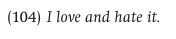
This suggests that the postulate in (103) cannot be maintained. But what other postulates could we advance? We could certainly advance postulates showing that love, like hate, is a hyponym of experience an emotion, but this is very far from giving us the detail we need in order to understand what love actually means. It would seem that the verb love in itself carries a meaning which does not necessarily impose any necessary set of cooccurrence relations on it: love can be put into an unlimited number of novel con texts, with new meaning combinations thereby being generated:

Sentence (105a) flies in the face of the usual expectation that the subject of love is an animate entity; (105b) counters the expectation that love is an ongoing state. It is, indeed, precisely because of this sort of flexibility that language has the productivity it has: we use a finite set of lexical items to create an infinite set of meanings, and one of the ways we do this is by varying the relations into which we put the items of our vocabulary.
As we have seen, it is possible to formulate a definition of love which allows for the fact that someone might simultaneously love and hate something, but it is hard to see how this same information could be couched as meaning postulates. The whole idea of the meaning postulate approach is that it is possible to specify certain propositions which follow necessarily from others. The proposition ‘I do not hate you’, for example, should flow necessarily from ‘I love you’. Yet, in language, this is rarely the case. Words can often be used in contexts where they lose many of their expected meaningful properties. This circumstance creates problems for any attempt to discern regularity in the lexicon, whether through definitions, semantic features or meaning postulates. The meaning postulates approach, however, is especially vulnerable to it, since it is limited to a logical formalism which seems ill-suited to the representation of the messy, variable and context-dependent relations that words contract with each other. The meaning postulate approach has not, indeed, ever resulted in any comprehensive body of semantic description.








