CONCEPTUALISING
EXPERIENCES FROM A DIFFERENT ANGLE
Nominalization and grammatical metaphor
BASIC REALISATIONS AND METAPHORICAL REALISATIONS
Situations and events can be conceptualized and expressed linguistically in two major ways. More transparent, because they are closer to the speaker’s experience, are the basic transitivity patterns that we have examined so far. In these semantic structures the processes, participants and circumstances are encoded by their typical clause functions, with agency and chronological sequencing made explicit. That is, in active clauses, the inherent participants such as Agent, Affected, Experiencer and Carrier are realized by NGs, processes are realized by VGs and circumstantials by PPs and by AdvGs. This correspondence between the semantics and the syntax of English structures is indeed the typical one, but it is by no means the only one.
We have to beware of assuming that a one-to-one correspondence exists between any semantic function and any syntactic function. We have to beware of assuming that entities such as people and things are necessarily expressed by nouns, that actions are necessarily expressed by verbs and that qualities are necessarily expressed by adjectives. Except in the language of children and in very basic English, our linguistic representation of reality tends to be more complex. Any situation can be expressed in more than one way; the first or typical realization may be called the ‘iconic’ one, in which the form mirrors the meaning; the other is the ‘metaphorical’ or ‘nominalized’. The two forms may be illustrated by an example.
Suppose that I wish to tell you that my friends and I walked in the evening along the river as far as Henley. In the ‘typical’ or ‘iconic’ version, I first select the process type from the options ‘material’, ‘mental’ and ‘relational’ processes. A process of ‘doing’ fits the conceptualized situation best, and more specifically, a process of motion which includes manner. Among possible types of motion I select a material process walk. To accompany a process such as walk used intransitively, I then select an Agent, or ‘doer’ of the action, and a number of circumstantial elements, of time, place and direction as a setting, to give the following semantic structure and its lexico-grammatical realization:
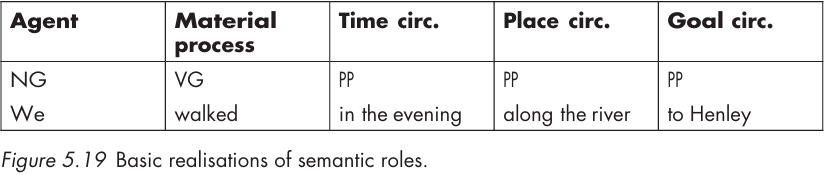
This is not the only way of expressing this situation. Instead, I could have said Our evening walk along the river took us to Henley. In this ‘nominalized’ interpretation the semantic functions are ‘transferred’ in relation to the syntactic functions. The material process walk has now become Agent, and the circumstances of time (in the evening) and place (along the river) have become classifier and post-modifier, respectively, of the new Agent realized at subject (evening walk along the river). The original Agent we is now divided into two; one-part functions as possessor of the Subject entity (our evening walk along the river), the other as Affected (us) of a new material process expressed by the verb took. Only the Goal circumstance to Henley is realized in the same way in both interpretations:
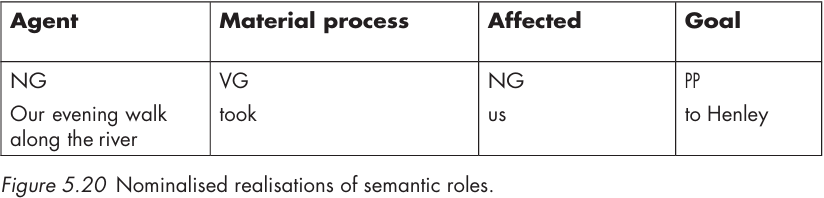
This second interpretation is a very simple instance of ‘grammatical metaphor’ or alternative realizations of semantic functions, and is a phenomenon which occurs all the time, in different degrees, in adult language, especially in certain written genres.
Even in everyday spoken language it sometimes happens that the metaphorical form has become the normal way of expressing a certain meaning. We have seen that the Range element drink/chat/rest in have a drink/chat/rest is the one that expresses the process, while the syntactic function of Predicator is now realized by the ‘light’ verb have. These are simple types of transferred semantic functions which have been incorporated into everyday language. Now compare the ordinary correspondences in example a below with the nominalized version of b:
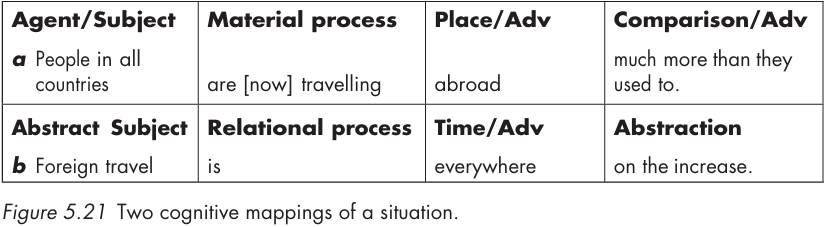
In a we have a process of ‘doing’ (are travelling), with an Agent/Subject and three circumstances (now, abroad and much more than they used to). In b, by contrast, the process is relational with be, the human Agent has disappeared, and instead we have an abstract subject based on the verb ‘travel’ (foreign travel), followed by two circum- stances. Apart from these differences, we note that the two meanings are not quite equivalent. The notion of ‘all countries’ is replaced by the less explicit ‘everywhere’, that of ‘abroad’ is replaced by ‘foreign’, while the notions expressed by ‘now’ and ‘used to’ are not encoded at all, but remain implicit.
More importantly, the two versions represent two different cognitive mappings of a situation on to different semantic and syntactic structures. The event is ‘perspectivized’ differently in each case, with attention centred in the second on the salient abstraction ‘foreign travel’, rather than on persons.








