0
EN
1
المرجع الالكتروني للمعلوماتية

Grammar

Tenses

Present

Present Simple

Present Continuous

Present Perfect

Present Perfect Continuous

Past

Past Simple

Past Continuous

Past Perfect

Past Perfect Continuous

Future

Future Simple

Future Continuous

Future Perfect

Future Perfect Continuous

Parts Of Speech

Nouns

Countable and uncountable nouns

Verbal nouns

Singular and Plural nouns

Proper nouns

Nouns gender

Nouns definition

Concrete nouns

Abstract nouns

Common nouns

Collective nouns

Definition Of Nouns

Animate and Inanimate nouns

Nouns

Verbs

Stative and dynamic verbs

Finite and nonfinite verbs

To be verbs

Transitive and intransitive verbs

Auxiliary verbs

Modal verbs

Regular and irregular verbs

Action verbs

Verbs

Adverbs

Relative adverbs

Interrogative adverbs

Adverbs of time

Adverbs of place

Adverbs of reason

Adverbs of quantity

Adverbs of manner

Adverbs of frequency

Adverbs of affirmation

Adverbs

Adjectives

Quantitative adjective

Proper adjective

Possessive adjective

Numeral adjective

Interrogative adjective

Distributive adjective

Descriptive adjective

Demonstrative adjective

Pronouns

Subject pronoun

Relative pronoun

Reflexive pronoun

Reciprocal pronoun

Possessive pronoun

Personal pronoun

Interrogative pronoun

Indefinite pronoun

Emphatic pronoun

Distributive pronoun

Demonstrative pronoun

Pronouns

Pre Position

Preposition by function

Time preposition

Reason preposition

Possession preposition

Place preposition

Phrases preposition

Origin preposition

Measure preposition

Direction preposition

Contrast preposition

Agent preposition

Preposition by construction

Simple preposition

Phrase preposition

Double preposition

Compound preposition

prepositions

Conjunctions

Subordinating conjunction

Correlative conjunction

Coordinating conjunction

Conjunctive adverbs

conjunctions

Interjections

Express calling interjection

Phrases

Sentences

Clauses

Part of Speech

Grammar Rules

Passive and Active

Preference

Requests and offers

wishes

Be used to

Some and any

Could have done

Describing people

Giving advices

Possession

Comparative and superlative

Giving Reason

Making Suggestions

Apologizing

Forming questions

Since and for

Directions

Obligation

Adverbials

invitation

Articles

Imaginary condition

Zero conditional

First conditional

Second conditional

Third conditional

Reported speech

Demonstratives

Determiners

Direct and Indirect speech

Linguistics

Phonetics

Phonology

Linguistics fields

Syntax

Morphology

Semantics

pragmatics

History

Writing

Grammar

Phonetics and Phonology

Semiotics

Reading Comprehension

Elementary

Intermediate

Advanced

Teaching Methods

Teaching Strategies

Assessment

قم بتسجيل الدخول اولاً لكي يتسنى لك الاعجاب والتعليق.

BACKSHIFT IN INDIRECT REPORTING

المؤلف:  Angela Downing

المصدر:  ENGLISH GRAMMAR A UNIVERSITY COURSE

الجزء والصفحة:  P275-C7

2026-06-17

10

+

-

20

BACKSHIFT IN INDIRECT REPORTING

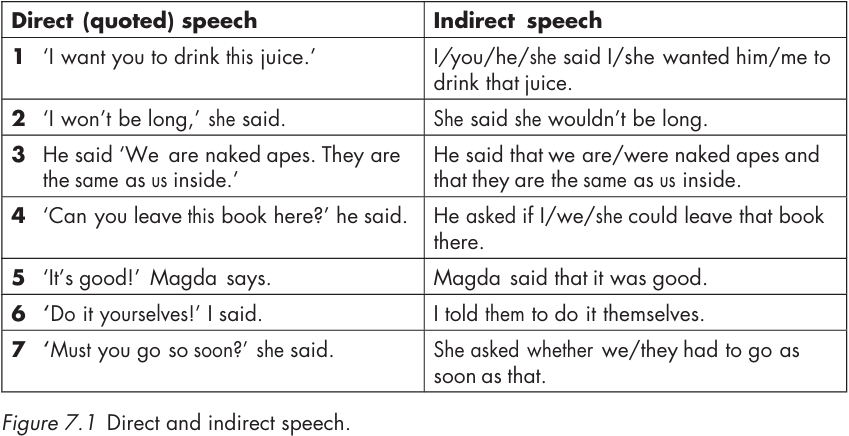
Indirect speech reporting is characterized by a series of formal features that distinguish it from quoted speech reporting. They have the effect of shifting all deictic elements (personal pronouns, demonstratives, tense and adverbs of time and place) away from direct reference to the speech situation, and instead to the reporting situation, as in the following example (we don’t give all the possible personal pronoun shifts, which depend on context):

‘I want you to drink this juice.’            I/you/he/she said she wanted him/me to drink that juice.


The shifts involved are as follows:

Personal pronouns in the 1st person, which refer to the speaker, are shifted to 2nd or 3rd person, unless the speaker is reporting him/herself, as in 1 below. The 2nd person pronoun, which refers to the listener, is shifted to 1st or 3rd, according to the identity of the listener, again as in 1.

Demonstratives and deictic adverbs which refer to the here and now (this, these, here, now) are replaced by more remote forms (that, those, there, then) 1 and 4.

Verb tenses are ‘back-shifted’ – that is, present forms are replaced by past forms 1, 2, 4, 5. This shift is not obligatory if the described state still holds, as in 3.

Clause type is also affected. A quoted interrogative with say is replaced by a declarative introduced by ask in reported speech 7. Imperatives and verbless clauses have less clear correspondences.


Verbs used in indirect statements and questions are essentially the same as those used in quoting. The main exceptions are shown in the table.
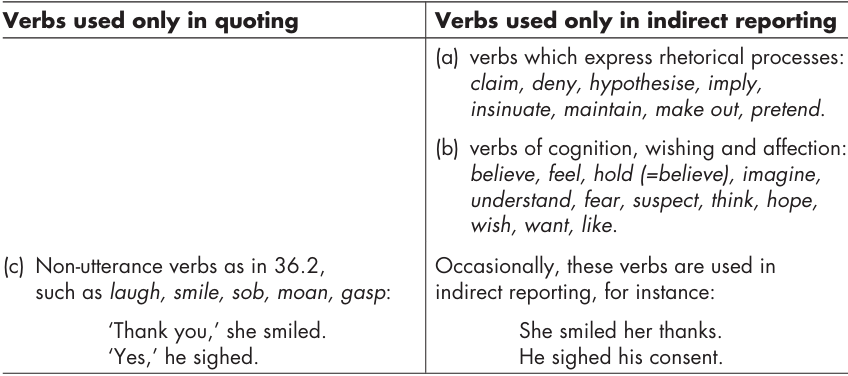


(a) Verbs such as claim, deny, insinuate represent an interpretation on the part of the reporter of the speech act in the original situation, and can indicate a certain stance, for instance of reservation or disbelief:

She claims her mother was related to a Polish aristocrat.

He denies being involved in the incident.

Are you insinuating that he knows something about it?


(b) The combination of mental processes with a reporting clause is the normal way of representing what people think, believe, hope, want and like. These typically occur as reported states of wishing, wanting, and so on, since such mental states are rarely quoted; even the possible form with let as in ‘Let me be the first to speak to him’, Janet wished is relatively infrequent. Syntactically, they are no different from the complementation patterns:

I hope that no damage has been done

It is feared that many lives have been lost.

She wishes she had never met him.


(c) Conversely, verbs which are not intrinsically verbs of saying are not normally used in indirect reporting. These include verbs of laughing, weeping, and the like. A quoted locution such as ‘So what?’, he sneered would be difficult to report in a similar form, and even perhaps with a similar meaning. A paraphrase such as He asked with a sneer what it mattered might be considered acceptable within a certain context.


اخر الاخبار

اشترك بقناتنا على التلجرام ليصلك كل ما هو جديد

