Cognitive approaches to grammar
Radical Construction Grammar
Why Radical Construction Grammar is radical
In contrast to Goldberg’s Construction Grammar, which is partly indebted to Fillmore’s non-commitment to a fully cognitive linguistic model, Croft’s (2001) Radical Construction Grammar is claimed to be radical for four reasons. Firstly, grammatical categories (i.e. words classes and syntactic roles) are not viewed as primitives but are argued to be construction-specific. One of the greatest merits of Radical Construction Grammar is to have exposed the circularity inherent in much of modern syntactic argumentation. Constructions are used to define categories (this is known as the distributional method) and then the categories so established are used to define (or categorize) other constructions. As a matter of illustration, consider how direct object status is evaluated in English (see Croft 2001: 35–45). Croft points out that, traditionally, passivizability– the fact that the alleged direct object in an active sentence can become the subject of the corresponding passive sentence, see (2a) vs. (2a’)– is taken to be the defining criterion for direct object status. Consequently, 80 kg in (2b) may not be categorized as a direct object by some linguists: no corresponding passive sentence is possible, see (2b’). By contrast, objects of prepositions may sometimes be passivized, see (2c’). This would lead us to classify such objects as direct objects. The problem here is that the choice of passivization (over, for example, obligatory presence vs. absence of a preposition after the verb) as the defining criterion for direct object status is not theoretically motivated. Further, there is no a priori reason why we should group different cases into the same category. In fact, a Radical Construction Grammar analysis would claim that the three sentences at hand contain three different types of “objects” whose properties overlap only partially: John immediately follows the verb and can become the subject of a passive sentence; 80 kg cannot become the subject of a passive sentence but, like John, occurs immediately after the verb; this house, like John, can become the subject of a passive sentence but, unlike John and 80 kg, is separated from the verb by a preposition.
(2) a. A mule kicked John.
a’. John was kicked by a mule
b. John weighs 80 kg.
b’. *80 kg are weighed by John.
c. Hemingway lived in this house.
c’. This house was lived in by Hemingway.
The second reason why Radical Construction Grammar is radical is because constructions are taken to be the basic units of syntactic representation. This assumption is also shared by Cognitive Grammar and Construction Grammar (at least in its latest implementations) and was illustrated in Table 1 in The symbolic alternative to traditional concepts of grammar.
Thirdly, Radical Construction Grammar is radical because syntactic relations are claimed not to exist. Croft argues that the term syntactic role should be used instead. He points out that the term “subject”, for example, can be used in two different ways (see e.g. Croft 2001: 24 and Croft and Cruse 2004: 285–286). “Subject” can be used to refer to the syntactic relation between an element of a construction and another element (the verb), e.g. we say that Heather is the subject of sings in Heather sings. “Subject” can also be used to refer to the role that an element has in a construction, i.e. the part-whole (or meronomic) relation of an element with the whole construction. For example, we say that Heather has the role subject in the intransitive construction Heather sings. The crucial point here is that Croft uses the term syntactic relation in a traditional (formal) sense, whereby a syntactic relation like subject is taken to be construction independent by definition– cf. the Government and Binding Theory configurational definition of subject as the Specifier of an Inflectional Phrase or [Spec, IP]– and does not necessarily symbolize any semantic content. Since the only entities which should be posited in grammar according to Croft are constructions (as well as relations among them), it follows that syntactic relations (as construction-independent objects) must be dispensed with. Accordingly, Radical Construction Grammar only uses the term role, which refers to the relation between an element and the whole construction rather than the relation between an element and another element within the same construction.
Finally, constructions are said to be language-specific: no two constructions can be assumed to be identical across languages. This assumption is also shared by Construction Grammar and Cognitive Grammar.
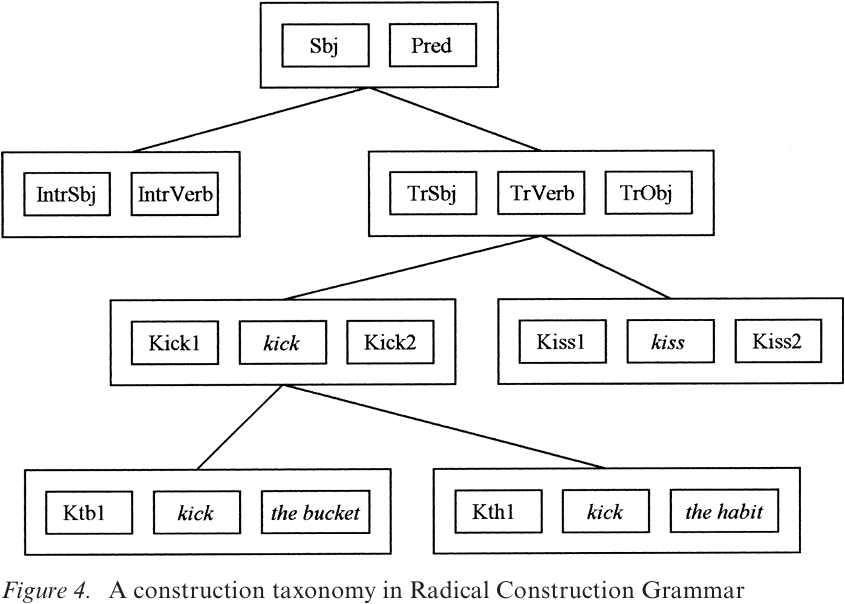
In sum, Radical Construction Grammar can be described as a usage-based model: grammar is maximalist and bottom-up, rather than minimalist and top-down (like formal approaches). It consists of taxonomic hierarchies of constructions which include very specific constructions (e.g. kick the bucket, kick the habit) as well as more general schemas abstracting away their commonalities (e.g. a transitive schema for kick, a general transitive schema, etc.). A self-explanatory example of the kind of taxonomy assumed in Radical Construction Grammar is offered in Figure 4 below (adapted from Croft 2001: Figure 1.15, p.56).
Although Radical Construction Grammar claims that grammatical categories are construction and language-specific, Croft (2001) shows that syntactic roles can be compared across languages once semantic notions (e.g. actor event, undergoer event, etc.) are appealed to. In a similar vein, he argues that a universal characterization of parts of speech is possible. (For reasons of space, I will only discuss parts-of-speech here.) Croft’s analysis is based on the interaction between discourse functions and semantic classes. Croft recognizes three discourse (or pragmatic/communicative) functions (see Croft 2001: 66), namely the propositional acts of predication (e.g. This intelligent detective is young, where young is predicated of this intelligent detective), reference (e.g. this intelligent detective, which picks out a certain referent) and modification (e.g. intelligent detective, where intelligent modifies our “cognitive file” for the detective in question, i.e. it enriches the detective’s identity by adding a property to the “features” already stored in our mind concerning the detective). As these examples illustrate, we tend to use certain constructions to code such discourse functions (the constructions in question are called propositional act constructions). Croft hypothesizes that the typological prototypes of the referring, attributive, and predicating constructions are the semantic classes of objects, properties and actions, respectively, i.e. we prototypically refer to objects, modify cognitive files by attributing properties to entities and predicate actions of entities. It should be observed that these semantic classes are only a small subset of the semantic classes of words found in human languages (and are defined in terms of four semantic properties, namely relationality, stativity, transitoriness, gradability, see Croft 2001: 87). Parts-of-speech in a given language can therefore be represented onto a bi-dimensional space (a semantic map) defined by the dimensions “discourse functions” and “semantic classes”. Nouns, adjectives and verbs are viewed as the (prototypical) pairings of reference/object, modification/property and predication/action, respectively. This is shown in Table 2 (adapted from Croft 2001: Table 2.3, p.88. “Unmarked” means that no derivational morphemes are employed, e.g. cat is an unmarked noun while happiness is a marked, deadjectival noun).4
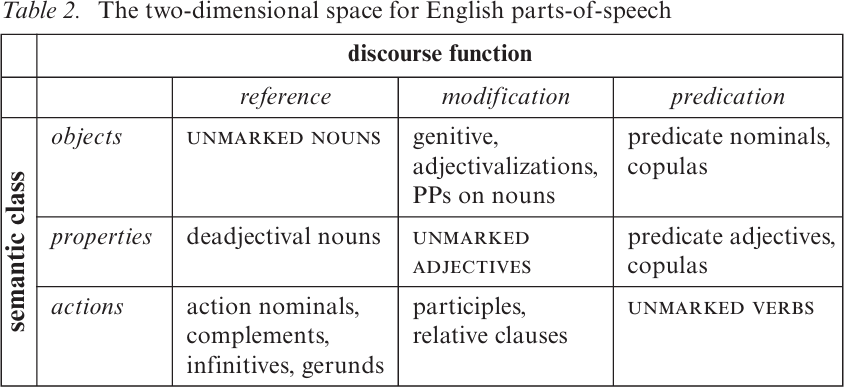
4. Table 2 is not the complete map of English part of speech constructions (see Croft 2001: Fig.2.3, p.99). But it will suffice for our present purposes.








