Liquids and solutions
Liquids have a very high molarity. Thus, chloro form, with a relative molecular mass of 119.4 and density 1.48 g/mL, can be said to be 12.4 M. According to Beer’s law, to detect the C1H stretch (ɛ ≈10) with absorption A 0.4, the pathlength required, given by l A/(ɛc), is approximately 3 X 10⁻³ cm – i.e. very short! Neat nonvolatile liquids can be measured simply by placing a drop between two IR trans parent plates and pressing the plates together to ensure a narrow (<0.1 mm) measurement pathlength (Fig. 1). Volatile liquids may need proper sealed liquid cells to prevent volatilisation.
When samples in solution are to be analysed, liquid cells can be used. These typically consist of two parallel transparent windows (0.1–0.01 mm apart) separated by a precise gasket made of Teflon or lead and fitted with inlet and outlet ports. Cells with variable pathlengths are also available, in which one window is retained on a screw that can be finely adjusted to give a precise pathlength in the 0.1–0.01 mm range. These cells are particularly useful for varying path length to accommodate for solvent absorption and variations in concentration ranges. If the absorbance is too strong, the pathlength of the cell can be reduced.
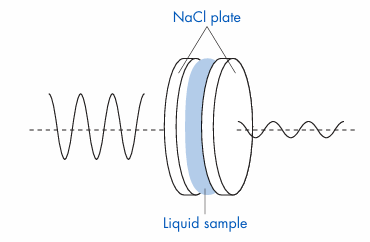
Figure 1 Liquid sample or Nujol mull sandwiched between two NaCl plates.
The number of solvents suitable for IR spectroscopy is limited because most solvents suit able for the dissolution of organic solutes will also absorb in the IR and hence will have their own IR spectrum. The spectrum of the solution is then a combination of the solute and the solvent. The measurement of the IR absorption of a solute is only possible in a spectral range for which the solvent is relatively transparent. Carbon tetrachloride and carbon disulfide, which lack hydrogen and contain a minimal number of bond types, are often suggested as the most useful solvents because they have relatively few absorption bands in the IR region. However, they have relatively poor solubilisation characteristics, particularly for polar solutes. In practice, solvent choice is based upon solubility and IR transparency at the wavenumber of interest. Deuterated solvents can help open regions for analysis. Chloroform can be replaced by deuterochloroform and water with deuterated water. Acetonitrile, toluene and dioxane are also good solvents to consider. Solvent absorption can be accounted for in a computer by comparison of the solution and solvent spectra. Spectral subtraction can be carried out, but caution should be observed when doing this.
To overcome the inherent absorption of solvents and the relatively low extinction coefficient of a vibrational transition, pathlengths should be narrow and concentrations of solutes high. The concentration of the test compound is usually about 5–10%, but concentrations up to 20% (w/v) can be employed. With these high concentrations, hydroxyl and amino compounds often exhibit bands caused by inter molecular hydrogen bonding. Interactions between the compound and the solvent can occur, which may result in changes in the intensity and wavenumber of bands in different solvents and the breakdown of Beer’s law. IR solvents are often volatile and require very short pathlengths. This combination can lead to solvent evaporation, which produces large concentration changes. In the older style IR spectrometers, the heat of IR radiation could cause evaporation – this is less of a problem with FT systems with the sample placed after the interferometer. An example is presented here of the determination of the amount of dimeticone in a cream formulation. Dimeticone can be extracted from creams with 4% (w/w) liquid paraffin in toluene and quantified by reference to standard solutions based upon the Si-O stretching vibration at 1260 cm-1 in a 0.1 mm sodium chloride liquid cell (Fig. 2).
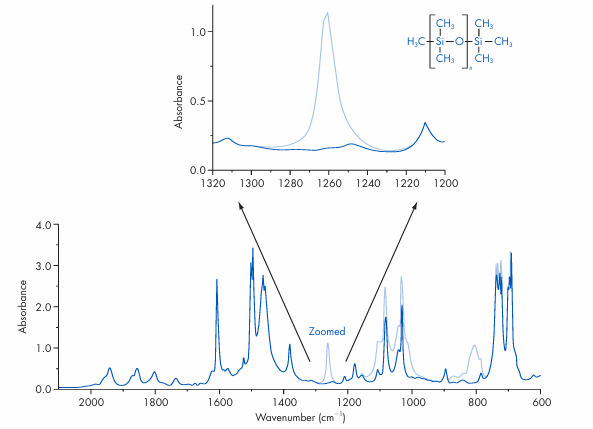
Figure 2 The IR spectrum of dimeticone dissolved in 4% (w/w) liquid paraffin in toluene. Heavy line: 4% (w/w) liquid paraffin in toluene. Light line: 1.5% (w/v) dimeticone dissolved in 4% (w/w) liquid paraffin in toluene.








