Infrared spectra of barbiturates
Important derivatives of malonylurea (barbituric acid) have two substituents at position 5. Others are also substituted at position 1 and in others the oxygen atom attached to position 2 is replaced by sulfur to form thiobarbiturates (Fig. 1).
The barbiturates can be classified chemically into three classes: 5,5-disubstituted barbituric acids, 1,5,5-trisubstituted barbituric acids and 5,5-disubstituted thiobarbituric acids. These classes can be further divided depending on whether the substituents in position 5 are alkyl, alkenyl, aryl or cycloalkenyl. In most common barbiturates, one of the 5-substituents is either ethyl or allyl and the other is either a straight- or branched-chain alkyl or alkenyl group with five or fewer carbon atoms. Some barbiturates are available as sodium salts. The IR spectrum of a barbiturate therefore depends on the class of compound, the nature of the substituents and whether it is the free acid or the sodium salt. With the exception of phenobarbital and barbituric acid, the free barbiturates do not absorb appreciably above 3300 cm1 (e.g. barbital, Fig. 1A), a feature that distinguishes them from the ureides; a weak band of unknown origin sometimes occurs between 3500 and 3400 cm1. All the barbiturates have two bands which occur near 3200 and 3100 cm-1 and are caused byN1Hstretchingvibrations.Inthe5,5 disubstituted compounds, the relative intensities of the two bands are similar, although that at 3100 cm1 is usually slightly less intense. In compounds substituted on the nitrogen atom at position 1, the intensity of the bandat3100 cm-1 may be greatly reduced and is often present only as a shoulder on the band at 3200 cm-1, e.g. metharbital. Methylphenobarbital appears to be an exception in that the band at 3100 cm-1 is the most intense one in the region. A similar phenomenon occurs with the sodium salts, since here again one of the hydrogen atoms in either position 1 or 3 has been replaced.
A series of up to four medium-to-intense bands occurs in the region 3000–2800 cm-1, and is caused by alkyl C-H stretching vibrations of the substituents in positions 1 and 5. The intensity of the bands gives a very approximate indication of the number of C-H bonds and hence the number of carbon atoms in the chain. This does not appear to apply to the sodium salts, in which the band that occurs at 3000–2950 cm-1 is usually increased in intensity, compared to that of the free acid, and becomes the strongest band. Compare, for example, the spectra of barbital (Fig. 1A) and barbital sodium (Fig. 1B). The barbiturates have up to three strong bands in the region 1765 to 1670 cm1, which result from C=O stretching vibrations. Knowledge of the origin of these bands helps us to understand the differences in the spectra of the various types of barbiturate.
In symmetrical molecules, the three bands are all of similar intensity. In asymmetrical molecules, the band at the highest frequency is often less intense than the other two, particularly so when the molecule is substituted in position 1. The sodium salts of the barbiturates have only two bands in this region, since the molecule is no longer symmetrical, and these occur at a lower frequency, between 1700 and 1650 cm-1. In addition, a broad strong band occurs between 1600 and 1550 cm-1; the free barbiturates show practically no absorption in this region. The sodium salts of the thiobarbiturates exhibit only the lowest of the three C=O vibrations in the region 1700–1680 cm1. They do, however, exhibit the broad, strong band that occurs between 1550 and 1600 cm-1. Therefore, the number, position and intensity of the bands between 1800 and 1500cm1give a very good indication of whether the barbiturate is the free acid, the salt or a thiobarbiturate. Most barbiturates have a number of strong bands between 1460 and 1250cm-1, and some of these result from C-H deformation and C-N stretching vibrations. The sodium salts of the thiobarbiturates have a broad strong band between 1500 and 1480cm-1, which is believed to be caused by C-N stretching vibrations of the carbon atom attached to sulfur. This band is not present in the ordinary barbiturates and therefore provides another way to distinguish those that contain sulfur. Many barbiturates exhibit a few weak-to-medium intensity bands in the region 1150–900 cm-1. The 1-substituted barbiturates exhibit a greater number of sharp bands of medium intensity. Those compounds that contain an allyl group exhibit bands at about 1000–960 cm-1, which probably result from C-H deformation vibrations. The sodium salts of the thiobarbiturates show a band of medium intensity between 1020 and 1000 cm1. Finally, many barbiturates, but not the thiobar biturates, exhibit a broad band of medium-to strong intensity between 900 and 800 cm-1.
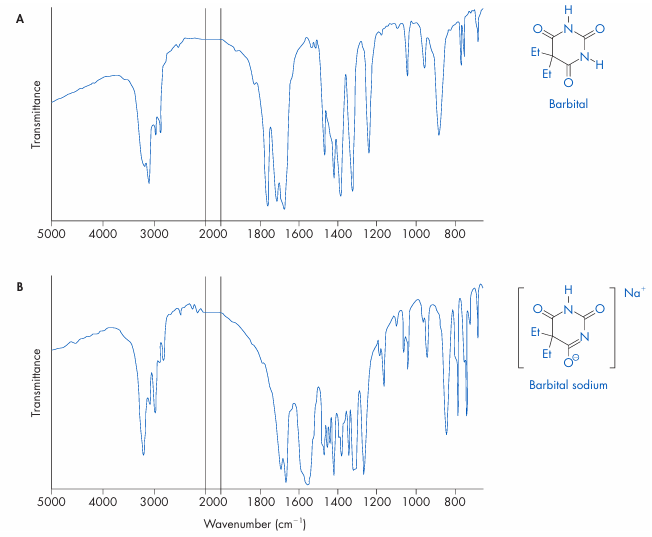
Figure 1 IR spectra of (A) barbital and (B) barbital sodium.








