Morphological Basis of English Spelling
Despite all these apparent variations and discrepancies, which violate one-to one phoneme–grapheme correspondences, English spelling reveals some useful lexical and morphophonemic information. For example, although prefixes and suffixes often change their pronunciation from one word to another depending on the phonological environment (allomorphy), their spelling is generally kept constant. For example, the -ed of the past tense is pronounced differently in tempted [tεm(p)təd], sipped [sɪpt], and jogged [dʒɑgd]. In this case, a given morpheme (i.e. ‘past’) is represented with a single spelling, despite the fact that it is pronounced differently in different environments. Since these different pronunciations can be predicted by a few phonological rules, only a single spelling is needed in the orthography.
Sometimes the orthographic representation is half way between the morphophonemic representation and the surface phonetic one. Such is the case with the spelling of the regular plural morpheme. The orthographic s is pronounced as [s] (e.g. cats) or [z] (e.g. dogs) depending on the environment, while es is pronounced as [əz/ɪz] (e.g. boxes). Thus, we have two different spellings for the same morpheme.
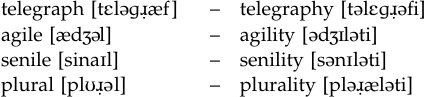
Roots and stems also maintain their spelling from word to word, despite their differences in pronunciation due to full or reduced vowel alternations correlated with stress, as in:
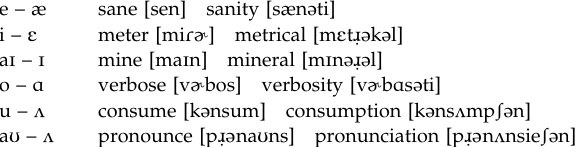
and as in words in which vowels alternate in stressed syllables of morphologically related pairs, where the long vowel/diphthong is shortened when it comes three syllables from the end of the word:
Prefixes borrowed from Latin behave differently than others in that their final consonant assimilates to the initial consonant of the stem. For example, the adjectival negative prefix in- changes to im- before p, b, m (consonant letters that represent bilabial consonants /p, b, m/), as in im-balanced, impossible, im-mature, while remaining in- otherwise. There are other examples given in manuals, for example ad- “toward” is characterized as assimilated in ab-breviate, af-fect, al-lege, ap-point, ar-rive; the prefix con- “together” is seen as assimilated in com-bat, col-lect, cor-rect; and the prefix sub- “under” (e.g. sub-merge) is considered assimilated in suf-fer, sug-gest, sup-port, and so on. While this way of looking at things may be accurate historically, I do not think one should put faith in its transparency in present-day usage, and such words should be treated as indivisible.
The morphological base of English orthography also surfaces in certain consonant letters’ alternating behavior (silent or pronounced). For example, a postvocalic g before final nasals /n/ and /m/ is silent in sign and paradigm ([saɪn], [pæɹ̣ədaɪm]), but is pronounced in derivatives of these words in signature and paradigmatic. Similarly, word-final b after m is silent in bomb and limb, but is pronounced in related bombardment and limbic. Finally, word-final n after mis silent, as in damn and autumn, but is pronounced in related damnation and autumnal.
Morphology–orthography correspondence sometimes takes the form of “same pronunciation but different spelling”. The suffix morpheme [əbl̩], which makes a root into an adjective, is orthographically represented as either-able or -ible. The orthographic representation is largely predictable on the basis of the sound value of pre-suffixal (root-final) consonant letters c and g; if these letters are pronounced as /k/ and /g/ respectively, then the ending is always-able (e.g. applicable, eradicable, navigable); if, on the other hand, they are pronounced as /s/ and /dʒ/ respectively, then the spelling of the suffix, commonly but not always, is -ible, as in eligible, invincible, reducible. This is not applicable to cases in which there is a ‘silent e’ between c and the suffix; in these cases, the spelling of the suffix is -able, as in serviceable and changeable.
An additional prediction can be made on the basis of whether the root takes the suffix -ation or -ion, -ition, -ive. If the former is the case (e.g. consider– consideration; apply– application; irritate– irritation), then the spelling of [əbl̩] is -able. If, on the other hand, the latter is the case (e.g. depress– depression, defense– defensive, digest– digestion– digestive), then the spelling of [əbl̩] mostly is -ible, as in depressible, defensible, and digestible. (Exceptions to this principle are found, e.g. support– supportive becomes supportable not *supportible, adopt adoption– adoptable not *adoptible.)








