Sample preparation and presentation
Cells
In the visible region, a matched pair of glass cells can be used, but they are inappropriate for the UV region because of the poor transmission properties of glass in this range (Fig. 1). Fused-silica or quartz cells have high transmittance from 190 to 1000 nm, and are therefore the cells of choice. The pathlength employed is usually 1.00 cm. Cells of longer pathlength are used for poorly absorptive drugs and/or where the concentration is low. Flow cells designed to minimise turbulent flow through the cell are used to monitor changes in absorbance during a reaction, for tablet dissolution studies, or for HPLC. Care should be taken that the cell walls do not block the radiation beam, otherwise variable errors are introduced. Most removable cells have two clear faces through which the incident and transmitted radiation pass and two non-clear faces. The cell should be handled via the non-clear faces, thereby avoiding contamination of the clear faces. The cell should be aligned in the instrument so that the radiation passes through the clear faces. Cells provided with a thermostat are used for studies on enzymatic and other processes in which temperature is a key parameter.
The meticulous handling and care of cells is a necessary condition for precise and accurate measurement. Cells should be cleaned carefully, filled with an appropriate solvent and matched for absorbance to less than 1%. Each pair of cells should be marked on the base in soft pencil to identify the set and its normal orientation. The tolerance on the pathlength of the cells used is 0.005 cm (Council of Europe 2008). When filled with the same solvent, the cells intended to contain the solution to be examined and the compensation liquid must have the same transmittance. If this is not the case, an appropriate correction must be applied. It is convenient to designate the more strongly absorbing cell as the ‘sample’ cell, the other cell being coded as ‘reference’. In this way the cell constant (i.e. the difference in absorbance at the measurement wavelength when filled with solvent) will be positive and can thus be subtracted from each absorbance reading. Moreover, the possibility of ‘oscillating error’ introduced by randomly changing the cell orientation during a series of measurements is eliminated. The ‘cell constant’ should be checked regularly at the measurement wavelength when filled with an appropriate solvent, or by scanning the baseline over the wavelength range.
Cells should be cleaned scrupulously after use. If they have contained aqueous solutions, they can be cleaned readily by repeated rinsing with distilled water or by soaking overnight in a very dilute solution of detergent. Special detergents should be used to clean cells contaminated with biological material. Cells that have been used with organic solvents require special care, with a sequence of solvents ending in spectroscopic ether being convenient to obtain dry, clean cells. In all cases, the manufacturer’s instructions should be followed, when available. Sharp glass or metal objects should not be introduced into a cell, lest the internal surface be scratched. The outside optical surfaces should be polished
before use with a soft cloth or photographic lens tissue. Cells should be stored in pairs, dry and in a protective container. The types of cells used for HPLC–UV-visible and capillary electrophoresis (CE)–UV-visible are small and delicate and need to be in a precise orientation with the radiation beam to function efficiently. These cells are typically not removed from the instrument unless absolutely necessary. If maintenance is required, the instrument hand book should be consulted and extreme care should be taken in handling the cells.
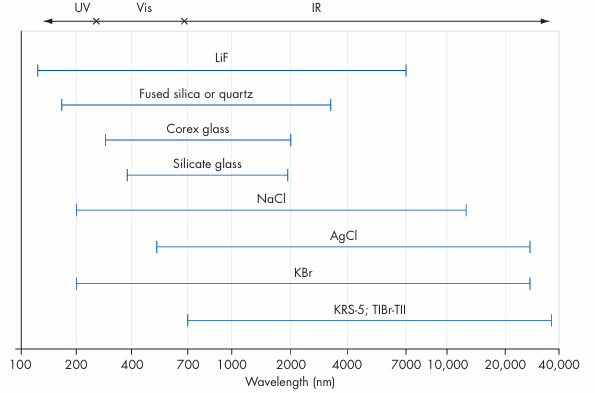
Figure 1 Transmittance range for various optical materials (from Skoog et al. 1996, p. 529).








