Cognitive approaches to grammar
Blending Theory
Conceptual and formal integration
Fauconnier and Turner’s (2002) Blending Theory is not a theory of grammar as such. Rather, Fauconnier and Turner show that the basic conceptual operation of blending should be invoked to account for a variety of grammatical constructions, including “simple” syntactic patterns like adjective-noun combinations (e.g. red ball, safe beach) and noun-noun combinations (e.g. land yacht). Structure from two (or more) input mental spaces is projected into a separate space, the blend, where it is integrated into a single conceptual unit. Crucially, the blend can develop structure of its own (i.e. structure which was not present in either input), known as emergent structure. Blending Theory points out that both in supposedly(semantically) simple cases like red ball and more exotic cases like land yacht (used to refer to a large, luxurious car) we resort to identical complex mental operations.
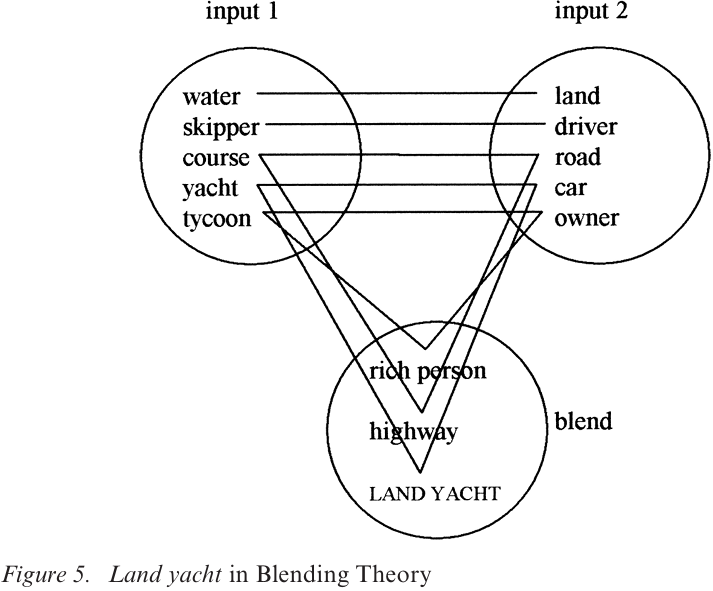
Consider the noun-noun combination land yacht. The conceptual pole of this noun phrase results from the blending of two input spaces, as is shown in Figure 5 (adapted from Fauconnier and Turner 2002: Fig.17.1, p. 357). One input involves water, a skipper, a course, a yacht and a tycoon; the other space includes land, a driver, a road, a car and an owner. These elements from the two inputs are put into correspondence with one another (so that water corresponds to land, skipper to driver, etc.) and some of them (e.g. tycoon/owner and car/yacht) are projected into the blend so as to create emergent structure: a land yacht names a new object, which is neither a generic car nor a yacht. (Cases like computer would be handled similarly. Computer involves the blending of an input space referring to the activity of computation, symbolized by the verb compute, and an input space referring abstractly to an entity performing an action, symbolized by -er. Crucially, the blended noun, computer, has features which are not inherited by either input because a computer is more than something that computes. In other words, the blend contains emergent structure.)
Let us now analyze the adjective-noun combination red ball. This noun phrase is deceptively simple. It could mean a pen whose case is red, a pen whose ink is red, a pen whose cap is red, a pen “used to record the activities of a team dressed in red” (see Fauconnier and Turner 2002: 355) and so on. In other words, we integrate (as was the case with land yacht) two input spaces, one containing the color red and the other containing the pen plus, if necessary, relevant frames (i.e. scenarios) in which the pen plays some role (e.g. a frame describing the use of the pen to record the activities of a team). The operation of conceptual integration takes place by virtue of the correspondences established between the two inputs (e.g. between the color of the pen cap and the color red) and by projecting the pen and the color red into the blend. The fact that certain interpretations seem to be simpler and more accessible than others is simply due to the existence of strong defaults: “[…] simplicity of form, conventionality of vocabulary, and frequency of use [do not] indicate simplicity of underlying conceptual organization” (Fauconnier and Turner 2002: 365).
More generally, Fauconnier and Turner demonstrate that the elements within any construction should be taken as prompts for the activation of complex blending operations. One more example will suffice. Consider copular constructions like The child is safe, The beach is safe, and The shovel is safe. Blending Theory contends that it is not strictly speaking correct to say that safe attributes a property to the subject referent (cf. the Radical Construction Grammar characterization of predication). After all, the first example means that the child is not likely to be harmed (i.e. the child is a potential victim), while the second and third examples mean that the beach and the shovel are not likely to cause harm (but observe that beach refers to a location while shovel refers to an instrument). In Fauconnier and Turner’s analysis (see Fauconnier and Turner 2002: 25–26 and 354) safe is a prompt for evoking an abstract frame of danger (i.e. an input space containing, among other things, a victim, a location and an instrument) which is blended with the current situation of the child playing on the beach (i.e. another input space) so as to obtain a counterfactual blend (where the child is harmed while playing on the beach). To put it differently, the counterfactual blend is disanalogous to the current situation since the child is not harmed in the “real world”. The counterfactual blend is blended, in its turn, with the current situation into a new blend where safe signals the compression of the relation of disanalogy between the counterfactual blend and the current situation: the child is not harmed while playing on the beach.
Conceptual integration can go hand in hand with formal integration. This is the case, for example, of the word Chunnel, which is used to refer to the underwater tunnel connecting England and France. Morphologically, tunnel and Channel (i.e. the English Channel) are blended into a single word by substituting the phoneme / æ / of Channel with / Λ / from tunnel. The formal integration mirrors the conceptual integration whereby the frame of a tunnel is put into correspondence with the frame of the specific stretch of water separating England and France.
Fauconnier and Turner claim that blending can also occur between a construction and a diffuse (or unintegrated) input. They illustrate this point by analyzing the resultative construction (e.g. I boiled the pan dry) and the caused motion construction (e.g. He sneezed the napkin off the table). They regard specific instantiations of these two constructions as originating from the blending of an input space which contains the schematic construction (represented in a Goldbergian format as a pairing of semantics and syntax) and an input containing the actual event sequence of e.g. sneezing and the napkin’s falling off the table. He sneezed the napkin off the table is illustrated diagramatically in Figure 6 in Blending Theory Discussion, adapted from Fauconnier and Turner 1996 (the generic space captures what is common across the input spaces; the syntax of the construction is represented purely for graphic reasons outside Input 1 and the Blend).
Importantly, in the blend it is as if the subject referent acted directly on the napkin (or, in the resultative example, the pan), see Fauconnier and Turner (2002: 178–179). We compress the diffuse event sequence into a scenario where an agent acts on object thus causing its displacement (or change of state in a resultative example).








