الوضع الليلي


 11:2:32
  2019-04-20
  1772
1772
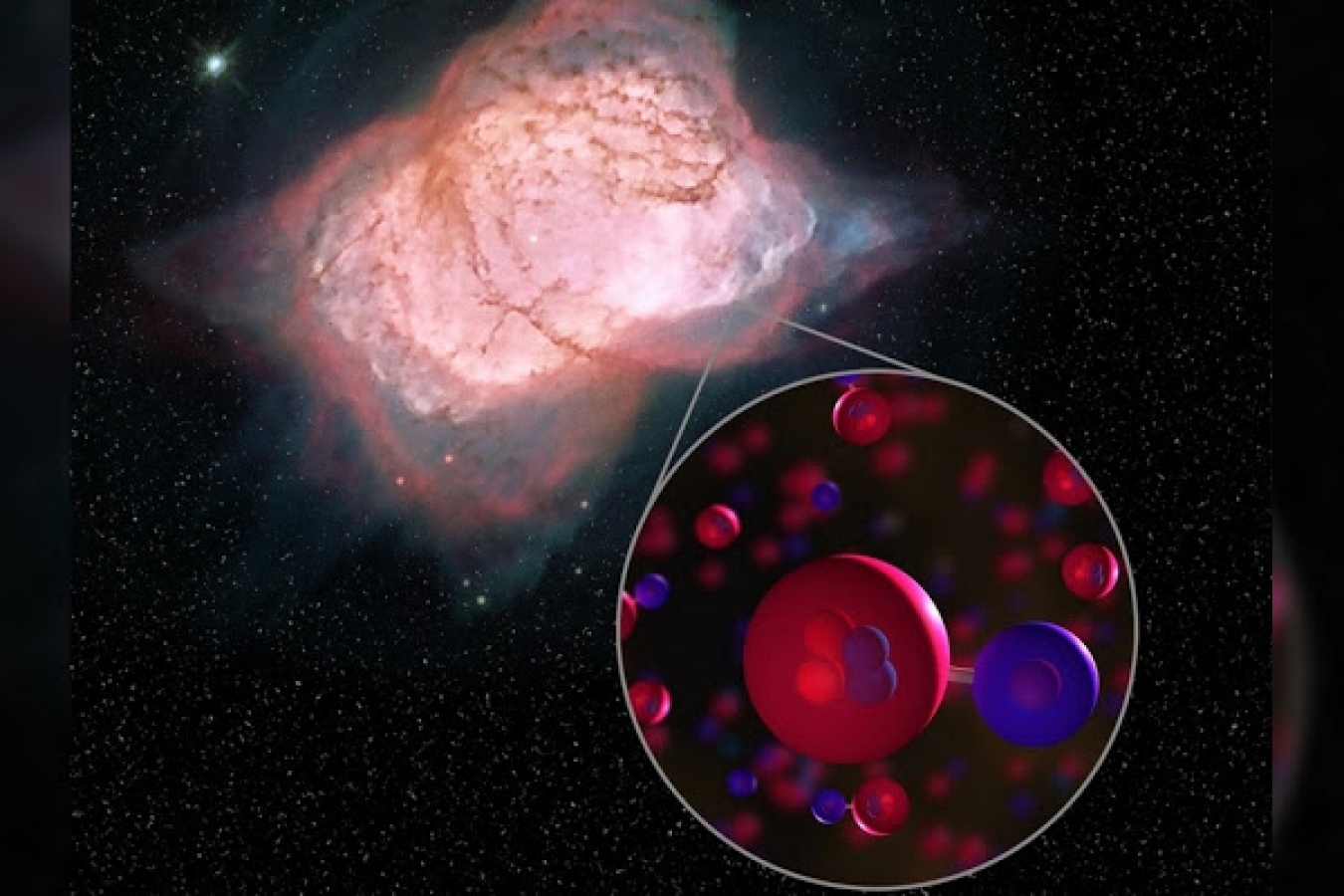
NASA's airborne observatory has detected the first type of molecule ever formed in the universe.
This is the first time helium hydride has been found in the modern universe.
Scientists discovered the molecule in our own galaxy using NASA's Stratospheric Observatory for Infrared Astronomy (SOFIA), as the aircraft flew high above the Earth's surface and pointed its sensitive instruments out into the cosmos.
SOFIA is a Boeing 747SP jetliner modified to carry a 106-inch diameter telescope. It found modern helium hydride in a planetary nebula, a remnant of what was once a Sun-like star.
Located 3,000 light-years away near the constellation Cygnus, this planetary nebula, called NGC 7027, has conditions that allow this mystery molecule to form, NASA said in a statement.
The discovery serves as proof that helium hydride can, in fact, exist in space, said the scientists in a paper published in the journal Nature.
"This molecule was lurking out there, but we needed the right instruments making observations in the right position - and SOFIA was able to do that perfectly," said Harold Yorke, director of the SOFIA Science Centre in California's Silicon Valley.
Scientists believe that around 100,000 years after the big bang, helium and hydrogen combined to make a molecule called helium hydride for the first time.
Helium hydride should be present in some parts of the modern universe, but it has never been detected in space.
"The lack of evidence of the very existence of helium hydride in interstellar space was a dilemma for astronomy for decades," said Rolf Guesten of the Max Planck Institute for Radio Astronomy, in Bonn, Germany, and lead author of the paper.
Helium hydride is a finicky molecule.
Helium itself is a noble gas making it very unlikely to combine with any other kind of atom.
In 2016, scientists turned to SOFIA for help. Flying up to 45,000 feet, SOFIA makes observations above the interfering layers of Earth's atmosphere.
But it has a benefit space telescopes don't -- it returns after every flight.
"We're able to change instruments and install the latest technology," said Naseem Rangwala, SOFIA deputy project scientist.
A recent upgrade to one of SOFIA's instruments added the specific channel for helium hydride that previous telescopes did not have.
Helium hydride's signal finally came through loud and clear.
Reality Of Islam |
|
Researchers
New phononi
For more th
A new polym
 9:3:43
2018-11-05
9:3:43
2018-11-05
10 benefits of Marriage in Islam
7:5:22
2019-04-08
benefits of reciting surat yunus, hud &
9:45:7
2018-12-24
advantages & disadvantages of divorce
11:35:12
2018-06-10
6:0:51
2018-10-16
2:34:48
2022-01-18
7:26:19
2022-04-08
10:43:56
2022-06-22
1:38:41
2021-12-08
10:55:53
2022-06-13
8:4:21
2022-01-08
7:45:39
2018-06-21
5:41:46
2023-03-18
| LATEST |
 HOME
HOME