الوضع الليلي


 2:30:17
  2024-06-18
  3766
3766
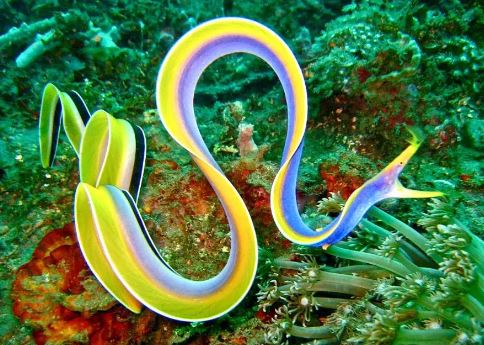
Ribbon eels (Rhinomuraena quaesita) are a smaller species of eel which are full of character and found at almost all of our dive sites across each of our regions in Indonesia. Ribbon eels are closely related to their larger ‘cousins’, moray eels but how much do you know about the lives of these strange critters? Here are some interesting facts that might surprise you!
RIBBON EEL COLOUR & GENDER PHASES:
Ribbon eels lead fascinating life cycles which not only involve three completely different phases of coloration but also complete changes in gender!
Black Phase (juvenile): Ribbon eels begin life as juveniles which are easily recognised by the bright yellow dorsal fin which runs the length of their dark, black bodies.
Blue Phase (male): As the eel matures the black changes to a bright, electric blue with an equally vivid yellow dorsal fin; this marks the male stage of the ribbon eel’s life cycle.
Yellow Phase (female): As the male ribbon eel continues to grow and at approximately 1.3 meters / 4 feet its colour changes again, this time to yellow, and this is when the ribbon eel enters its female stage. Female stage ribbon eels are able to lay eggs.
Ribbon eels are found predominantly on healthy coral reefs but they also seem to thrive on damaged reefs too where the bottom composition is mainly sand and rubble. Usually it is only the ribbon eels head and upper body that are visible as they live burrow in the sand and hide under rocks and in crevices. It is a very special sight to see an entire ribbon eel – especially one which is swimming freely, but if you do, you’ll soon realise where their name comes from!
Ribbon eels have long protruding nostrils which are almost seahorse like in appearance. Ribbon eels use their nostrils to sense vibrations in the water which helps them to hunt and defend themselves. As with moray eels, divers often mistake ribbon eels as being aggressive as they are commonly seen with their mouths opening and closing in what could be interpreted as a threatening manner when they are in fact just breathing. Look carefully when a ribbon eels mouth is open – their razor-like teeth are tiny but quite menacing!
Ribbon eels are carnivores and their diets consist of shrimps and small fish. Ribbon eels are nocturnal hunters which leave their hiding spots under the cover of darkness.
Despite their slender bodies ribbon eels have surprisingly long life spans. They are thought to live up to 20 years in their natural habitat and can grow to over one meter in length.
Reality Of Islam |
|

Researchers

New phononi

For more th

A new polym
 9:3:43
2018-11-05
9:3:43
2018-11-05
10 benefits of Marriage in Islam
7:5:22
2019-04-08
benefits of reciting surat yunus, hud &
9:45:7
2018-12-24
advantages & disadvantages of divorce
11:35:12
2018-06-10
6:0:51
2018-10-16
8:30:23
2022-03-03
2:11:12
2022-10-15
4:2:19
2022-10-10
12:10:56
2022-11-17
6:14:17
2018-06-21
the happy life of mankind requirement
6:36:36
2022-01-25
9:30:2
2021-11-12
5:41:46
2023-03-18
| LATEST |
 HOME
HOME