الوضع الليلي


 3:36:46
  2024-12-23
  4545
4545
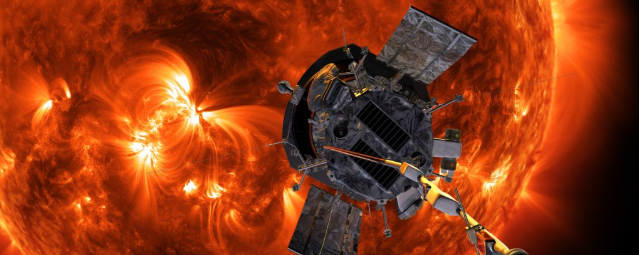
NASA's Parker Solar Probe is about to make history, once again.
On Christmas Eve, the spacecraft is going to get closer to the Sun than any human-made object ever has, traveling at speeds faster than any human-made object has traveled.
In its 22nd close flyby, the probe will skim just 6.1 million kilometers (3.8 million miles) from the surface of the Sun, speeding by at around 192 km per second.
NASA has received transmission from the spacecraft that all systems are operational and Parker is where it needs to be for its daredevil dive on December 24 at 06:53 EST (December 23 at 11:53 UTC).
It will be the first of the probe's final set of close flybys, known as perihelions, each of which will attain similar proximity and speed over the course of 2025, before Parker completes its mission.
"This is one example of NASA's bold missions, doing something that no one else has ever done before to answer longstanding questions about our universe," says astronomer Arik Posner, Parker Solar Probe program scientist at NASA.
"We can't wait to receive that first status update from the spacecraft and start receiving the science data in the coming weeks."
Parker launched in 2018, and has been making history ever since, breaking both solar proximity and speed records.
The spacecraft was designed to give us the closest data ever obtained of the star around which the Solar System revolves, swooping within the vast bubble of hot plasma that constitutes the Sun's atmosphere.
The measurements taken by the probe are helping scientists figure out how the Sun works – something we don't really have a good handle on.
One of the biggest mysteries about the Sun is how the atmosphere that extends more than 8.3 million kilometers into space is so much hotter than the Sun’s visible surface, known as the photosphere.
Another is that we don't know how its magnetic field is generated, deep within its interior; nor do we have a grasp on what drives the solar cycles of activity. And there are some unresolved peculiarities about its chemical composition.
By sampling the solar corona and observing how the Sun behaves at closer proximities, scientists hope Parker will give us information that will help us on our way to solving these mysteries.
But the flyby of December 24 will be a true test of human ingenuity and Parker's capabilities.
"We are basically almost landing on a star," astrophysicist Nour Raouafi of the Johns Hopkins University Applied Physics Laboratory and Parker project scientist told BBC News last year. "This will be a monumental achievement for all humanity. This is equivalent to the Moon landing of 1969."
Following the perihelion, the probe will transmit a beacon tone on December 27 to confirm that it has survived.
"No human-made object has ever passed this close to a star, so Parker will truly be returning data from uncharted territory," says aerospace engineer Nick Pinkine, Parker Solar Probe mission operations manager at the Applied Physics Laboratory. "We're excited to hear back from the spacecraft when it swings back around the Sun."
Parker is scheduled to perform up to four more perihelions in 2025 at the same speed and distance from the Sun, currently slated for March 22 and June 19; and, tentatively, September 15 and December 12.
At some point, however, the probe will run out of the fuel it needs to make attitude adjustments to keep its components safely protected behind its carbon heat shield. And, on that day, the probe will likely die in a blaze of glory, having boldly gone where no human-made instrument has gone before.
"One day, we will run out of fuel for the rocket thrusters that help us control trajectory and the solar probe will no longer be able to compensate for the pressure of the sunlight. The Sun will flip us around and the entire backside of the spacecraft should be incinerated in seconds," explained astrophysicist and Parker principal investigator Justin Kasper of the University of Michigan in 2018.
"The carbon heat shield, the Faraday cup and some other parts should be able to survive those high temperatures. So, what you'll basically have is a sort of molten blob that will be in a ten-solar-radii orbit – for the next billion years or so."
Reality Of Islam |
|

Researchers

New phononi
For more th
A new polym
 9:3:43
2018-11-05
9:3:43
2018-11-05
10 benefits of Marriage in Islam
7:5:22
2019-04-08
benefits of reciting surat yunus, hud &
9:45:7
2018-12-24
advantages & disadvantages of divorce
11:35:12
2018-06-10
6:0:51
2018-10-16
the happy life of mankind requirement
6:36:36
2022-01-25
8:25:12
2022-03-09
4:26:43
2022-02-21
1:38:41
2021-12-08
allah will not answer all your prayers
6:56:28
2022-01-01
9:39:36
2022-12-28
6:28:21
2022-12-20
5:41:46
2023-03-18
| LATEST |
 HOME
HOME