الوضع الليلي


 10:37:20
  2025-03-18
  3039
3039
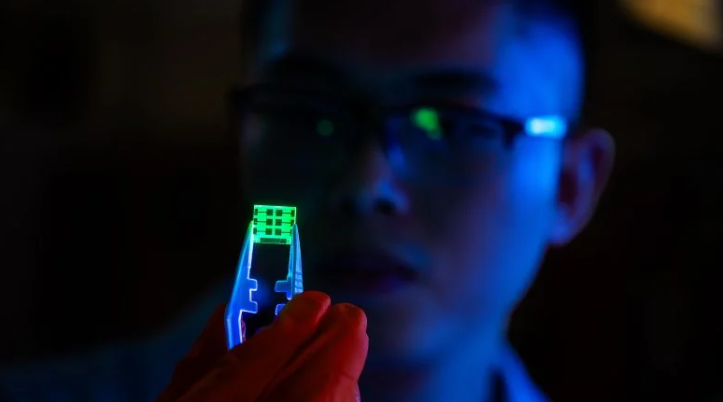
Perovskite LEDs are emerging as a game-changing technology, offering vibrant colors, lower costs, and easier manufacturing compared to traditional LEDs.
But for these next-generation LEDs to take over the market, researchers at Linköping University argue that technical performance alone isn’t enough—they must also be affordable and environmentally sustainable.
The Next Generation of LED Technology
Cost, performance, and environmental impact are the three key factors that determine whether a new LED technology can achieve widespread commercial success. Researchers at Linköping University explored this in a study published in Nature Sustainability.
“Perovskite LEDs are cheaper and easier to manufacture than traditional LEDs, and they can also produce vibrant and intense colors if used in screens. I’d say that this is the next generation of LED technology,” says Feng Gao, professor of optoelectronics at Linköping University.
However, replacing today’s LEDs with perovskite-based alternatives requires more than just technical improvements. To understand the broader impact of this transition, Gao’s research group collaborated with Professor Olof Hjelm and Assistant Professor John Laurence Esguerra, experts in environmental sustainability and market adoption of new technologies.
Analyzing Cost and Environmental Impact
Together, they analyzed the cost and environmental footprint of 18 different perovskite LED designs, a subject where current knowledge remains incomplete. Their study applied life cycle assessment and techno-economic analysis to evaluate the technology’s viability from production to disposal.
Such analyses require a clear system definition – that is, what is included and not in terms of cost and environmental impact. Within this framework, what happens from the product being created until it can no longer be used is investigated. The life cycle of the product, from cradle to grave, can be divided into five different phases: raw material production, manufacturing, distribution, use, and decommissioning.
“We’d like to avoid the grave. And things get more complicated when you take recycling into account. But here we show that it’s most important to think about the reuse of organic solvents and how raw materials are produced, especially if they are rare materials,” says Olof Hjelm.
Rethinking Toxicity: Lead Isn’t the Only Concern
One example where the life cycle analysis provides guidance concerns the small amount of toxic lead found in perovskite LEDs. This is currently necessary for the perovskites to be effective. But, according to Olof Hjelm, focusing only on lead is a mistake. There are also many other materials in LEDs, such as gold.
“Gold production is extremely toxic. There are byproducts such as mercury and cyanide. It’s also very energy-consuming,” he says.
The greatest environmental gain would instead be achieved by replacing gold with copper, aluminum, or nickel, while maintaining the small amount of lead needed for the LED to function optimally.
The Biggest Challenge: Longevity
The researchers have concluded that perovskite LEDs have great potential for commercialization in the long term. Maybe they can even replace today’s LEDs, thanks to lower costs and less environmental impact. The big issue is longevity. However, the development of perovskite LEDs is accelerating and their life expectancy is increasing. The researchers believe that it needs to reach about 10,000 hours for a positive environmental impact, something they think is achievable. Today, the best perovskite LEDs last for hundreds of hours.
Shifting Research Focus for Real-World Impact
Muyi Zhang, PhD student at the Department of Physics, Chemistry and Biology at LiU, says that much of the research focus so far is on increasing the technical performance of LED, something he believes will change.
“We want what we develop to be used in the real world. But then, we as researchers need to broaden our perspective. If a product has high technical performance but is expensive and isn’t environmentally sustainable, it may not be highly competitive in the market. That mindset will increasingly come to guide our research.”
Reality Of Islam |
|

Researchers
New phononi

For more th
A new polym
 9:3:43
2018-11-05
9:3:43
2018-11-05
10 benefits of Marriage in Islam
7:5:22
2019-04-08
benefits of reciting surat yunus, hud &
9:45:7
2018-12-24
advantages & disadvantages of divorce
11:35:12
2018-06-10
6:0:51
2018-10-16
7:34:7
2023-02-28
8:39:51
2022-09-23
3:42:22
2021-12-24
2:34:48
2022-01-18
8:30:23
2022-03-03
5:57:34
2023-03-18
2:13:43
2022-05-27
5:41:46
2023-03-18
| LATEST |
 HOME
HOME