الوضع الليلي


 12:44:11
  2025-05-01
  1893
1893
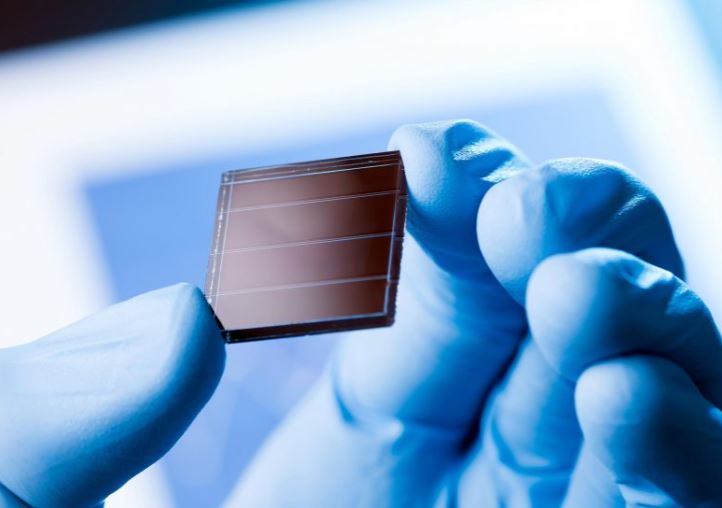
KAUST is part of an international collaboration that has demonstrated how an ionic salt molecule, known as CPMAC, can significantly boost solar cell performance by 0.6%.
A new study published in science reveals that integrating a synthetic molecule significantly improves the energy efficiency and lifespan of perovskite solar cells. The molecule, called CPMAC, was developed through an international collaboration that included researchers from King Abdullah University of Science and Technology (KAUST).
CPMAC is an ionic salt synthesized from buckminsterfullerene, a black, carbon-based material composed of 60 atoms, commonly referred to as C60. While C60 has helped perovskite solar cells achieve record-breaking energy efficiencies, it also poses challenges by limiting the cells’ overall performance and long-term stability. To overcome these limitations, scientists have been investigating alternative materials, leading to the development of CPMAC.
“For over a decade, C₆₀ has been an integral component in the development of perovskite solar cells. However, weak interactions at the perovskite/C₆₀ interface lead to mechanical degradation that compromises long-term solar cell stability. To address this limitation, we designed a C₆₀-derived ionic salt, CPMAC, to significantly enhance the stability of the perovskite solar cells,” explained Professor Osman Bakr, Executive Faculty of the KAUST Center of Excellence for Renewable Energy and Sustainable Technologies (CREST), who led the KAUST contributions to the research.
Performance Improvements with CPMAC
The chemistry of CPMAC improved the electronic properties of the solar cells. Cells with CPMAC had a power conversion efficiency – a standard metric used to evaluate the energy efficiency of solar cells – that was 0.6% higher than solar cells built with C60.
If the average power plant produces 1 gigawatt of power, then less than a 1% difference would still be enough to power 5,000 extra homes.
“When we deal with the scale of a typical power station, the additional electricity generated even from a fraction of a percentage point is quite significant,” said Hongwei Zhu, a research scientist at KAUST who also contributed to the study.
Furthermore, CPMAC solar cells showed a drop in their power conversion efficiency that was one-third that of C60 solar cells when the two types were exposed to hot temperatures at different humidities for over 2,000 hours, a benchmark for testing the stability of solar cells.
The difference between the two types became more apparent upon assembling them into modules consisting of four solar cells, a simplified model of a solar panel, which generally consists of somewhere between 50 to 100 cells.
These benefits were attributed to CPMAC reducing defects in a key component of the solar cell known as the electron transfer layer by creating ionic bonds with the perovskite rather than the weaker van der Waals bonds made with C60.
Reality Of Islam |
|
Researchers
New phononi
For more th
A new polym
 9:3:43
2018-11-05
9:3:43
2018-11-05
10 benefits of Marriage in Islam
7:5:22
2019-04-08
benefits of reciting surat yunus, hud &
9:45:7
2018-12-24
advantages & disadvantages of divorce
11:35:12
2018-06-10
6:0:51
2018-10-16
8:25:12
2022-03-09
the happy life of mankind requirement
6:36:36
2022-01-25
3:42:22
2021-12-24
10:47:11
2022-11-22
10:43:56
2022-06-22
allah will not answer all your prayers
6:56:28
2022-01-01
9:30:2
2021-11-12
5:41:46
2023-03-18
| LATEST |
 HOME
HOME