الوضع الليلي


 10:57:0
  2025-11-30
  1481
1481
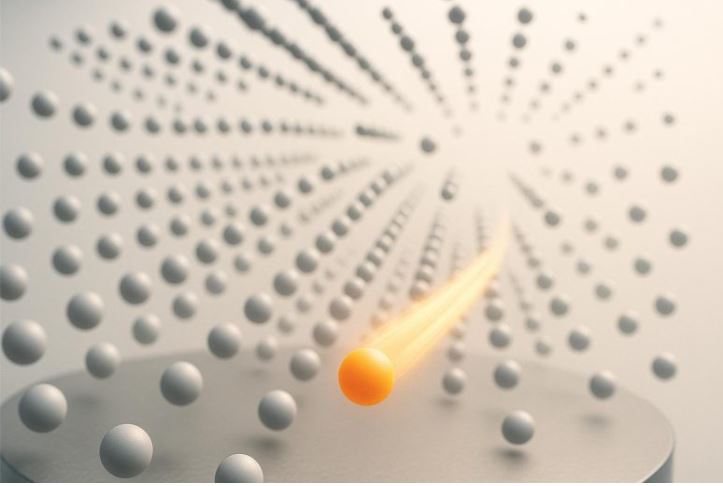
Researchers are investigating hole mobility in compressively strained germanium on silicon to improve the performance of next-generation electronics.
Scientists from the University of Warwick and the National Research Council of Canada have set a new record by creating and measuring the highest “hole mobility” ever observed in a material that works with standard silicon technology.
Today’s semiconductor devices are typically built from Silicon (Si). As these components become increasingly compact and tightly packed, they generate more heat and begin to approach fundamental performance limits. Germanium (Ge), which appeared in some of the earliest transistors of the 1950s, is gaining renewed attention as researchers look for ways to take advantage of its stronger electronic performance while still relying on the well-established manufacturing methods used for silicon.
According to a new study published in Materials Today, a research group headed by Warwick’s Dr. Maksym Myronov has taken an important step toward future electronic systems. The team developed a nanometer-thin germanium layer that is compressively strained and grown on silicon, resulting in a material that lets electrical charge travel faster than ever before while remaining fully compatible with current chip production processes.
Maksym Myronov, Associate Professor and leader of the Semiconductors Research Group, Department of Physics, University of Warwick, says, “Traditional high-mobility semiconductors such as gallium arsenide (GaAs) are very expensive and impossible to integrate with mainstream silicon manufacturing. Our new compressively strained germanium-on-silicon (cs-GoS) quantum material combines world-leading mobility with industrial scalability — a key step toward practical quantum and classical large-scale integrated circuits.”
Engineering Ultra-Clean Germanium on Silicon
The breakthrough was achieved by carefully engineering a thin germanium layer on top of a silicon wafer. By applying just the right amount of strain to the germanium layer, they created an ultra-clean crystal structure that allows electrical charge to flow almost without resistance.
When evaluated, the material demonstrated a record hole mobility of 7.15 million cm2 per volt-second (compared to ~450 cm2 per volt-second in industrial silicon), meaning charge can move through it far more easily than in silicon. This could enable future chips to run faster and dissipate less energy.
Dr. Sergei Studenikin, Principal Research Officer, National Research Council of Canada, adds: “This sets a new benchmark for charge transport in group-IV semiconductors – the materials at the heart of the global electronics industry. It opens the door to faster, more energy-efficient electronics and quantum devices that are fully compatible with existing silicon technology.”
The research establishes a new pathway for ultra-fast, low-power electronics, with potential applications spanning quantum information processing, spin qubits, cryogenic controllers for quantum processors, AI, and data center hardware with reduced energy and cooling demands.
Reality Of Islam |
|

Researchers

New phononi

For more th

A new polym
 9:3:43
2018-11-05
9:3:43
2018-11-05
10 benefits of Marriage in Islam
7:5:22
2019-04-08
benefits of reciting surat yunus, hud &
9:45:7
2018-12-24
advantages & disadvantages of divorce
11:35:12
2018-06-10
6:0:51
2018-10-16
8:25:12
2022-03-09
9:30:2
2021-11-12
8:3:0
2018-06-21
7:59:14
2018-06-21
al-hussain (peace be upon him)
10:18:1
2022-09-21
8:19:41
2018-06-21
allah will not answer all your prayers
6:56:28
2022-01-01
5:41:46
2023-03-18
| LATEST |
 HOME
HOME