الوضع الليلي


 9:45:38
  2019-03-31
  2025
2025
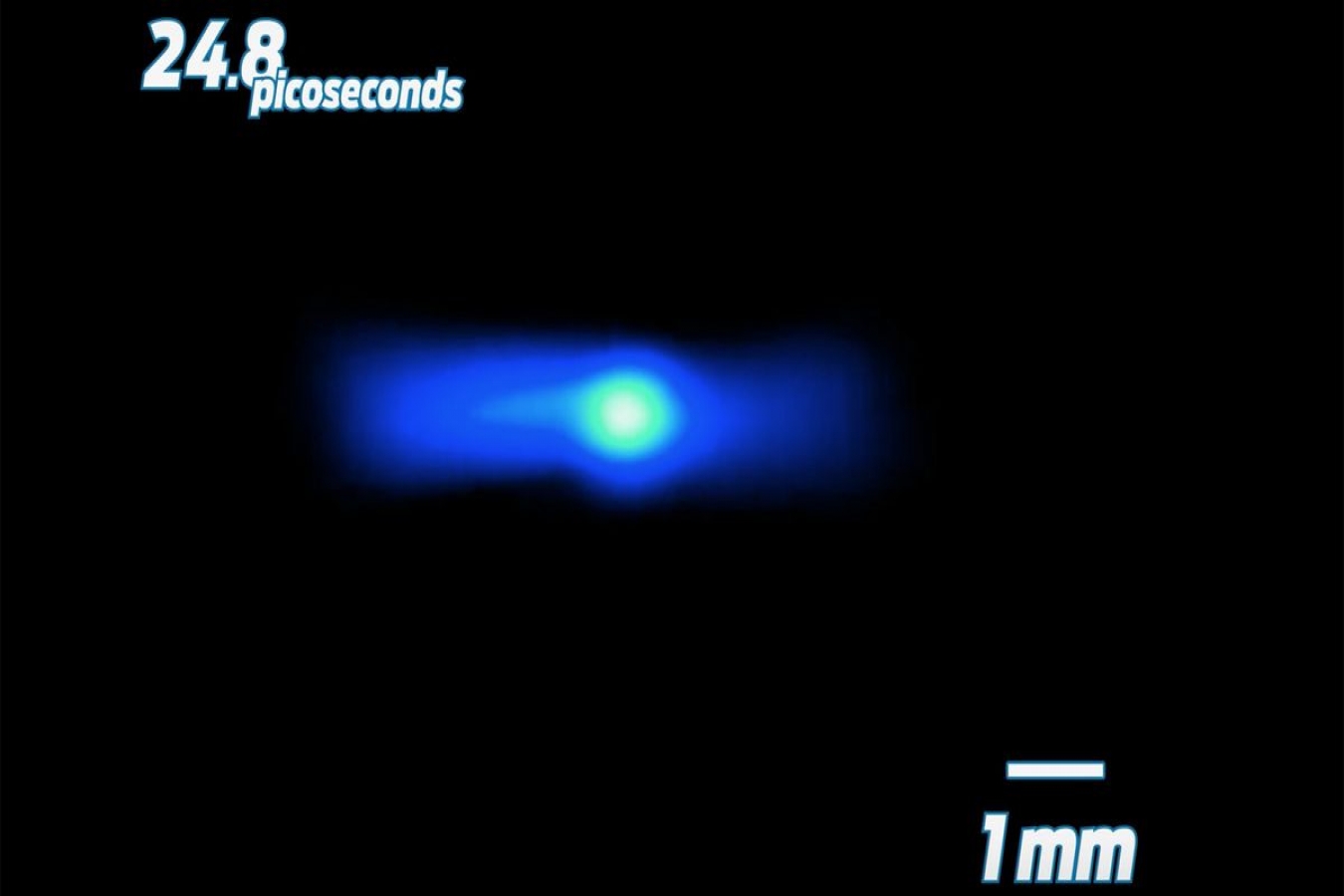
Light travels at 186,000 miles per second (300 million meters per second) and is believed to set the unsurpassable speed limit of the universe. But what does the speed of light actually look like?
It might sound like a ridiculous question, but optical researchers at the California Institute of Technology recently built the world's fastest camera to find an answer. In a new video posted to The Slow Mo Guys YouTube channel, CalTech researchers demonstrated their camera's capabilities by filming a laser beam passing through a bottle of milk at about 100 billion frames per second. (For comparison, most movies are filmed at 24 frames per second.)
In the resulting footage, photons clearly streak through the milk in a blue blur as the laser travels across the screen from left to right. Milk molecules helped scatter the photons in the laser beam, similar to how clouds of cosmic dust scatter the light from otherwise-invisible stars. According to Peng Wang, the CalTech postdoctoral student who demonstrated the camera in the new video, the light traveled through the length of the bottle in about 2,000 picoseconds, or 2 millionths of a second.
Amazingly, 100 billion frames per second is only a fraction of what the CalTech camera is capable of capturing. Known as T-CUP, the camera was first described in an October 2018 paper in the journal Light: Science and Applications and is reportedly capable of photographing light at 10 trillion frames per second. The researchers developed T-CUP for the express purpose of filming ultrashort laser pulses in incredible detail — in other words, to capture the speed of light.
While the camera on your phone takes two-dimensional photos, T-CUP is a type of streak camera, which records images in a single dimension, very very quickly. Unlike prior streak cameras, which create composite images of light by recording different horizontal slices of laser over multiple laser pulses, the T-CUP is able to image an entire laser pulse in a single frame. It does this by diverting the laser beam to two different cameras simultaneously, then using a computer program to combine the two images.
More remarkable still, researchers may soon be able to surpass T-CUP's power with a camera capable of recording 1 quadrillion frames per second, according to Lihong Wang, a CalTech professor and one of the camera's inventors. Cameras this fast could one day make their way into medical research, Wang told the The Slow Mo Guys in a subsequent video. This would allow researchers to image living human tissue (including the brain) with unprecedented detail. We'd tell you to keep your eyes open for more updates — but you probably aren't fast enough to see them, anyway.
By Brandon Specktor, Live Science
Reality Of Islam |
|

Researchers

New phononi
For more th

A new polym
 9:3:43
2018-11-05
9:3:43
2018-11-05
10 benefits of Marriage in Islam
7:5:22
2019-04-08
benefits of reciting surat yunus, hud &
9:45:7
2018-12-24
advantages & disadvantages of divorce
11:35:12
2018-06-10
6:0:51
2018-10-16
6:14:17
2018-06-21
a hero waters thirsty wild animals
9:4:9
2022-01-06
al-hussain (peace be upon him)
10:18:1
2022-09-21
2:13:43
2022-05-27
1:16:44
2018-05-14
2:42:26
2023-02-02
7:26:19
2022-04-08
5:41:46
2023-03-18
| LATEST |
 HOME
HOME