الوضع الليلي


 3:23:3
  2024-11-10
  2086
2086
Off the coast of Chile and Peru, along the entire western length of South America, the seafloor takes a sharp, steep plunge deep into the Pacific Ocean. Known as the Chile margin, the region is defined by three tectonic plates sliding underneath the continental plate of South America.
This process generates some interesting activity. At the junctions where the plates meet, volcanic activity bubbles up from below the seafloor, infusing the deep ocean with warmth and chemicals. And where such hydrothermal activity runs rampant, so too does an entire ecosystem, far beneath the waves.
From aboard the Schmidt Ocean Institute's research vessel Falkor (too), a team of marine scientists led by Jeffrey Marlow from Boston University in the US, Patricia Esquete from the University of Aveiro in Portugal, and Eulogio Soto from the Universidad de Valparaíso in Chile, has ventured to explore these ecosystems, mapping the diversity and distribution of marine life that swarms the depths below.
The 55-day expedition commenced on 11 October, and already the wealth of data is jaw-dropping. And, as part of their data collection, the researchers are obtaining spectacular videos of sights usually off-limits to humans, using the remotely-operated underwater vehicle, SuBastian.
"As marine organisms die, they sink to the seafloor, where they are buried in the sediment – decomposing and enabling the slow buildup of methane. Eventually, the gas escapes upward through cracks and fissures, forming methane seeps," the Institute explains.
"Tiny single-celled organisms, chemosynthetic microbes, convert methane into energy to grow, forming carbonate rocks in the process. These seeps are known to be essential habitats, and the microbes consuming methane ensure this greenhouse gas remains locked in the seafloor and out of our atmosphere."
Since the expedition is still underway, science results may be some time away yet, but we are being treated to some of the videos. An incredible compilation hints at much more treasures to come.
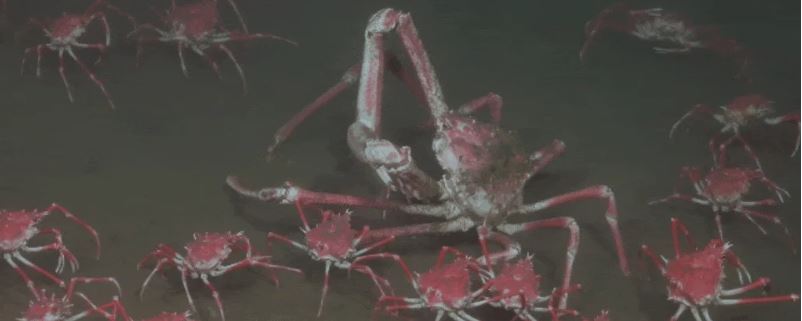
Highlights include a seafloor absolutely teeming with spider crabs; Lamellibrachia tubeworms so abundant they form a reef-like structure around which entire food webs thrive; skates, sea stars, and anemones; and a mother Gonatus onyx squid, carrying her eggs around on a membrane like a blanket, which after months of careful incubation is shaken vigorously to help her young hatch and swim free.
A separate video posted to Instagram shows a polychaete worm rippling along the seafloor, its bristles shimmering with iridescence. These invertebrates are extremely diverse and fill important ecological roles, serving as predator, prey, and clean-up crew for ocean detritus.
The expedition is set to continue until 5 December. Until then, the researchers will look for previously undiscovered seeps and vents, with a focus on the region called the Chile Triple Junction. This is the point at which the Nazca and Antarctic plates are subducted beneath the South American plate.
Where the two former plates meet a ridge runs perpendicular to the subduction zone; it's the only place in the world where an ocean ridge is being subducted beneath a continental plate. This means even more ocean life discoveries await in some of the ocean's most dynamic geophysical environments.
Reality Of Islam |
|
Keeping sil
Two experim
Changing a
Plants are
 9:3:43
2018-11-05
9:3:43
2018-11-05
10 benefits of Marriage in Islam
7:5:22
2019-04-08
benefits of reciting surat yunus, hud &
9:45:7
2018-12-24
advantages & disadvantages of divorce
11:35:12
2018-06-10
6:0:51
2018-10-16
2:13:43
2022-05-27
9:30:2
2021-11-12
7:45:39
2018-06-21
9:42:16
2022-10-19
7:34:7
2023-02-28
10:43:56
2022-06-22
2:34:48
2022-01-18
5:41:46
2023-03-18
| LATEST |
 HOME
HOME