الوضع الليلي


 10:55:38
  2026-10-12
  31
31
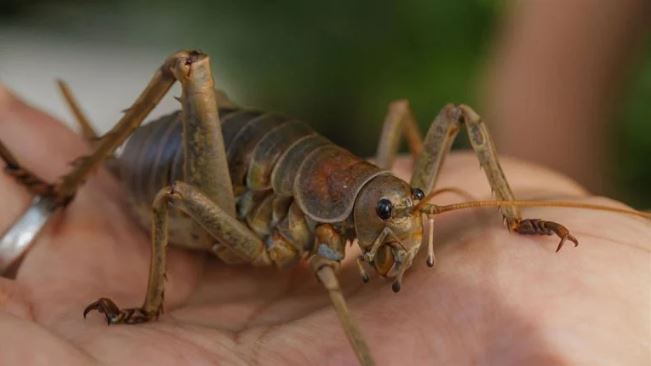
Captive breeding has helped New Zealand’s largest giant wētā establish new wild populations, with at least four generations now born on two islands.
As early European settlers cleared land for farms and introduced rats, stoats, and other pests, wētāpunga disappeared from every wild refuge except Te Hauturu-o-Toi/Little Barrier Island. Moving these giant insects elsewhere offered a way to rebuild their populations, but surveys between 2005 and 2009 found that too few remained to supply those transfers directly.
Conservationists collected a small founding group and began breeding them at Butterfly Creek, creating a source of insects for release without relying on large collections from the wild. Over 15 years, that effort, later expanded by Auckland Zoo, produced tens of thousands of wētāpunga and supplied more than 11,000 for release at 10 new sites.
Raising wētāpunga by the thousands
Butterfly Creek staff developed ways to care for and breed Deinacrida heteracantha, New Zealand’s largest giant wētā and the world’s heaviest member of the insect order that includes crickets and grasshoppers. Their founding colony eventually produced enough animals for the first releases on Motuora and Tiritiri Matangi, two islands in the Hauraki Gulf/Tīkapa Moana, in 2010 and 2011.
Auckland Zoo established a second breeding colony in 2012 and refined the care techniques to raise large numbers of young wētā together in communal nurseries. Scaling up production made more insects available for release, allowing conservationists to extend the program to additional refuges. Between 2014 and 2025, the zoo alone bred and released 8,874 wētāpunga.
The program’s 45 transfers carried wētāpunga to eight predator-free islands in the Hauraki Gulf and Bay of Islands, followed more recently by two fenced mainland sanctuaries north of Auckland. Each release also required people and resources to support the work on the ground and track how the insects fared afterward.
Ngāti Manuhiri provided ongoing support and engagement as kaitiaki, or guardians, of wētāpunga and mana whenua, the people with customary authority over Te Hauturu-o-Toi/Little Barrier Island. Wētāpunga are a taonga, or treasured, species for Ngāti Manuhiri, whose island supplied the founders of the breeding program.
Community restoration groups across the upper North Island raised money for the intensive management the insects required and helped organize releases and subsequent monitoring. Dr. Chris Green, lead author of a journal paper documenting the recovery and an honorary research associate with New Zealand’s Department of Conservation, credits that shared effort: “The expertise, commitment, and collaboration of many people and organizations contributed to the recovery of this iconic giant wētā.”
Four generations born on two islands
Monitoring on Motuora and Tiritiri Matangi has recorded at least four generations of wētāpunga born on the islands. Internationally, reaching that milestone is recognized as confirmation that a released population has successfully established itself. Many of the other island populations are progressing toward the same benchmark.
Wētāpunga had been identified as needing urgent action in a Department of Conservation recovery plan in the 1990s. Their conservation status has since improved from Threatened – Nationally Endangered in 2004, before the breeding program began, to Threatened – Nationally Increasing in 2022.
Wētāpunga recovery guides Māhoenui breeding
Green and his co-authors have brought the breeding, release, and monitoring experience together so other conservationists can draw on it. “The journal paper summarizes one of the most comprehensive case studies of invertebrate conservation breeding, translocation, and species recovery ever undertaken in Aotearoa New Zealand, perhaps the world. My co-authors have contributed significant expertise gained from years of hands-on experience working with wētāpunga.”
“The future of wētāpunga is looking bright. What we have learnt is now informing breeding of Māhoenui giant wētā at the Ōtorohanga Kiwi House. There are many more critically endangered invertebrates that could benefit from similar programs, for example the Canterbury knobbled weevil (Hadramphus tuberculatus) and several native stag beetle species,” says Chris.
Once confined to Te Hauturu-o-Toi/Little Barrier Island, wētāpunga are now reproducing on other islands, giving future generations more than one refuge to call home.
Reality Of Islam |
|

A study of

Researchers

MIT enginee
 9:3:43
2018-11-05
9:3:43
2018-11-05
10 benefits of Marriage in Islam
7:5:22
2019-04-08
benefits of reciting surat yunus, hud &
9:45:7
2018-12-24
advantages & disadvantages of divorce
11:35:12
2018-06-10
6:0:51
2018-10-16
8:4:21
2022-01-08
4:25:57
2023-02-11
1:16:44
2018-05-14
6:14:3
2023-01-18
7:45:39
2018-06-21
11:34:48
2022-06-29
10:35:40
2022-05-26
5:41:46
2023-03-18
| LATEST |
 HOME
HOME