الوضع الليلي


 4:39:44
  2024-11-30
  3905
3905
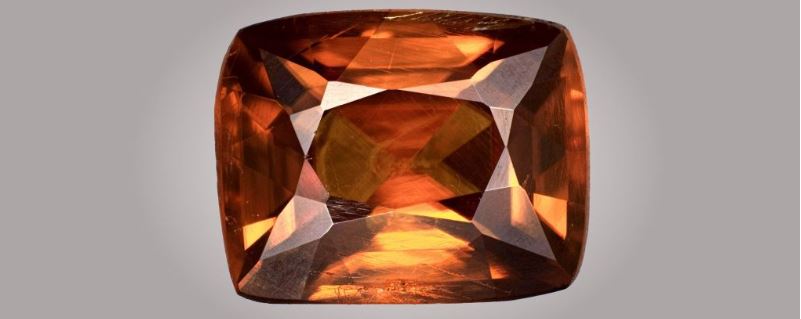
There's a mineral so rare that only one specimen of it has ever been found in the entire world.
It's called kyawthuite (cha-too-ite), a tiny, tawny-hued grain weighing just a third of a gram (1.61 carats). On first glance, you might mistaken it for amber or topaz; but the unassuming mineral speck has value beyond measure.
The stone itself was purchased in 2010 at a market in Chaung-gyi in Myanmar by gemologist Kyaw Thu, who thought the raw gem was a mineral called scheelite. After he faceted the stone, though, he realized that he was looking at something unusual.
Unable to match the mineral with anything known, he sent it to the Gemological Institute of America (GIA) Laboratory in Bangkok, Thailand. There, mineralogists were able to relate the stone to synthetic BiSbO4 – bismuth antimonate – though with the formula Bi3+Sb5+O4, an arrangement never before found in nature.
"This is the first in the world. It is not found in other countries," Thu told the Myanmar Times in 2016.
"From studying in the field and buying stones from the Khanae market, [I could tell that] this stone was a little strange and I bought it. Then, when I reached Yangon, I examined it [and determined that] this was not like any other gem we've ever found."
We don't know much about the stone itself. It has a saturated orange color, with a red overtone and a white streak; that's the color of the powder the gem produces when it is dragged across a coarse surface. It also has hollow, tube-shaped inclusions called en echelon veins that are caused by shear stress – evidence of its natural formation.
Geologist think that was likely igneous in origin, an inclusion in a type of common volcanic rock called pegmatite, common in the region where the stone was found. Like granite, pegmatite's composition is similar to that of a fruit cake, with different minerals jumbled together; it's common to find large crystals of gems in pegmatite.
Traces of titanium, niobium, tungsten, and uranium in the kyawthuite are consistent with a pegmatite formation. Additionally, experiments in the lab show that bismuth antimonite crystals form at high temperatures consistent with the temperatures of cooling magma. Since the mineral appears to be so rare, there are likely other special circumstances about how it forms, but we don't know what they are.
The value of kyawthuite is currently listed as priceless. The world's second-rarest gem, a mineral called painite, is valued at US$50,000 to $60,000 a carat.
The world's only known piece of kyawthuite is currently housed safely at the National History Museum of Los Angeles County.
Reality Of Islam |
|
Keeping sil
Two experim
Changing a
Plants are
 9:3:43
2018-11-05
9:3:43
2018-11-05
10 benefits of Marriage in Islam
7:5:22
2019-04-08
benefits of reciting surat yunus, hud &
9:45:7
2018-12-24
advantages & disadvantages of divorce
11:35:12
2018-06-10
6:0:51
2018-10-16
6:14:17
2018-06-21
allah will not answer all your prayers
6:56:28
2022-01-01
2:33:4
2023-02-15
5:57:34
2023-03-18
2:13:43
2022-05-27
1:38:41
2021-12-08
8:3:0
2018-06-21
5:41:46
2023-03-18
| LATEST |
 HOME
HOME