الوضع الليلي


 1:43:50
  2025-04-30
  1953
1953
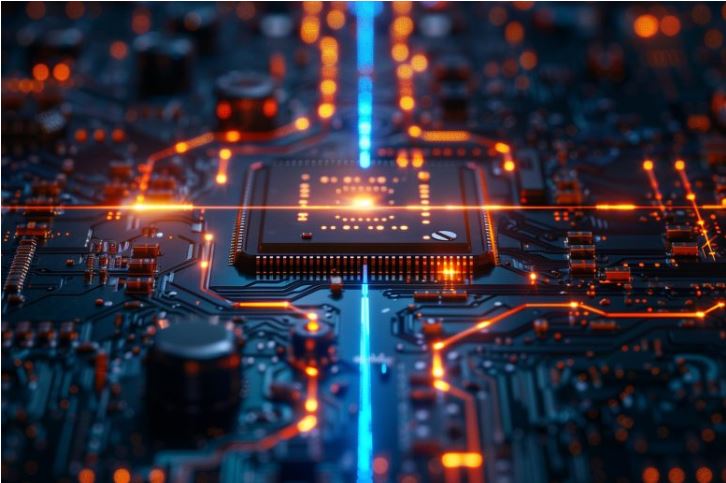
Researchers have, for the first time, decoded how Electrochemical Random-Access Memory (ECRAM) works, using a special technique to observe internal electron behavior even at extreme temperatures. This hidden mechanism, where oxygen vacancies act like shortcuts for electrons, could unlock faster AI systems and longer-lasting smartphones, laptops, and tablets.
Breakthrough at POSTECH: Boosting AI Efficiency
As artificial intelligence (AI) continues to evolve, researchers at POSTECH (Pohang University of Science and Technology) have made a breakthrough that could significantly boost the speed and efficiency of AI technologies.
Professor Seyoung Kim and Dr. Hyunjeong Kwak from POSTECH’s Departments of Materials Science & Engineering and Semiconductor Engineering, working alongside Dr. Oki Gunawan from the IBM T.J. Watson Research Center, have become the first to reveal the hidden operating mechanisms of Electrochemical Random-Access Memory (ECRAM). ECRAM is considered a promising next-generation technology for advancing AI. Their groundbreaking findings were recently published in the prestigious journal Nature Communications.
Uncovering ECRAM’s Hidden Mechanisms
As AI capabilities grow, so do the demands for faster and more efficient data processing. Traditional computing architectures separate data storage (“memory”) from data processing (“processors”), which leads to major inefficiencies, requiring constant data transfer between the two units and consuming both time and energy. To solve this problem, researchers have been exploring a new approach called ‘In-Memory Computing.’
‘In-Memory Computing’ enables calculations directly within memory, eliminating data movement and achieving faster, more efficient operations. ECRAM is a critical technology for implementing this concept. ECRAM devices store and process information using ionic movements, allowing for continuous analog-type data storage. However, understanding their complex structure and high-resistive oxide materials has remained challenging, significantly hindering commercialization.
ECRAM: Powering In-Memory Computing
To address this, the research team developed a multi-terminal structured ECRAM device using tungsten oxide and applied the ‘Parallel Dipole Line Hall System’), enabling observation of internal electron dynamics from ultra-low temperatures (-223°C, 50K) to room temperature (300K).
They observed, for the first time, that oxygen vacancies inside the ECRAM create shallow donor states (~0.1 eV), effectively forming ‘shortcuts’ through which electrons move freely. Rather than simply increasing electron quantity, the ECRAM inherently creates an environment facilitating easier electron transport. Crucially, this mechanism remained stable even at extremely low temperatures, demonstrating the robustness and durability of the ECRAM device.
Revealing Electron Shortcuts at Ultra-Low Temperatures
Prof. Seyoung Kim from POSTECH emphasized, “This research is significant as it experimentally clarified the switching mechanism of ECRAM across various temperatures. Commercializing this technology could lead to faster AI performance and extended battery life in devices such as smartphones, tablets, and laptops.”
Reality Of Islam |
|
Researchers

New phononi
For more th
A new polym
 9:3:43
2018-11-05
9:3:43
2018-11-05
10 benefits of Marriage in Islam
7:5:22
2019-04-08
benefits of reciting surat yunus, hud &
9:45:7
2018-12-24
advantages & disadvantages of divorce
11:35:12
2018-06-10
6:0:51
2018-10-16
9:30:2
2021-11-12
11:11:59
2023-02-01
2:13:43
2022-05-27
8:21:9
2018-06-21
2:42:26
2023-02-02
2:33:4
2023-02-15
allah will not answer all your prayers
6:56:28
2022-01-01
5:41:46
2023-03-18
| LATEST |
 HOME
HOME