الوضع الليلي


 11:55:55
  2025-09-28
  2281
2281
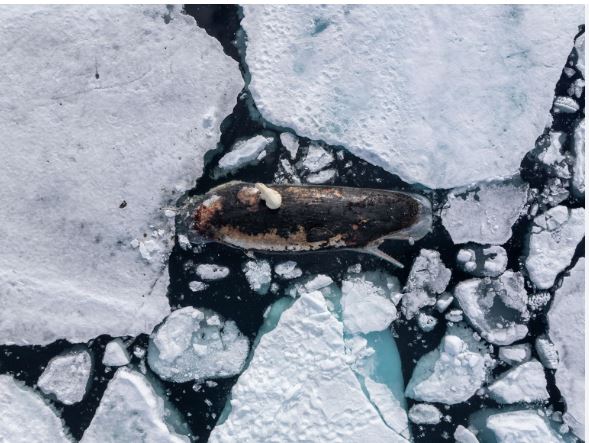
A sperm whale lies on its side amid shards of polar pack ice, dead and decomposing, its mouth hanging open in a silent scream. The lateral image on a flat plain resembles a textbook’s illustration of a whale, save for the blackening flesh, with scaly orange spots of deterioration like rust on an old boat. The composition is so captivating, a viewer might not initially notice the polar bear ambling along the whale’s back.
Photographer Roie Galitz happened upon the scene after receiving a message from a friend who initially spotted the whale carcass at 82° north, well above the Arctic Circle. In early July, Galitz was leading an expedition for a small group of nature lovers and photographers along the Norwegian archipelago of Svalbard upward into the Arctic Ocean toward the North Pole. Upon finding the black hump rising among a sea of ice, Galitz and his crew took a full 24 hours to pilot their ice-breaker vessel through floes to situate themselves along the carcass—only to find a male polar bear snoozing nearby.
Galitz’s photography class, with daily image review and editing sessions, took on a new dimension as he leapt into action, leaning over the boat’s hull to get as low as possible to photograph the female polar bear who eventually joined the scene.
“The guests—since it’s their first time there, and my 34th time—didn’t appreciate how incredibly lucky they were,” says Galitz.
How a whale found its way north
Indeed, that latitude is typically too high north for sperm whales, which enjoy temperate waters all around the world but tend to stay away from ice. In addition to notifying other photographers in the area, Galitz alerted two whale scientists, Michelle Dutro from the National Oceanic and Atmospheric Administration and Sean O'Callaghan at Atlantic Technological University in Galway, Ireland.
“Both were excited about this sighting just because it’s super rare. Sperm whales are deep divers, so they usually stay on the west part of Svalbard, [and it’s] only the males. Females and calves stay farther south where it’s warmer,” he says.
The experts Galitz spoke with speculate that the whale was carried north by the current and wind. As for a cause of death, the scientists could not find visible evidence of what killed the whale. They suspect old age, exposure to a lethal toxin, or perhaps injury from a boat. “Without better indications, I think it's impossible to find out,” says Galitz.
Since Galitz’s expeditions generally follow the shot instead of a schedule, the boat camped out near the whale for another 24 hours, during which he launched a drone over the scene. “That’s when you really get the grand scale of things. I had an idea of what to expect, but I didn’t expect it to be that epic,” he says.
Aboard the vessel, Galitz had a screen allowing him to see what the drone saw, and adjust shutter, aperture, and ISO as needed. The thrill of the experience was overwhelming. “When I was flying the drone, I was shouting and cursing, just because as a photographer you get really excited,” Galitz laughs. “The day I stop being excited is the day I stop taking photos.”
The resulting image, seen above, was so fantastical that some viewers on social media actually accused Galitz of creating or manipulating it with AI.
Reality Of Islam |
|
Two experim

Changing a

Plants are
After spend
 9:3:43
2018-11-05
9:3:43
2018-11-05
10 benefits of Marriage in Islam
7:5:22
2019-04-08
benefits of reciting surat yunus, hud &
9:45:7
2018-12-24
advantages & disadvantages of divorce
11:35:12
2018-06-10
6:0:51
2018-10-16
9:42:16
2022-10-19
6:0:8
2023-03-19
10:47:11
2022-11-22
allah will not answer all your prayers
6:56:28
2022-01-01
8:15:37
2023-02-16
11:34:48
2022-06-29
1:38:41
2021-12-08
5:41:46
2023-03-18
| LATEST |
 HOME
HOME