الوضع الليلي


 11:37:15
  2025-11-04
  1861
1861
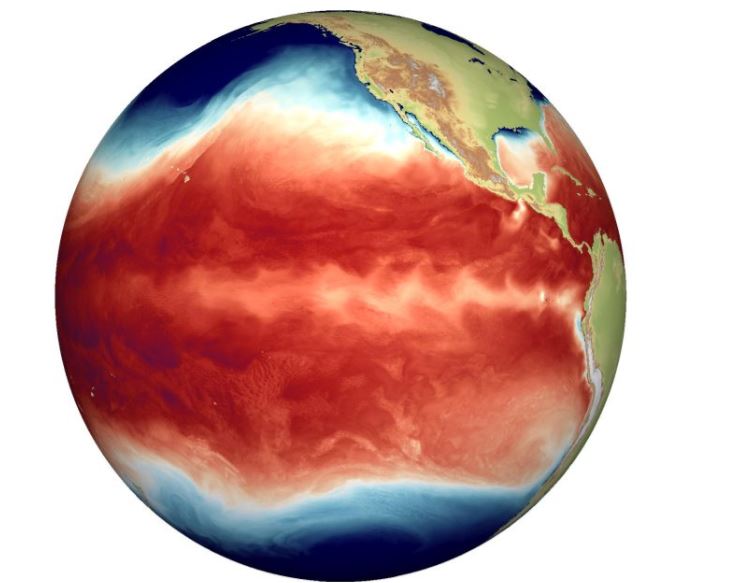
Scientists predict that global warming could make El Niño far more powerful and consistent than before.
High-resolution models show that within decades, the Pacific may hit a tipping point, locking Earth into intense, rhythmic climate cycles. This synchronization of global systems could increase extreme weather and rainfall variability around the world.
El Niño’s Future Shock: A Climate System on the Brink
A new study published in Nature Communications reports that the El Niño–Southern Oscillation (ENSO), one of the most influential forces shaping Earth’s climate, may undergo a major transformation as greenhouse gas levels rise. Using high-resolution climate simulations (Figure 1), researchers from South Korea, the USA, Germany, and Ireland found that ENSO could rapidly strengthen in the coming decades and begin to move in sync with other global climate systems. These changes are expected to reshape worldwide temperature and rainfall patterns by the end of the century.
From Chaos to Rhythm: A Dramatic Shift in ENSO Cycles
The study predicts that within the next 30 to 40 years, the irregular swings of El Niño and La Niña could evolve into consistent, powerful cycles defined by stronger sea surface temperature (SST) variations (Figure 2).
“In a warmer world, the tropical Pacific can undergo a type of climate tipping point, switching from stable to unstable oscillatory behavior. This is the first time this type of transition has been identified unequivocally in a complex climate model,” says Prof. Malte F. Stuecker, lead author of the study and Director of the International Pacific Research Center at the University of Hawaiʻi at Mānoa, USA. “Enhanced air-sea coupling in a warming climate, combined with more variable weather in the tropics, leads to a transition in amplitude and regularity,” he adds.
Climate Phenomena in Sync: A Planetary Chain Reaction
The team’s high-resolution model simulations show that a stronger and more regular ENSO may begin to synchronize with other major climate systems, including the North Atlantic Oscillation (NAO), the Indian Ocean Dipole (IOD), and the Tropical North Atlantic (TNA) mode. This synchronization is similar to how loosely connected pendulums eventually start swinging together at the same rhythm.
“This synchronization will lead to stronger rainfall fluctuations in regions such as Southern California and the Iberian Peninsula, increasing the risk of hydroclimate ‘whiplash’ effects,” says Prof. Axel Timmermann, corresponding author of the study and Director of the IBS Center for Climate Physics at Pusan National University, South Korea. “The increased regularity of ENSO could improve seasonal climate forecasts; however, the amplified impacts will necessitate enhanced planning and adaptation strategies,” he adds.
Supercomputers and Climate Tipping Points
To examine these changes, researchers used the Alfred Wegener Institute Climate Model (AWI-CM3), which simulates atmospheric conditions at a resolution of 31 km and ocean processes at 4–25 km, under a high-emission greenhouse gas scenario. They also compared their results with observational data and other climate models to confirm the findings.
“Our simulation results, which some other climate models support, show that ENSO’s future behavior could become more predictable, but its amplified impacts will pose significant challenges for societies worldwide,” says Dr. Sen Zhao, co-lead author of the study and researcher at the University of Hawaiʻi at Mānoa.
Global Consequences and the Need for Preparedness
The study emphasizes that human-driven climate change could fundamentally reshape ENSO and its influence on other climate processes, even in regions far from the tropical Pacific, including Europe.
“Our findings underscore the need for global preparedness to address intensified climate variability and its cascading effects on ecosystems, agriculture, and water resources,” says Prof. Axel Timmermann.
Next Steps: Probing the Planet’s Rhythms in Even Higher Detail
The research team plans to continue exploring how global climate systems become synchronized by conducting additional high-resolution simulations, including experiments with 9 km and 4 km resolution models. These studies are being performed on the Aleph supercomputer at the IBS Center for Climate Physics in South Korea.
Reality Of Islam |
|
Two experim
Changing a

Plants are

After spend
 9:3:43
2018-11-05
9:3:43
2018-11-05
10 benefits of Marriage in Islam
7:5:22
2019-04-08
benefits of reciting surat yunus, hud &
9:45:7
2018-12-24
advantages & disadvantages of divorce
11:35:12
2018-06-10
6:0:51
2018-10-16
8:30:23
2022-03-03
3:42:22
2021-12-24
2:33:4
2023-02-15
10:47:11
2022-11-22
11:2:27
2022-10-06
11:34:48
2022-06-29
8:25:12
2022-03-09
5:41:46
2023-03-18
| LATEST |
 HOME
HOME