الوضع الليلي


 1:56:36
  2026-08-05
  652
652
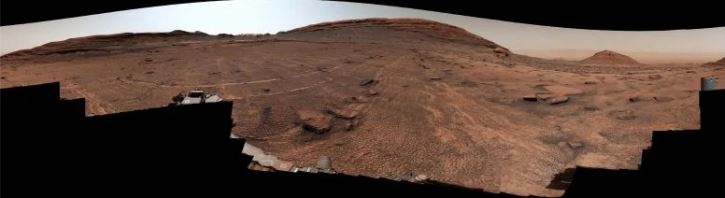
Curiosity has found a vast sea of Martian polygons that may reveal how water and climate once reshaped the Red Planet.
NASA’s Curiosity rover has encountered an enormous field of honeycomb-shaped fractures while climbing through a Martian valley known as “Valle Grande.” Each geometric feature measures roughly 1.5 to 3 inches (4 to 8 centimeters) across.
Curiosity has seen smaller groups of similar formations before, but mission scientists have never observed them covering such a broad area.
A Sea of Polygons Across Mars
The rover photographed the landscape in a 360-degree panorama on June 19 and 20, during the mission’s 4,930th and 4,931st Martian days, or sols. The polygonal patterns stretch outward in every direction, continuing as far as Curiosity can see.
The fractures also extend around the sides of a nearby butte called “Miraflores.” The formation rises 20 feet (6 meters) above the surrounding terrain and is capped by a thick layer of sand.
“We’ve seen a lot of fascinating landscapes through Curiosity’s eyes, but this sea of polygons took our breath away,” said the mission’s project scientist, Ashwin Vasavada of NASA’s Jet Propulsion Laboratory in Southern California. “We measured their shapes and chemistry carefully and are hopeful there are clues in the data as to how these features formed.”
How the Martian Honeycomb May Have Formed
Some polygonal features previously studied by Curiosity were clearly created by drying mud. However, several other processes can produce similar honeycomb patterns.
Repeated shifts between warmer and colder conditions can fracture the ground into geometric shapes. Compression may also have played a role by forcing water out of sediment after the surface became buried.
Scientists are now examining the new measurements to determine which process, or combination of processes, shaped the vast polygon field in Valle Grande.
Curiosity’s Long Record of Mars Discoveries
The newly discovered fractures add to a growing collection of unexpected sights Curiosity has encountered since landing on Mars 14 years ago, on August 5, 2012.
During its journey, the rover has found sulfur crystals, reflective meteorites, and many other unusual geological features. More importantly, Curiosity has uncovered strong evidence that ancient Mars once contained the water, chemical ingredients, and nutrients needed to support microbial life.
Clues From Mars’ Watery Past
Billions of years ago, lakes and streams covered parts of the lower slopes of Mount Sharp, a 3-mile-tall (5-kilometer-tall) mountain that Curiosity has been climbing since 2014.
The rover has detected chemical traces left behind by this wetter period, including carbon-based molecules thought to be precursors to RNA and DNA, two nucleic acids that carry genetic information.
Researchers cannot determine whether those organic molecules formed through biological activity or geological processes. Either explanation remains possible. Even so, the finding provided further evidence that ancient Mars once had the chemistry required for life.
Reality Of Islam |
|
Two experim

Changing a
Plants are

After spend
 9:3:43
2018-11-05
9:3:43
2018-11-05
10 benefits of Marriage in Islam
7:5:22
2019-04-08
benefits of reciting surat yunus, hud &
9:45:7
2018-12-24
advantages & disadvantages of divorce
11:35:12
2018-06-10
6:0:51
2018-10-16
allah will not answer all your prayers
6:56:28
2022-01-01
2:5:14
2023-01-28
5:57:34
2023-03-18
2:2:13
2022-10-08
11:2:27
2022-10-06
4:2:19
2022-10-10
8:39:51
2022-09-23
5:41:46
2023-03-18
| LATEST |
 HOME
HOME