الوضع الليلي


 11:8:45
  2023-06-10
  3596
3596
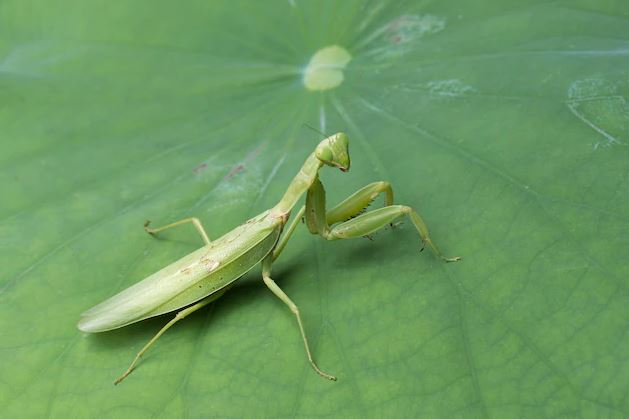
Praying mantises are predatory insects named for the look of their folded forelegs, which are held close together as if praying. The name most commonly refers to Mantis religiosa, the European praying mantis—but it is also used for many of the other 2,500 mantis species in the world, which live on all continents except Antarctica.
But whatever you call the praying mantis, its name is only one vowel off from the mantises’ real defining characteristic—preying.
Mantis may stalk or ambush prey, waiting silently then launching a sudden, individually calculated attack on their quarry that takes only milliseconds. Springing forward, they grasp their victim with those forelegs, called raptorial legs. The second and third sections of these limbs have interlocking spines, like a claw clip for your hair, making escape impossible.
Females are often as merciless to their mates as they are to their meals, cannibalizing a mate. He may lose his head as she bites into him—but he doesn't lose his purpose, as he continues to mate with her.
Appearance
The mantid’s thorax, or center part of the body, is long and slender enough to look like a neck. Between the head and the thorax there is a flexible joint that allows mantises to swivel their heads around 180 degrees, the only insect that can do so.
They’re also the only invertebrate that can see in 3D—but it’s a different kind of 3D vision than our own. Preying mantises have two large forward-facing compound eyes and three small, simple eyes called ocelli, which only see light and motion and can detect movement from 60 feet away. Experiments have showed they will ignore stationary objects but react to the slightest movement. This enables them to calibrate their attacks to the movement of their quarry, which they make short work of with their strong jaws.
Praying mantises are excellent at using camouflage to blend into their surroundings. European praying mantises are green or brown to match trees and plants. The conehead mantis of southern Europe and Turkey, meanwhile, has a spiny crown on its heart-shaped head and a lower body that looks like parts of a tree’s twigs or branches. The Southeast Asian orchid mantis is white with pink or yellow shading like a flower, and the dragon mantis of Brazil resembles the leaves of trees in the rain forest right down to its ability to sway just a bit in the breeze.
Mantis use all these refined methods to catch other insects—though the larger of the mantis species will also eat small reptiles, amphibians, and birds.
Yet another distinction of mantids is their notorious mating behavior—sexual cannibalism. Males, the smaller of the two sexes, risk ending up as a meal. Some 30 percent of the time, the female will bite into the male’s head and consume it until it’s gone—sometimes even for hours while the male’s dying body continues trying to mate.
Mantises tend to mate in the autumn. Females lay hundreds of eggs in a small case called an ootheca, which starts out as a large, foamy secretion stuck to a plant but hardens into a protective nursery. The ootheca structure varies according to species. For example, European and Carolina mantises lay flatter, textured egg cases while the Chinese mantis’ ootheca is more rounded and puffy.
Females die shortly after this feat, and the young, called nymphs, hatch in the spring, looking like tiny versions of the adults. The nymphs disperse immediately and will start looking for food, and might eat each other. They will molt several times before entering adulthood in summertime.
Reality Of Islam |
|

Two experim

Changing a
Plants are

After spend
 9:3:43
2018-11-05
9:3:43
2018-11-05
10 benefits of Marriage in Islam
7:5:22
2019-04-08
benefits of reciting surat yunus, hud &
9:45:7
2018-12-24
advantages & disadvantages of divorce
11:35:12
2018-06-10
6:0:51
2018-10-16
12:47:1
2022-12-20
the happy life of mankind requirement
6:36:36
2022-01-25
2:34:48
2022-01-18
2:42:26
2023-02-02
3:18:29
2022-12-24
1:34:8
2022-02-01
6:14:3
2023-01-18
5:41:46
2023-03-18
| LATEST |
 HOME
HOME