الوضع الليلي


 12:9:22
  2023-07-29
  1314
1314
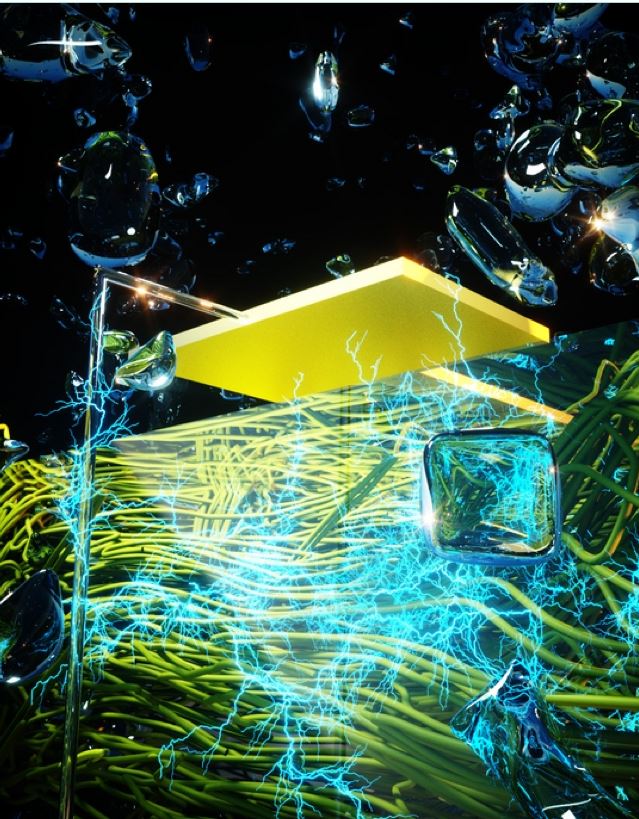
Scientists Find a Way to Harvest Clean Energy from Nothing but Air
Engineers have demonstrated something marvelous. Almost any material can be used to create a device that continuously harvests energy from humid air.
It's not a development that's ready for practical application, but it does, its creators say, transcend some of the limitations of other harvesters. All the material needs is to be pocked with nanopores less than 100 nanometers in diameter. That's around a thousandth of the width of a human hair, so easier said than done but far simpler than expected.
Such material can harvest the electricity generated by microscopic water droplets in humid air, according to a team led by engineer Xiaomeng Liu of the University of Massachusetts Amherst.
They have called their discovery the "generic Air-gen effect".
"The air contains an enormous amount of electricity," says engineer Jun Yao of UMass Amherst.
"Think of a cloud, which is nothing more than a mass of water droplets. Each of those droplets contains a charge, and when conditions are right, the cloud can produce a lightning bolt – but we don't know how to reliably capture electricity from lightning. What we've done is to create a human-built, small-scale cloud that produces electricity for us predictably and continuously so that we can harvest it."
If Air-gen sounds familiar, it's because the team previously developed an air energy harvester. However, their earlier device relied upon protein nanowires grown by a bacterium called Geobacter sulfurreducens.
Well, as it turns out, the bacterium isn't necessary.
"What we realized after making the Geobacter discovery is that the ability to generate electricity from the air – what we then called the 'Air-gen effect' – turns out to be generic: literally any kind of material can harvest electricity from air, as long as it has a certain property," Yao explains.
That property is the nanopores, and their size is predicated on the free mean path of water molecules in humid air. That's the distance a water molecule can travel in the air before it collides with another water molecule.
The generic Air-gen device is made from a thin film of material, such as cellulose, silk protein, or graphene oxide. Water molecules in the air can easily enter the nanopores and travel from the top of the film to the bottom, but they run into the sides of the pore as they travel.
These transfers charge to the material, producing a buildup, and because more water molecules run into the top of the film, a charge imbalance occurs between the two sides.
This produces an effect similar to what we see in lightning-producing clouds: rising air creates more collisions between water droplets at the top of a cloud, resulting in an excess of positive charge in higher clouds and an excess of negative charge in lower ones.
In this case, the charge could potentially be redirected to power small devices or stored in a battery of some kind.
At the moment, it's still in the early stages. The cellulose film the team tested had a spontaneous voltage output of 260 millivolts in the ambient environment, whereas a mobile phone requires a voltage output of around 5 volts. But the thinness of the films means they could be stacked to scale the Air-gen devices to make them more practically applicable.
And the fact that they can be made out of different materials means that the devices could be adapted for the environment where they are to be used, the researchers say.
"The idea is simple, but it's never been discovered before, and it opens all kinds of possibilities," Yao says. "You could imagine harvesters made of one kind of material for rainforest environments, and another for more arid regions."
The next step would be to test the devices in different environments and also work on scaling them up. But the generic Air-gen effect is real, and the possibilities it represents are hopeful.
"This is very exciting," Liu says. "We are opening up a wide door for harvesting clean electricity from thin air."
The research has been published in Advanced Materials.
Reality Of Islam |
|
Moving with
A cobalt al

A wearable

Modern comp
 9:3:43
2018-11-05
9:3:43
2018-11-05
10 benefits of Marriage in Islam
7:5:22
2019-04-08
benefits of reciting surat yunus, hud &
9:45:7
2018-12-24
advantages & disadvantages of divorce
11:35:12
2018-06-10
6:0:51
2018-10-16
3:43:50
2022-11-05
8:15:37
2023-02-16
6:28:21
2022-12-20
7:45:39
2018-06-21
2:33:4
2023-02-15
10:47:11
2022-11-22
bahlool & the throne of haroun rashid
8:20:35
2018-06-21
5:41:46
2023-03-18
| LATEST |
 HOME
HOME