الوضع الليلي


 9:46:48
  2024-05-10
  1714
1714
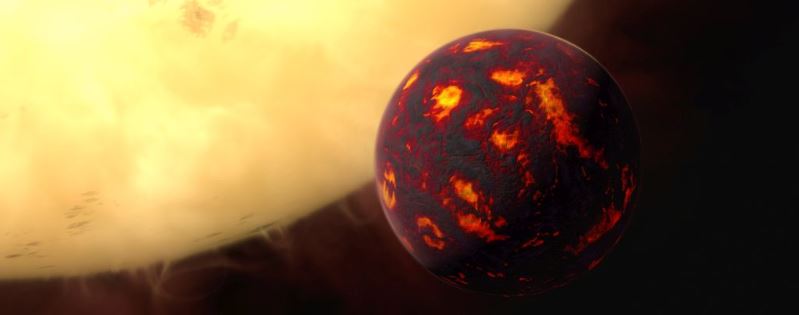
For the first time, we've found evidence of a substantial atmosphere wrapped around a rocky world outside the Solar System.
Don't pack your travel bag just yet, though: the world in question is Janssen, or 55 Cancri E, a super-Earth exoplanet so close to its host star that its surface is thought to be covered in a global ocean of molten lava.
So, it's not exactly habitable to life as we know it. But the discovery, made using James Webb Space Telescope observations, is a significant step forward in a major endeavor for planetary astronomy: characterizing rocky exoplanets, and all the wonderful shapes and forms they take in the wider Milky Way galaxy.
Janssen orbits a star named Copernicus, or 55 Cancri A, the brighter of a binary pair of dwarf stars located some 41 light-years from Earth. Copernicus was one of the very first stars discovered to host exoplanets, and each of the five orbiting it is special in its own way.
The discovery of Janssen was announced in 2004, and ever since, astronomers have been fascinated by this strange, alien exoplanet. It's around 8.8 times the mass and 1.95 times the radius of Earth, and so close to its host star that it whips around Copernicus once every 18 hours or so. And its temperatures are insane – 2,573 Kelvin (2,300 degrees Celsius, or 4,172 degrees Fahrenheit) on the dayside, and 950 Kelvin lower on the nightside.
These temperatures would make it difficult for a normal atmosphere to be present; the proximity to the star would encourage evaporation. But in 2016, scientists announced that they had detected hydrogen and helium in the space around Janssen, suggesting that the exoplanet had somehow managed to retain part of the cloud from which it formed.
Led by planetary scientist Renyu Hu at NASA's Jet Propulsion Laboratory and the California Institute of Technology, a team of scientists have now used the vastly more sensitive JWST to see what's really going on at Janssen.
They carefully observed the star during secondary eclipses, with the exoplanet passing behind. Then, they made a careful comparison and analysis of the light of Copernicus with and without the added light of Janssen. From this data, they were able to tease out the thermal light emitted by the exoplanet alone, and compare it against models for different gasses in its atmosphere.
Their results suggest that a primordial atmosphere rich in hydrogen and helium is unlikely. But there's something else there: a thick, volatile atmosphere rich in carbon monoxide or carbon dioxide. There could be other elements, too, such as water, sulfur dioxide, and phosphine.
The star's intense irradiation would likely accelerate the rate at which this gas leaks into space, leading the scientists to conclude that the atmosphere didn't form with the exoplanet, but was generated and replenished by outgassing from the planet's own magma ocean much like the atmosphere of Jupiter's moon Io.
This, the researchers say, could explain variations in the exoplanet's emission of thermal radiation as detected by the Spitzer space telescope. The formation and dissipation of a transient atmosphere would fit the data, but so too would changes in the atmospheric composition, as different elements absorb different wavelengths of radiation.
There's still a lot we don't know – but with these new findings, planetary science has taken another step towards understanding how alien worlds form and evolve in the Milky Way.
"Future observations with JWST and other observatories," the researchers write, "will help further understand the atmosphere and its interaction with the surface and interior of this intriguing rocky planet."
Reality Of Islam |
|

Researchers

New phononi
For more th
A new polym
 9:3:43
2018-11-05
9:3:43
2018-11-05
10 benefits of Marriage in Islam
7:5:22
2019-04-08
benefits of reciting surat yunus, hud &
9:45:7
2018-12-24
advantages & disadvantages of divorce
11:35:12
2018-06-10
6:0:51
2018-10-16
8:25:12
2022-03-09
the happy life of mankind requirement
6:36:36
2022-01-25
8:21:9
2018-06-21
10:55:53
2022-06-13
2:42:26
2023-02-02
a hero waters thirsty wild animals
9:4:9
2022-01-06
7:34:7
2023-02-28
5:41:46
2023-03-18
| LATEST |
 HOME
HOME