الوضع الليلي


 12:32:51
  2024-06-27
  1884
1884
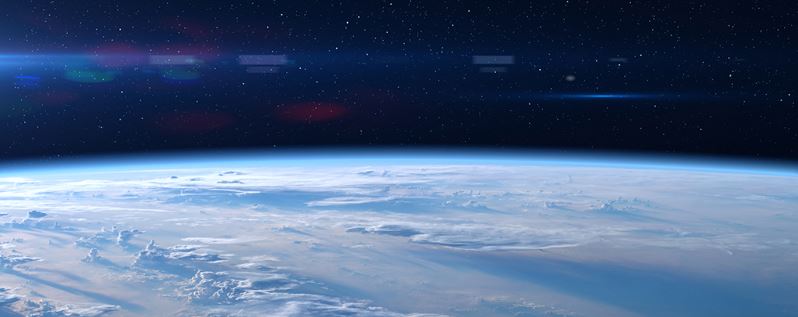
Earth's atmosphere whips into a frenzy where it fades into the emptiness of space, yet a new study has uncovered currents amid the turbulence that eerily reflect the winds swirling closer to the surface, hinting at hidden forces that connect them.
This new knowledge could give us a better understanding of the environmental systems that circulate around the globe, and improve space and Earth weather forecast, say a team of researchers from the University of Rostock in Germany and Kyushu University in Japan.
When we say space here, we're talking about the thermosphere, about 80--550 kilometers (50--342 miles) above sea level. It's not outer space, but it is where the International Space Station and most satellites orbit, and where auroras form.
The layer of diffuse gases sit atop Earth's lower atmosphere, made up of the troposphere (from the surface to around 12 kilometers or 7.5 miles up) and the stratosphere (which is the layer between the troposphere and the thermosphere.
Amid the chop and swirl of winds within each layer there are larger statistical patterns that can be used to identify deeper mechanics of meteorology.
Until now, the thermosphere's structure has been largely unexplored. The new findings identify patterns that reflect similar structures that have been measured far below.
"This means that both the thermosphere and the troposphere – despite having drastically different atmospheric compositions and dynamics – follow the same physical laws," says space scientist Huixin Liu, from Kyushu University.
"How the energy flows and dissipates in these two regions is very similar."
To reach these conclusions, the team analyzed cross-track winds in the thermosphere using satellite data from the Challenging Minisatellite Payload and the Gravity Field and Steady State Ocean Circulation Explorer.
The researchers used what are known as third-order structure functions in their analysis – statistical tools that can help spot patterns in wind and turbulence – finding that despite the different conditions in each atmosphere layer, a lot of the 'rules' stayed the same.
What's more, the tendency of the winds to circle in one direction (cyclonic motion) was the same in the thermosphere and the lower atmosphere: counterclockwise in the Northern Hemisphere and clockwise in the Southern Hemisphere.
"This suggests that similar underlying large-scale turbulence mechanisms may be at play," write the researchers in their published paper.
There's still a lot we don't understand about near-space atmosphere dynamics, and it's important to fill those gaps in our knowledge: Parts of the atmosphere closer to space are more susceptible to phenomena such as solar storms, and we need to know about any potential dangers ahead of time.
These findings also feed into models of climate change, which inform our predictions on how weather systems might evolve over the coming decades. Now we know that as far as turbulence is concerned at least, shifts in Earth's atmosphere could closely match shifts further out into space.
"Similar to atmospheric weather forecasting, comprehending the energy distributions in the thermosphere is vital to advance our understanding of space dynamics," says Liu.
"We hope these findings can be used to improve space weather forecasting and ensure the continued functionality and safety of satellite-based technologies essential to everyday life."
Reality Of Islam |
|

Researchers

New phononi
For more th

A new polym
 9:3:43
2018-11-05
9:3:43
2018-11-05
10 benefits of Marriage in Islam
7:5:22
2019-04-08
benefits of reciting surat yunus, hud &
9:45:7
2018-12-24
advantages & disadvantages of divorce
11:35:12
2018-06-10
6:0:51
2018-10-16
8:21:9
2018-06-21
9:30:2
2021-11-12
7:6:7
2022-03-21
2:13:43
2022-05-27
1:38:41
2021-12-08
3:43:50
2022-11-05
2:42:26
2023-02-02
5:41:46
2023-03-18
| LATEST |
 HOME
HOME