الوضع الليلي


 4:4:0
4:4:0  2024-12-11
  2989
2989
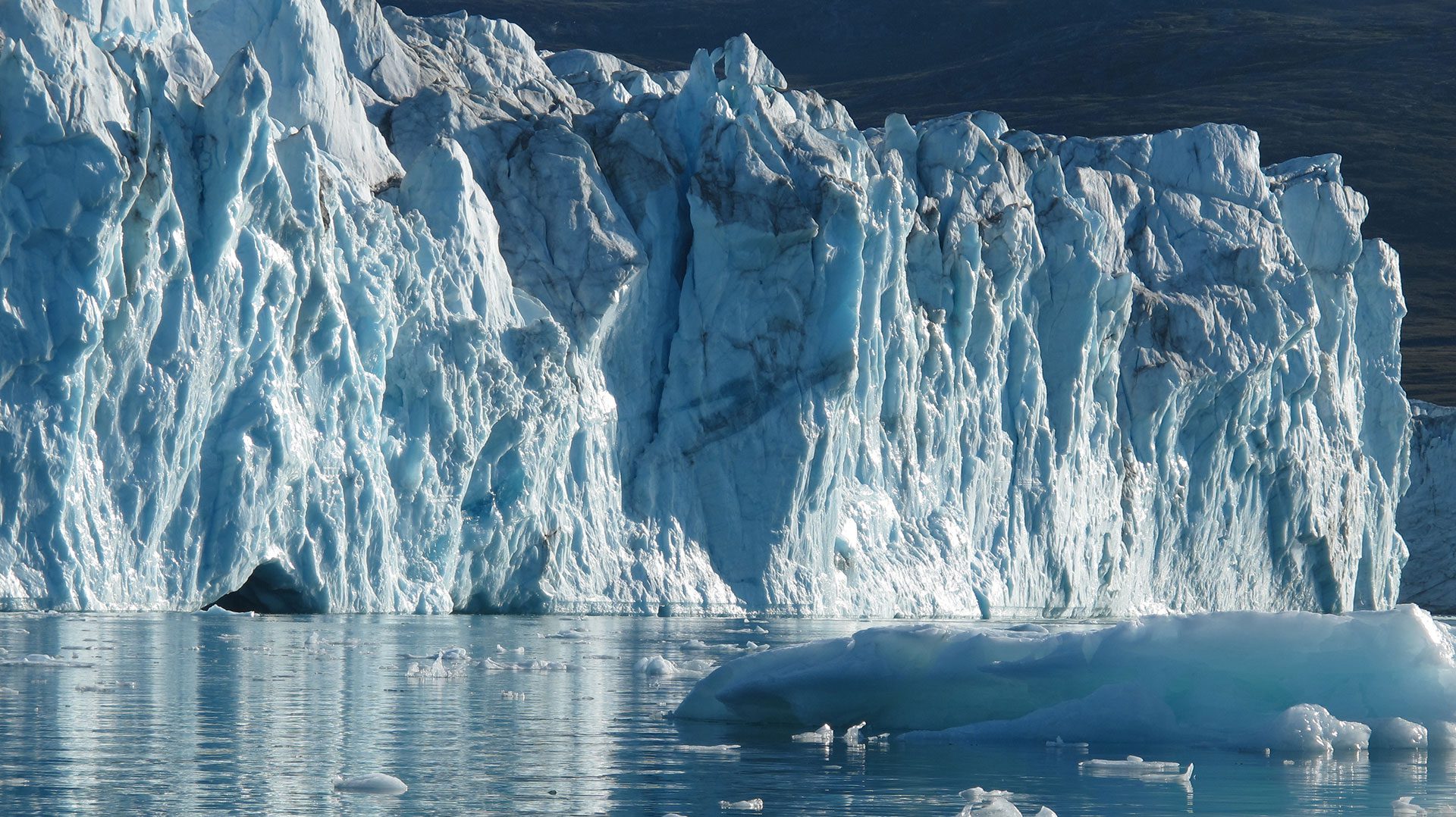
In 1971, researchers made a surprising discovery while studying Greenland's ice: Temperatures over the island spiked by very large amounts within short periods thousands of years ago. The finding showed that abrupt warming could happen over just several decades and changed how they thought about natural climate change.
Today, the world is the in the grips of another major shift, this time due to anthropogenic activities. And scientists are making predictions about how ice will soon evolve as temperatures warm.
In a new study published today in the journal The Cryosphere, researchers modeled how much glaciers will melt by the year 2100. The results show that more ice will disappear than what's predicted in the latest Intergovernmental Panel on Climate Change (IPCC) report, generally considered the scientific consensus on the state of climate change.
"We have a field program on a glacier in Switzerland, where we go back and see how much has melted, and the changes are absolutely massive," says lead author and glaciologist Harry Zekollari at ETH Zurich and Vrije Universiteit Brussel.
The vast majority of the world's 200,000 glaciers are also showing clear signs of warming, thinning between three and six feet per year, on average.
Predicting the future flow of glaciers
Simply tallying the annual losses for each glacier to predict how much ice will be left wouldn't result in accurate predictions.
"Because of the way glaciers flow, they respond to climate in a non-linear way," says glaciologist Lizz Ultee at NASA Goddard Space Flight Center, who was not involved in the study.
To account for this, Zekollari and his colleagues used two computer models to simulate the complex physics of how glaciers move and change in mass.
They first ran the models for the years between 2000 and 2019, fine-tuning the parameters to best-match the predicted changes in mass to actual ones. The latter were first documented in a paper published in 2021.
"We now have satellite observations for every glacier in the world that we used to calibrate our models," says coauthor and hydrologist Rodrigo Aguayo also of Vrije Universiteit Brussel.
Then, the team ran the simulations forward up to the end of the century using climate scenarios based on how well the world reduces greenhouse gas emissions.
The results show that, globally, between about a quarter and one-half of the volume of glaciers will be lost by the year 2100, depending on the amount of warming.
For instance, if net zero emissions are achieved around mid-century, the lower estimate would apply, while continued emissions at present levels or even higher amounts, progressively result in the higher estimates.
Last month, the United Nations published the most recent Emissions Gap Report, 2024, which suggests that the world is headed for somewhere in the middle for emissions, if countries don’t switch to cleaner energy quickly enough.
The team also calculated glacial losses at smaller-scales, which in many cases were higher.
“Some regions are committed to become almost entirely ice free even with limited warming,” says Zekollari.
This includes glaciers located in Western Canada, the U.S., east South Asia, and central Europe.
Reality Of Islam |
|

Keeping sil
Two experim
Changing a
Plants are
 9:3:43
2018-11-05
9:3:43
2018-11-05
10 benefits of Marriage in Islam
7:5:22
2019-04-08
benefits of reciting surat yunus, hud &
9:45:7
2018-12-24
advantages & disadvantages of divorce
11:35:12
2018-06-10
6:0:51
2018-10-16
2:5:14
2023-01-28
8:25:12
2022-03-09
8:15:37
2023-02-16
2:33:4
2023-02-15
8:21:9
2018-06-21
9:39:36
2022-12-28
4:25:57
2023-02-11
5:41:46
2023-03-18
| LATEST |
 HOME
HOME